When homeowners weigh a one-piece covered-gutter system like LeafGuard against putting a separate micro-mesh guard on a standard seamless gutter, they're really choosing between two philosophies: an integrated, proprietary system versus a modular, off-the-shelf one. Both can keep debris out. The difference shows up in cost, in who can service it later, and in how each handles the Treasure Valley's pine needles and freeze-thaw winters.
Fairness first: we're comparing categories — the integrated one-piece reverse-curve approach (LeafGuard stands in for it) versus a modular seamless gutter fitted with a separate stainless micro-mesh guard. We install the modular micro-mesh approach, so that's our stated perspective. Any brand-specific claim below is attributed to its source — LeafGuard's marketing claims are LeafGuard's, and worth confirming in writing — and we're not asserting any competitor's owner names, license numbers, or verbatim warranty fine print as fact.
Section
Can you get seamless gutters with a leaf guard?
Yes, two ways. You can buy a one-piece covered gutter like LeafGuard, where the hood is roll-formed into the gutter itself, or you can have seamless aluminum gutters roll-formed on site and fit a separate stainless micro-mesh leaf guard on top. Both give you seamless runs with debris protection. The second route can also go on existing seamless gutters that are sound and securely hung, so a full replacement isn't required.
In the Treasure Valley we install the second route: seamless gutter installation in Boise with micro-mesh gutter guards fitted after the gutter is hung and pitched. The rest of this post compares the two approaches honestly, including where the one-piece system has the edge.
Section
How does the one-piece system (LeafGuard) work?
LeafGuard markets itself as a one-piece seamless aluminum gutter with the guard built in — the curved hood is roll-formed as part of the gutter rather than added on top. Per the company's "How It Works" material, it's a reverse-curve / surface-tension design: water clings to the curved hood and wraps into the gutter through a slot while leaves and larger debris shed off the front edge. Because the hood is integral, there's no separate guard-to-gutter seam — that's the core selling point of the one-piece approach.
The system is roll-formed on-site from one continuous piece of aluminum and installed only by LeafGuard-certified technicians or authorized dealers, and the guard only fits a LeafGuard gutter. That has a practical consequence covered below: you can't add it to your existing gutters — the old system comes off and a new one goes on.
Section
How does the modular seamless + micro-mesh approach work?
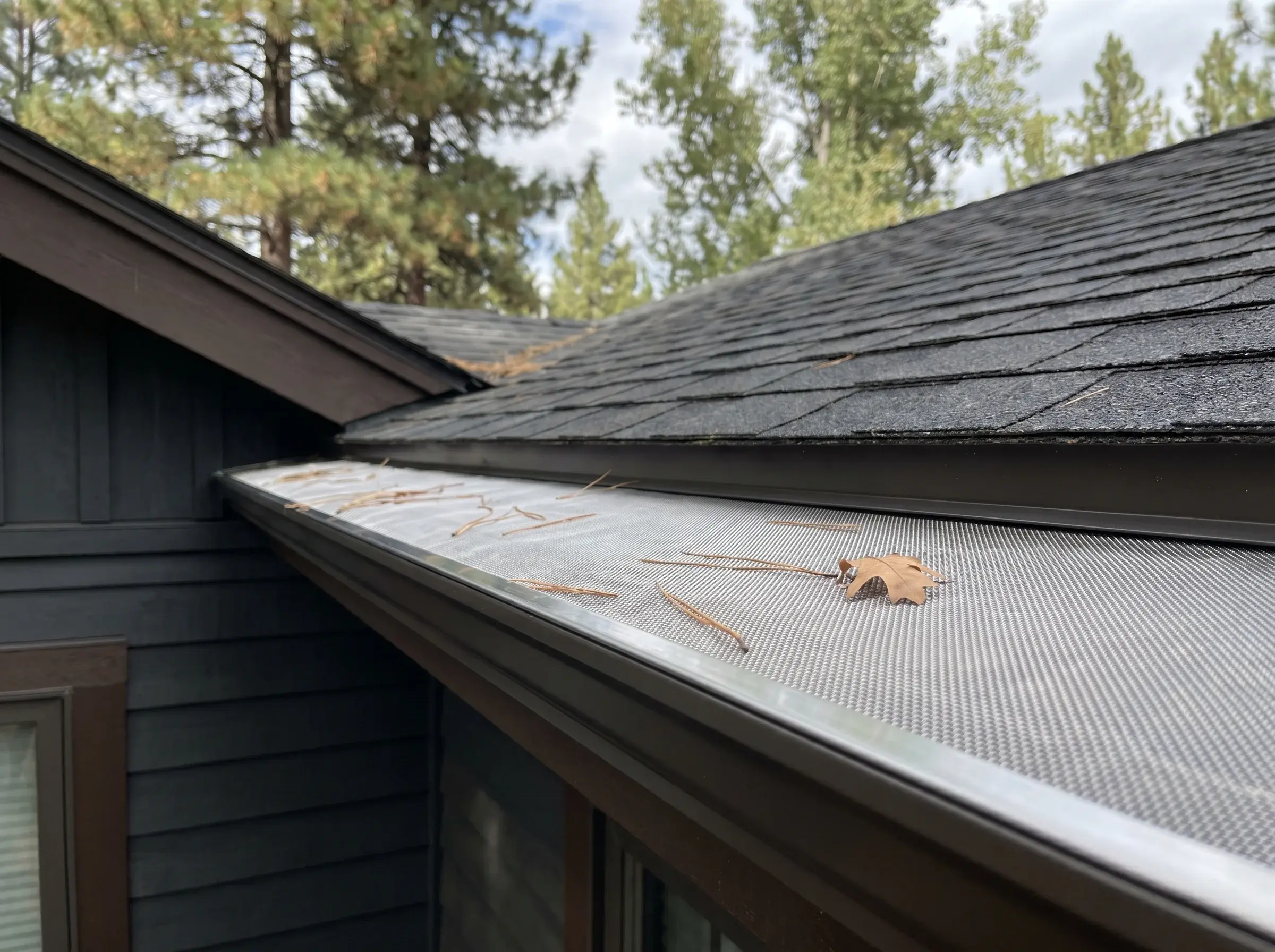
In the modular approach, a standard seamless aluminum gutter is roll-formed and hung on-site, and a separate stainless micro-mesh guard panel is fitted on top. The two are independent, off-the-shelf products. The mesh is woven stainless — premium lines use 316/316L grade — over a frame, with openings commonly under about 1 mm (down to roughly 100–200 microns) so it screens out the pine needles, shingle grit, and seed pods that open screens miss.
Because nothing is proprietary, a micro-mesh guard can be installed over existing gutters as long as they're sound and securely fastened — no forced full replacement. And any competent gutter installer can service it: a damaged or clogged panel lifts off to clean or replace without touching the gutter run underneath. That serviceability is the quiet advantage of keeping the gutter and the guard as two separate products.
Want this handled by a local crew?
Free on-site estimate across the Treasure Valley — call or send a few details and we'll get back the same day.
Section
One-piece (LeafGuard category): honest pros and cons
- Pro — no guard-to-gutter seam. The hood is roll-formed as part of the gutter, so there's no separate attachment point between guard and gutter (LeafGuard's central design claim).
- Pro — professionally roll-formed and installed by a certified network, with a warranty the company markets as transferable. Confirm the exact transfer and proration terms in writing with the company.
- Con — whole-system replacement, not a retrofit. Because the guard can't go on existing gutters, the home's current gutters are removed and replaced; you can't keep good gutters and just add the guard (per This Old House, EcoWatch, Today's Homeowner).
- Con — single-vendor servicing. Future service, repair, or warranty work routes back through the certified network; a typical local contractor can't source or service the proprietary one-piece profile. We frame that as a structural trade-off, not a company admission.
- Con — section-level repair. Since gutter and guard are one continuous piece, you generally replace a section rather than swap a separate guard panel.
- Con — premium cost. A 2025 homeowner survey cited around $20+ per linear foot.
- Con — reverse-curve cold caveat. Third-party sources note hooded designs can hold snow on the solid top and that melt can refreeze on top of the guard rather than draining, feeding freeze-thaw buildup at the eave.
Section
Modular seamless + micro-mesh: honest pros and cons
- Pro — retrofit-friendly. Micro-mesh can go on existing gutters if they're sound and securely fastened — no forced full replacement.
- Pro — any-installer serviceable. The gutter and guard are non-proprietary; mesh panels are swappable independently, so a clogged or damaged section can be lifted, cleaned, or replaced without replacing the gutter.
- Pro — fine aperture for needles. Openings down to roughly 100–200 microns screen out the pine needles and grit that defeat open screens; premium lines use 316/316L stainless.
- Con — needs surface maintenance. Like any mesh, the top surface collects fine debris and pollen and needs periodic brush/blow-off so water keeps passing through.
- Con — cold-climate caveat (attributed). As water nears freezing it gets denser and harder to pull through fine mesh by surface tension, so mesh isn't immune to ice; low-profile mesh near-flush with the gutter, sometimes paired with heat cable, is the commonly cited mitigation.
- Con — two products to spec well. You're choosing both a gutter and a guard, so install quality and mesh grade matter — a cheap thin mesh undercuts the whole point.
Section
LeafGuard one-piece vs seamless + micro-mesh: how do they compare side by side?
| Criteria | One-piece (LeafGuard category) | Seamless + micro-mesh |
|---|---|---|
| Guard-to-gutter seam | None — guard is integral to the gutter | Separate guard sits on the gutter |
| Retrofit existing gutters | No — full replacement required | Yes, if gutters are sound |
| Who can service it | Certified network only (proprietary) | Any competent gutter installer |
| Repairing damage | Replace a section | Swap the mesh panel independently |
| Fine debris / pine needles | Reverse-curve; fine debris can enter slot | Fine aperture screens needles + grit |
| Cold-climate caveat | Hood can hold snow; melt can refreeze on top | Use low profile, possibly heat cable |
| Cost (cited) | ~$20+/ft (2025 homeowner survey) | Varies; non-proprietary materials |
| Warranty | Marketed as transferable (per the company — confirm terms) | Per installer (product + workmanship) |
Section
Which is better for Treasure Valley homes?
The Treasure Valley climate is semi-arid high desert: the NWS Boise climate summary describes roughly 11 inches of annual precipitation, dry summers, cold winters with limited but real snowfall, and January inversions that trap cold air — conditions that produce repeated freeze-thaw cycling at the roofline. That freeze-thaw is the documented caveat for reverse-curve hoods specifically, where melt can refreeze on top of the solid cover instead of draining.
Layer on the trees. Ponderosa pine is a native Idaho evergreen with long needles, present at lower-to-middle elevations including the Treasure Valley foothills, per the Idaho Forest Products Commission. Long needles are exactly the fine debris that defeats open screens, so fine-aperture protection matters here — and either category can deliver a fine aperture, so that's not the deciding factor. What tips it for a local home is flexibility: a low-profile micro-mesh on a sound seamless gutter keeps the system serviceable by any local installer and avoids a forced full-system replacement, while still handling needles and, with the right profile, ice.
If you want the seamless-gutter side of this decision on its own, our breakdown at /blog/are-seamless-gutters-worth-it-treasure-valley covers why seamless beats sectional in our freeze-thaw climate. For the guard-type mechanics, /blog/gutter-helmet-vs-micro-mesh compares reverse-curve against micro-mesh in more detail, and the pine-needle deep dive lives at /blog/best-gutter-guards-pine-needles-treasure-valley.
FAQ
Common questions on this topic.
Can I add a gutter guard to my existing gutters, or do I need a new system?
Who services a LeafGuard system if something goes wrong?
How much does LeafGuard cost compared to micro-mesh on seamless gutters?
Is a one-piece gutter better than a gutter with a separate guard?
Do micro-mesh guards work in cold, snowy winters?
About the author
Mark
Owner· Licensed Idaho Contractor RCE-6681702
Mark owns Boise Gutter Guards, a licensed Idaho contractor (RCE-6681702) serving Boise, Meridian, Eagle, Nampa, Caldwell, Kuna, Star, and Garden City. He started the company after seeing too many Treasure Valley homeowners get sold under-sized gutters, nailed-on hangers, and silicone-sealed seams that fail in the first hard freeze. Every estimate is done in person, every install is backed in writing, and every customer gets a job-site walkthrough before the crew leaves.