
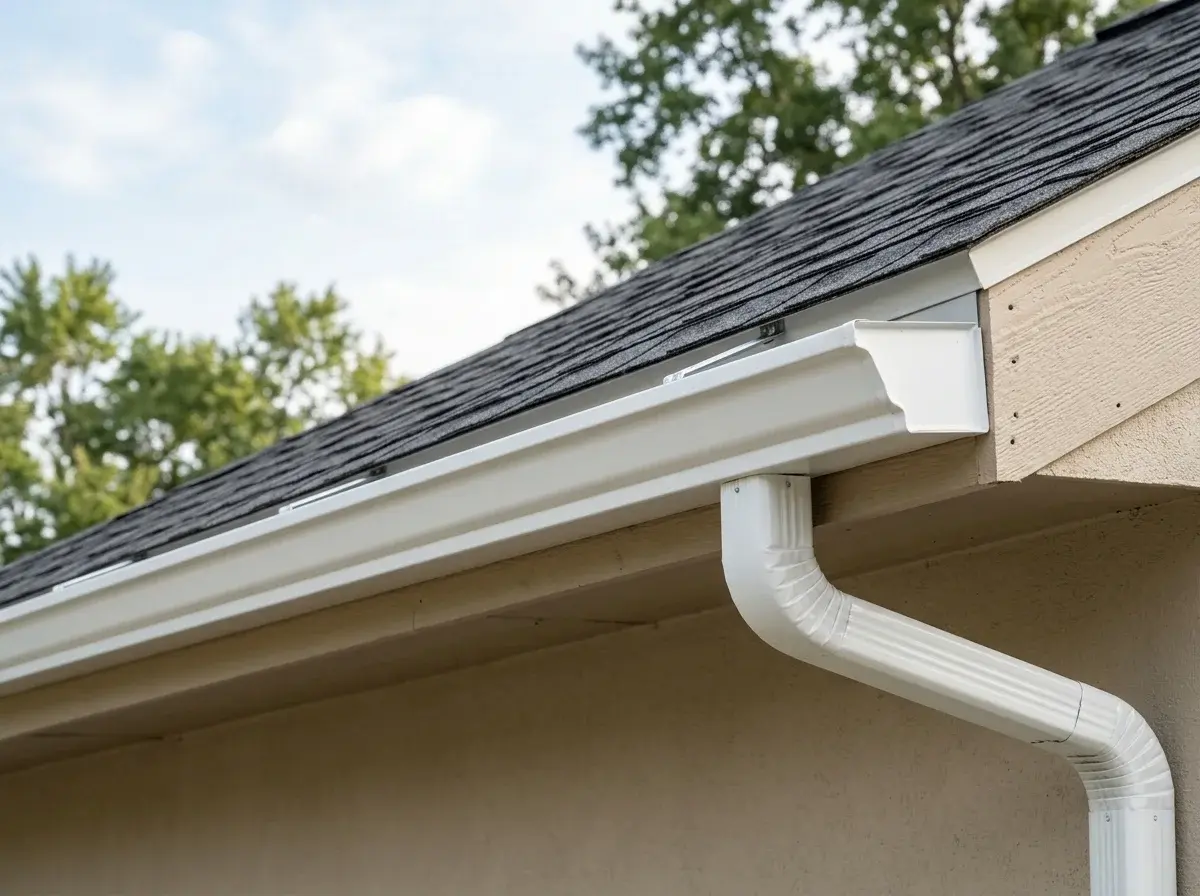
Downspout Installation & Drainage in the Treasure Valley
Get roof water away from the foundation.
Free on-site estimate · No-pressure quote · Same crew start to finish
QUICK ANSWER
Downspouts and drainage are the second half of the gutter system — getting collected water down and far enough from the house. We size and place downspouts to roof area, add surface extensions or buried drains past the splash zone, and confirm the grade falls away from the foundation.
- 5″ & 6″ K-Style
- Half-Round
- Aluminum
- Color-Matched
- Hidden Hangers
WHAT’S INCLUDED
What’s included in Downspouts & Drainage?
A gutter only does half the job — collecting the water. The other half is getting it down and away from the house, and that's where most foundation-water problems start. A single 1-inch rain produces roughly 600 gallons off a 1,000-square-foot roof (University of Arizona Extension), and dumping that at the base of the house is what feeds soil saturation against the footing. We size and place downspouts to actual roof drainage area, carry the discharge past the splash zone with surface extensions or buried drains, and confirm the finished grade falls away from the foundation so the water you moved actually keeps going.
- Downspout installation and replacement, sized to roof drainage area
- Downspout extensions to carry discharge past the splash zone
- Underground / buried PVC drains to a pop-up emitter or daylight outlet
- Splash blocks positioned to stop point erosion at outlets
- Grade and discharge coordination so water drains where it's sent
- Oversized 3×4 outlets where standard 2×3 downspouts overflow
WHY US
Why Treasure Valley homeowners choose us.
Move roof water away from the foundation, not into it
Stop the corner overflow that comes from undersized or too-few downspouts
Keep extensions out of the mowing path with buried drains
Cheap insurance against the soil saturation that feeds foundation movement
OUR PROCESS
How does downspouts work?
Roof-area and drainage assessment
We measure the roof drainage area feeding each run and check downspout count, outlet size, and placement against design guidance (about 600 sq ft per 2×3, 1,200 per 3×4, outlets every 20–40 ft). We also walk the discharge points to see where water is currently going and confirm whether the grade falls away from the house.
Downspout sizing and placement plan
We lay out the right number and outlet size for the roof load, oversizing to 3×4 on large or steep roofs that overwhelm standard 2×3 downspouts. Too-few or undersized downspouts overflow the gutter no matter how big it is, so this is where corner-overflow problems get solved.
Downspout installation or replacement
New or replacement downspouts are installed with matched elbows and offsets, secured to the wall, and routed to discharge away from the foundation rather than straight down the wall to the base of the house.
Extensions, splash blocks, or buried drains
We carry the discharge past the splash zone. Surface extensions (rigid or flexible) move water several feet out; splash blocks are the budget option to stop point erosion at the outlet; buried solid-PVC drains to a pop-up emitter or daylight outlet are the choice where extensions would be in the way of mowing or walkways.
Grade and discharge confirmation
We confirm the finished grade falls away from the house (the IRC target is 6 inches over the first 10 feet) so the extended discharge actually drains instead of running back toward the footing. In clay-heavy Treasure Valley soil that sheds water fast, this is what keeps the system working.
Flow test and walkthrough
We run water through the downspouts and watch it move cleanly to its discharge point, well clear of the foundation. We walk the routing with you, explain why each outlet was placed where it is, and leave a written summary.
MATERIALS
Downspouts materials and options.
Downspouts
- 2×3 aluminum (standard, ~600 sq ft of roof per outlet)
- 3×4 aluminum oversized (~1,200 sq ft; large or steep roofs)
- Round corrugated (architectural match for half-round gutters)
Surface discharge
- Rigid downspout extensions (durable, carry water several feet out)
- Flexible / roll-out extensions (adjustable around landscaping)
- Splash blocks (budget option; stop point erosion at the outlet)
Buried drainage
- Solid PVC drain pipe (cleaner flow than corrugated, less clogging)
- Pop-up emitter outlets (discharge at grade away from the foundation)
- Daylight outlets where the lot slopes to an open edge
Connections
- Downspout-to-drain adapters and elbows
- Round and rectangular elbows matched to the downspout profile
COST RANGE
How much do downspouts cost in the Treasure Valley?
Downspouts in the Treasure Valley typically run $40–$90 each — about $65 on average — when added to a gutter job. Individual downspouts are priced as a per-downspout add-on; full drainage routing — underground tie-ins, pop-up emitters, and grading — is scoped on-site after we map where the water needs to go.
PER DOWNSPOUT
Typical $65 per downspout
These are Treasure Valley ranges only — the on-site visit gives the real number. Actual cost depends on roof access, story count, existing condition, and the system selected.
WHAT AFFECTS PRICE
Downspout add-ons are priced per outlet (about $40–$90 each) on our per-foot gutter services, which is the range our cost calculator uses. Underground and buried drain runs are project-specific — trenching and footage drive the cost — so those are quoted on-site rather than from a published figure. We didn't find verified Idaho-specific downspout-system pricing to publish, so we keep the ranged add-on for outlets and quote buried work directly.
Use the interactive calculator →Real numbers come from on-site visits.
Read the full Downspouts cost guide — tiers, components & local factors →
SERVICE AREA
Available in Downspouts across the Treasure Valley.
We serve Boise and all surrounding Treasure Valley communities. Select your city for local pricing, neighborhoods, and availability.
Boise, ID
Ada County
Downspouts in Boise →
Meridian, ID
Ada County
Downspouts in Meridian →
Eagle, ID
Ada County
Downspouts in Eagle →
Nampa, ID
Canyon County
Downspouts in Nampa →
Caldwell, ID
Canyon County
Downspouts in Caldwell →
Kuna, ID
Ada County
Downspouts in Kuna →
Star, ID
Ada County
Downspouts in Star →
Garden City, ID
Ada County
Downspouts in Garden City →
Hidden Springs, ID
Ada County
Downspouts in Hidden Springs →
Southeast Boise, ID
Ada County
Downspouts in Southeast Boise →
West Boise, ID
Ada County
Downspouts in West Boise →
Middleton, ID
Canyon County
Downspouts in Middleton →
Emmett, ID
Gem County
Downspouts in Emmett →
Mountain Home, ID
Elmore County
Downspouts in Mountain Home →
More Services
Other services in the Treasure Valley
Gutter Guard Installation
Stop cleaning gutters for good.
See gutter guards →Gutter Installation & Replacement
Seamless gutters that actually drain.
See gutter installation →Gutter Repair
Fix leaks, sags, and pulled-away sections.
See gutter repair →Gutter Cleaning
Hand-cleaned gutters, flushed downspouts.
See gutter cleaning →Seamless Gutter Installation
Formed on-site. No joints to leak.
See seamless gutters →Copper Gutter Installation
50-year gutters that get better looking over time.
See copper gutters →Half-Round Gutter Installation
The correct profile for craftsman and historic homes.
See half-round gutters →Ice Dam Prevention
Stop the freeze-thaw cycle before it reaches your ceiling.
See ice dam prevention →Fascia & Soffit Repair
Rebuild the board your gutters bolt to.
See fascia & soffit →CHOOSING A CONTRACTOR
What to ask any downspouts contractor.
These are the questions we’d ask if we were hiring someone for our own home. A legitimate contractor answers all of them without hesitation.
Questions to ask
- How are you sizing the number and size of downspouts to my roof area?
- How far will the discharge be carried from the foundation, and with what — extension, splash block, or buried drain?
- Will you confirm the grade falls away from the house before extending the downspouts?
- For buried runs, is it solid PVC (not corrugated) to a pop-up or daylight outlet?
- Is the price per outlet, per system, or per foot, and what changes it?
- Are you a licensed Idaho contractor? (License number should be on the estimate.)
Red flags to watch for
- Downspout count guessed at instead of sized to roof drainage area — undersized outlets overflow at the corners.
- Discharge left at a splash block alone, which only moves water 1–2 feet from the foundation.
- A '1 downspout per X feet' or 'discharge X feet out' figure quoted as a code mandate — those are SMACNA / trade design guides, not regulation.
- Extensions added without checking that the grade falls away from the house, so water runs back toward the footing.
- Corrugated pipe used for buried runs where it traps debris — solid PVC flows cleaner.
- A promise that downspout work alone will prevent foundation damage — it's cheap insurance, not a guarantee.
WHY PROFESSIONAL
Is professional downspouts worth it?
The default new-construction setup is a downspout that dumps onto a splash block at the base of the house — fine on paper, but a splash block only carries water 1–2 feet out, and in the Treasure Valley's clay-heavy soil that water sheds along the surface and pools against the footing. Foundation repair averages around $5,174 nationally (HomeAdvisor), so moving roof water several feet farther with an extension or a buried drain is cheap insurance by comparison. The work isn't complicated; the part DIY usually misses is sizing the downspouts to the actual roof area and confirming the grade falls away before extending — get those two right and the system does what it's supposed to.
Ready for Downspouts in the Treasure Valley?
Free on-site estimates. Licensed Idaho contractor. Call (208) 247-2660 or request a quote online.
BEFORE YOU BOOK
How we run the job and what we stand behind.
Our process, step-by-step
Seven steps from quote to walkthrough. What to expect at every stage, including lead time, install day, and post-install follow-up.
Workmanship & material warranty
What our workmanship covers, what manufacturer warranties cover, and what’s explicitly not covered. Specific terms disclosed in writing on every estimate.
Frequently asked questions
Why does roof water pool against the house in Boise instead of soaking away?
How many downspouts does my roof need?
How much do downspouts and drainage cost?
Is a splash block enough, or do I need an extension?
What does code actually require for drainage around the foundation?
Can you bury the downspout drains so they're out of the way?
Get a free Downspouts estimate today.
Licensed · Insured · Locally owned in the Treasure Valley.