
Ice Dam Prevention in the Treasure Valley
Stop the freeze-thaw cycle before it reaches your ceiling.
Free on-site estimate · No-pressure quote · Same crew start to finish
QUICK ANSWER
Ice dams form when attic heat melts roof snow that refreezes at the cold eave. We address the gutter side: drainage audit, pre-freeze cleaning, slope correction, self-regulating heat cable in chronic runs, and an honest insulation referral when that's the root cause.
- 5″ & 6″ K-Style
- Half-Round
- Aluminum
- Color-Matched
- Hidden Hangers
WHAT’S INCLUDED
What’s included in Ice Dam Prevention?
Ice dams form when heat escaping from your living space warms the roof deck, melts snow above the eaves, and that meltwater refreezes at the cold overhang — right where your gutters sit. The result is backed-up water that lifts shingles, soaks fascia, and eventually finds its way into your walls or ceiling. We address ice dams from the gutter side: clearing debris so meltwater can actually drain, correcting gutter slope so water moves instead of pooling and freezing, installing self-regulating heat cable in chronic problem runs, and flagging attic insulation deficiencies that are the root cause of most recurring dams. We don't do attic insulation, but we'll tell you when it's the fix — and when gutter work alone solves the problem.
- Full gutter drainage audit covering slope, debris, and downspout clearance
- Debris removal from gutters and downspouts before freeze season
- Self-regulating heat cable installation in chronic ice dam runs
- Downspout heat cable to keep meltwater moving through the drain path
- Micro-mesh guard system recommendations to prevent future debris buildup
- Honest attic insulation referral when that's the root cause (we flag it, we don't sell it)
- Post-storm check recommendations for north-facing and shaded roof runs
- Written assessment of all problem areas with priority ranking
WHY US
Why Treasure Valley homeowners choose us.
Prevent shingle lift, fascia rot, and interior water intrusion from ice-dam backup
Address the drainage side of the problem, not just tape over it with heating cables
Self-regulating heat cable only draws power when temperatures require it
One visit covers assessment, cleaning, and heat cable installation where needed
OUR PROCESS
How does ice dam prevention work?
Full drainage audit
We walk every eave run and check three things: debris load, gutter slope, and downspout clearance. Any of the three can create the pooling and freezing conditions that lead to ice dams. We use a level to confirm pitch on runs that have had previous ice problems — a dead-flat or back-pitched run is common on homes where the fascia has settled or hangers have pulled. You get a written summary of what we found and what we recommend.
Pre-freeze cleaning
Gutters are hand-cleaned of leaves, pine needles, seed pods, and cottonwood flock before freeze season. Every downspout is flushed and confirmed flowing. A partially blocked downspout freezes solid from the bottom up in the first hard freeze, creating a full-system backup. This step is the most straightforward ice dam prevention available and works on every home regardless of attic insulation condition.
Slope correction and hanger reinforcement
Back-pitched or flat sections are re-pitched to drain toward their downspouts. Pulled or sagging hangers are replaced with new hidden-hanger screws into solid fascia — pulled gutters fill with standing water that freezes solid and creates a dam even when the rest of the system is clean. If the fascia is too damaged to hold a new fastener, we flag it before proceeding.
Self-regulating heat cable installation
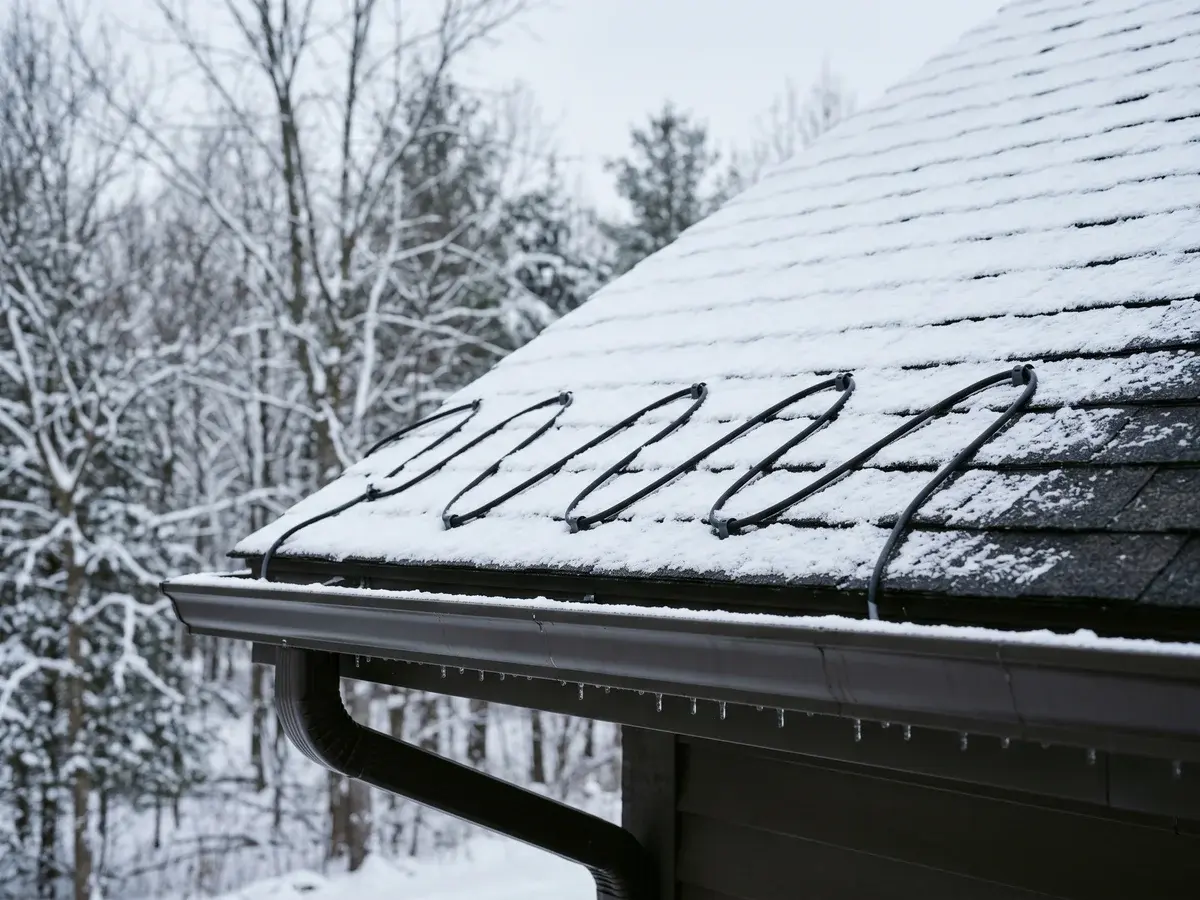
In runs that are chronically prone to ice formation — north-facing, heavily shaded, or immediately above known heat-loss areas — we install self-regulating heat cable in a zigzag pattern across the gutter and first few feet of roof surface, plus straight down any downspout at risk of freezing solid. Self-regulating cable adjusts its heat output based on ambient temperature, so it draws maximum power only when it's coldest and shuts down when conditions warm. It's not a constant draw. We route power from an exterior outlet or the attic depending on your home's configuration.
Guard system installation (where appropriate)
If your gutter is in good condition and the primary ice dam contributor is recurring debris buildup, a micro-mesh guard system is the most durable fix. Guards keep the gutter free of the debris that compresses and freezes into dams, eliminating the need for pre-freeze cleaning calls in most cases. We install guards only on gutters that have been cleaned and confirmed pitched correctly — guards on a back-pitched gutter don't solve the standing water problem.
Attic assessment referral and written report
If the pattern of ice damage — shingle lift above the overhang, interior staining at exterior walls, ice dams that reform within a week of heat cable installation — points to significant attic heat loss, we say so in writing. We're not insulation contractors and we don't pretend to be. We give you our read on what we see from the gutter side and recommend you have an insulation contractor assess your attic's R-value and vapor barrier. That referral isn't a hedge — it's the honest diagnosis.
MATERIALS
Ice Dam Prevention materials and options.
Heat cable
- Self-regulating heat cable (adjusts output to ambient temperature; preferred over constant-wattage)
- Roof and gutter rated (exterior-rated, not pipe-heat tape; different product)
- 12W/ft to 20W/ft self-regulating options depending on eave length and exposure
Downspout heat
- Self-regulating downspout heat cable (pre-formed or cut-to-length for round and rectangular downspouts)
- Freeze-proof downspout inserts for minor exposure situations
Gutter guards
- Stainless-steel micro-mesh (prevents debris buildup that accelerates dam formation)
- Half-round-rated micro-mesh (for homes with round gutter profiles)
Fasteners and brackets
- Hidden-hanger screws for re-hanging ice-pulled sections
- Heat cable clips and downspout clips (non-penetrating, manufacturer-rated)
COST RANGE
How much does ice dam prevention cost in the Treasure Valley?
Ice Dam Prevention pricing depends entirely on the scope of the work — the size of the affected area, the underlying cause, and what the repair or prevention plan involves. We don’t publish a flat range because an honest number requires seeing the job in person.
Get a free on-site estimate and we’ll give you a written, itemized quote — no guesswork, no obligation.
These are Treasure Valley ranges only — the on-site visit gives the real number. Actual cost depends on roof access, story count, existing condition, and the system selected.
WHAT AFFECTS PRICE
Ice dam prevention is typically scoped as a visit that may include cleaning, slope correction, and heat cable installation depending on what the audit finds. Cleaning and slope correction are priced similarly to standalone gutter repair. Heat cable is priced by linear footage of coverage (gutter run plus downspout) plus the cost of the cable and clips. Our cost calculator gives a baseline range for gutter cleaning and repair; contact us for a combined ice-dam-prevention quote after an on-site assessment.
Use the interactive calculator →Real numbers come from on-site visits.
Read the full Ice Dam Prevention cost guide — tiers, components & local factors →
FALL & WINTER PREP
When does ice dam season start in the Treasure Valley?
Freezing nights start stacking up in November and peak in December and January. Heat cable, pitch corrections, and pre-freeze cleaning all belong on the calendar before then.
BOISE WINTER BY THE NUMBERS
- nights a year at or below 32°F
- 108
- days a year that never thaw
- 16
- average snowfall a season
- 17.6″
- median first 32°F night
- Oct 21
Freezing nights per month
NOVEMBER – MARCH
Stop ice dams at the cause
Only about 16 days a year stay below freezing all day, so most winter days melt roof snow in the afternoon and refreeze it at night — the cycle that builds ice at the eave. Clear the drainage first; add heat cable only on chronic runs.
LATE OCTOBER – NOVEMBER
Clean after the leaves drop, before December
Valley-floor fall color usually peaks in the second half of October, and November still averages only 2 inches of snow before December's 5.6 inches. That makes November the window to clear leaves so winter meltwater has somewhere to go.
DECEMBER – FEBRUARY
Make sure the gutter can carry snow and ice
December and January average about 25 freezing nights each and most of Boise's 17.6-inch seasonal snowfall. Hangers every 24 inches, a front lip set below the roof line, and micro-mesh that sheds snow keep gutters on the house.
SERVICE AREA
Available in Ice Dam Prevention across the Treasure Valley.
We serve Boise and all surrounding Treasure Valley communities. Select your city for local pricing, neighborhoods, and availability.
Boise, ID
Ada County
Ice Dam Prevention in Boise →
Meridian, ID
Ada County
Ice Dam Prevention in Meridian →
Eagle, ID
Ada County
Ice Dam Prevention in Eagle →
Nampa, ID
Canyon County
Ice Dam Prevention in Nampa →
Caldwell, ID
Canyon County
Ice Dam Prevention in Caldwell →
Kuna, ID
Ada County
Ice Dam Prevention in Kuna →
Star, ID
Ada County
Ice Dam Prevention in Star →
Garden City, ID
Ada County
Ice Dam Prevention in Garden City →
Hidden Springs, ID
Ada County
Ice Dam Prevention in Hidden Springs →
Southeast Boise, ID
Ada County
Ice Dam Prevention in Southeast Boise →
West Boise, ID
Ada County
Ice Dam Prevention in West Boise →
Middleton, ID
Canyon County
Ice Dam Prevention in Middleton →
Emmett, ID
Gem County
Ice Dam Prevention in Emmett →
Mountain Home, ID
Elmore County
Ice Dam Prevention in Mountain Home →
More Services
Other services in the Treasure Valley
Gutter Guard Installation
Stop cleaning gutters for good.
See gutter guards →Gutter Installation & Replacement
Seamless gutters that actually drain.
See gutter installation →Gutter Repair
Fix leaks, sags, and pulled-away sections.
See gutter repair →Gutter Cleaning
Hand-cleaned gutters, flushed downspouts.
See gutter cleaning →Seamless Gutter Installation
Formed on-site. No joints to leak.
See seamless gutters →Copper Gutter Installation
50-year gutters that get better looking over time.
See copper gutters →Half-Round Gutter Installation
The correct profile for craftsman and historic homes.
See half-round gutters →Fascia & Soffit Repair
Rebuild the board your gutters bolt to.
See fascia & soffit →Downspouts & Drainage
Get roof water away from the foundation.
See downspouts →CHOOSING A CONTRACTOR
What to ask any ice dam prevention contractor.
These are the questions we’d ask if we were hiring someone for our own home. A legitimate contractor answers all of them without hesitation.
Questions to ask
- Will you do a full drainage audit (slope, debris, downspout clearance) before recommending heat cable?
- Is the heat cable you're installing self-regulating or constant-wattage?
- Is the cable listed for roof and gutter use (exterior-rated), or is it pipe-heat tape?
- How is the cable attached: proper manufacturer clips or zip ties?
- Will you flag any attic insulation issues you observe from the gutter side?
- What's the written scope of work: what's being installed, where, and how many linear feet?
Red flags to watch for
- Contractor installs constant-wattage heat cable instead of self-regulating. Constant-wattage draws full power regardless of temperature and runs up your electric bill unnecessarily.
- Heat cable sold as a standalone fix without cleaning or slope correction. Cable in a debris-clogged or back-pitched gutter doesn't prevent the dam from forming.
- No attic conversation at all. A contractor who never mentions insulation as a contributing cause either doesn't know it or is selling cable they can't fully justify.
- Heat cable zip-tied or duct-taped to the gutter rather than properly clipped. Manufacturer clips maintain proper contact and prevent hotspots.
- Roof-rake service sold without gutter work. Removing snow from the roof without addressing the drainage path below it often just relocates the problem.
- No written assessment of what they found or what was installed. You should know the full scope of work, especially if heat cable is plugged into your power.
WHY PROFESSIONAL
Is professional ice dam prevention worth it?
The DIY response to ice dams is usually a roof rake and a box of constant-wattage heat cable from a hardware store. Roof raking is genuinely useful during an active event — it reduces the snow load feeding the melt cycle. Constant-wattage cable works but draws power at maximum output regardless of conditions, which shows up in January electric bills. Self-regulating cable costs more upfront and draws less power over the season. What most DIY approaches miss is the drainage audit — confirming that the gutter is clean, properly pitched, and has a clear downspout path before freeze season. That step is inexpensive to fix and is the reason many ice dam calls happen on homes where the gutters were clogged the previous fall. Fixing the drain path first, then adding heat cable only where the run is chronically exposed, is more durable than cable alone.
Ready for Ice Dam Prevention in the Treasure Valley?
Free on-site estimates. Licensed Idaho contractor. Call (208) 247-2660 or request a quote online.
BEFORE YOU BOOK
How we run the job and what we stand behind.
Our process, step-by-step
Seven steps from quote to walkthrough. What to expect at every stage, including lead time, install day, and post-install follow-up.
Workmanship & material warranty
What our workmanship covers, what manufacturer warranties cover, and what’s explicitly not covered. Specific terms disclosed in writing on every estimate.
Frequently asked questions
What causes ice dams in the Treasure Valley?
Do heat cables actually work?
Which homes in Boise are most at risk for ice dams?
Should I fix my gutters or my attic insulation first?
Will gutter guards help with ice dams?
How soon should I address ice dams?
Can ice dams damage my gutters permanently?
Get a free Ice Dam Prevention estimate today.
Licensed · Insured · Locally owned in the Treasure Valley.