Copper Gutter Installation in the Treasure Valley
50-year gutters that get better looking over time.
Free on-site estimate · No-pressure quote · Same crew start to finish
QUICK ANSWER
Copper gutter installation typically runs 3–5x the cost of aluminum and is a 50-year system. We install 16oz and 20oz copper in half-round and K-style profiles with soldered seams at every joint, copper-compatible hangers, and round corrugated downspouts.
- 5″ & 6″ K-Style
- Half-Round
- Aluminum
- Color-Matched
- Hidden Hangers
WHAT’S INCLUDED
What’s included in Copper Gutter Installation?
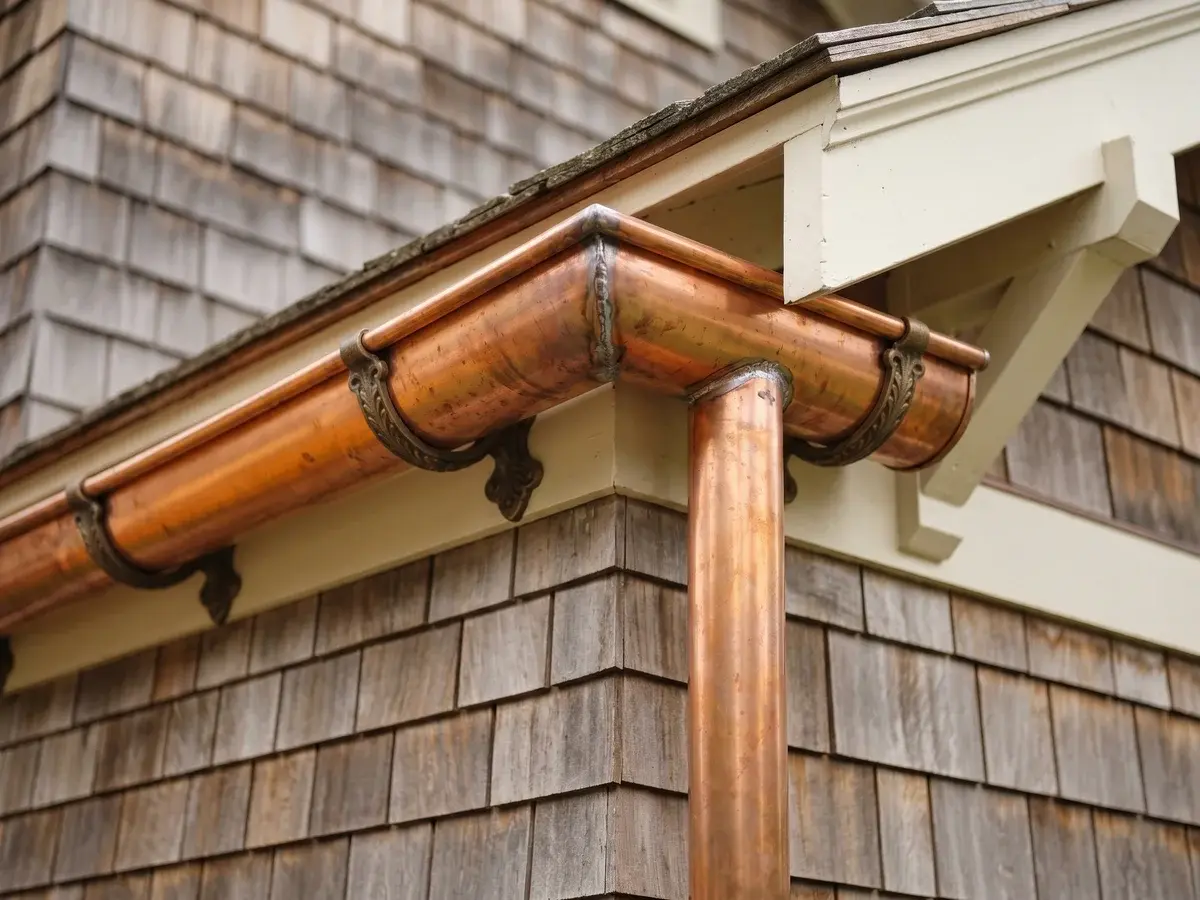
Copper gutters are the highest-durability, highest-aesthetic option available — and they're purpose-built for homes where standard aluminum won't do. The patina that develops over the first few years isn't a defect; it's a stable copper-oxide layer that actually protects the metal and reads as a finish element on custom and historic architecture. We install 16oz and 20oz copper in K-style and half-round profiles, with soldered seams at every joint. This is not a one-day commodity install — it's a measured, fabricated, hand-soldered system that's designed to outlast the home's next three roof cycles.
- 16oz copper (standard) and 20oz copper (heavy-gauge custom projects)
- Half-round and K-style profiles, both historically appropriate depending on era
- Soldered seams at all miters, end caps, and outlets (no sealant-only joints)
- Round corrugated copper downspouts with soldered elbows
- Copper-specific hidden hangers to prevent galvanic corrosion
- No painting, no re-coating; patina develops naturally to a blue-green finish
- Compatible with micro-mesh gutter guards for debris management
- Free design consultation on profile and downspout routing for custom homes
WHY US
Why Treasure Valley homeowners choose us.
50-plus year service life with no painting or coating required
Patina finish is architecturally appropriate for craftsman, colonial, and historic homes
Soldered joints eliminate the primary failure mode of standard gutter systems
Adds measurable curb appeal and resale value on high-end homes
Zero rust; copper doesn't corrode the way steel does
OUR PROCESS
How does copper gutters installation work?
Design consultation and fabrication planning
Copper gutter installations start with a design conversation, not just a measurement. We confirm the profile (half-round vs. K-style), gauge (16oz vs. 20oz), downspout count and routing — including any staining risk to masonry or siding — and hanger spacing for the specific span lengths on your home. Sections are fabricated to your exact measurements before the install day.
Existing gutter removal and substrate inspection
Old gutters are stripped and the fascia inspected for rot, previous fastener damage, and any corrosion from dissimilar-metal contact. Copper hangers require solid fascia or rafter-tail attachment to carry the added weight of copper — heavier than aluminum, especially after snow load. Any fascia issues are addressed before copper goes up.
Copper-specific hanger installation
We use copper or copper-compatible stainless hangers throughout — no aluminum or galvanized fasteners in contact with the copper. Galvanic corrosion starts at the fastener and works outward. Hangers are spaced appropriately for the weight and span, and set to establish correct pitch before the gutter is hung.
Hanging and fitting
Pre-fabricated copper sections are hung and fitted at corners and outlet locations. Half-round profiles use round corrugated copper downspouts with proper elbow angles to maintain flow. K-style copper uses standard copper outlet boxes. All joints are dry-fitted and checked for pitch before soldering begins.
Soldering all seams
Every joint — miters, end caps, outlet connections, and downspout elbows — is soldered with lead-free plumbing solder and a propane torch. Soldering is the process that makes copper gutters a 50-year system rather than a 10-year sealant gamble. The joint is mechanically sound and watertight without relying on any caulk or butyl to hold.
Flow test and walkthrough
Each run is flushed with water to confirm pitch and joint integrity. We walk the full installation with you, point out what the patina process will look like over the next few years, flag any downspout routing considerations, and leave you with the written material and workmanship warranty.
MATERIALS
Copper Gutters materials and options.
Copper sheet
- 16oz copper (standard residential, fits most homes)
- 20oz copper (heavy-gauge for wide spans, custom projects, and premium installs)
Profiles
- Half-round copper (historically correct for pre-1950 and craftsman architecture)
- K-style copper (contemporary and colonial homes)
Downspouts
- Round corrugated copper (standard match for half-round gutters)
- Square copper downspouts (K-style copper installs)
- Copper-soldered elbows and offsets throughout
Fasteners
- Copper spike-and-ferrule (historic restoration, period-appropriate)
- Copper-compatible stainless hidden hangers (modern install, no galvanic contact)
Solder
- Lead-free plumbing solder (50-50 or 60-40 rosin-core rated for copper gutters)
COST RANGE
How much do copper gutters cost in the Treasure Valley?
Copper Gutters is priced per linear foot and runs materially higher than the aluminum baseline of $10–$22 per foot — copper is quoted on-site. The biggest variables are total footage, story count and access, gutter profile, and existing condition.
PER LINEAR FOOT
Typical $14 per linear foot
The range above is the aluminum installation baseline for reference. Copper runs materially higher— typically several times the cost of aluminum — because of the material itself and the hand-soldered labor at every joint. We don’t publish a flat copper number because an honest figure depends on profile, gauge (16oz vs. 20oz), and total footage. Copper is quoted on-site.
These are Treasure Valley ranges only — the on-site visit gives the real number. Actual cost depends on roof access, story count, existing condition, and the system selected.
WHAT AFFECTS PRICE
Copper gutter installations are significantly more expensive than aluminum — typically 3 to 5 times the per-linear-foot cost — reflecting both material price and the skilled soldering labor at every joint. Variables that affect the quote: gauge (16oz vs. 20oz), profile (half-round vs. K-style), total linear footage, downspout count, and story count. Our cost calculator provides a general range for gutter installation; contact us for a copper-specific on-site estimate.
Use the interactive calculator →Real numbers come from on-site visits.
Read the full Copper Gutters cost guide — tiers, components & local factors →
SERVICE AREA
Available in Copper Gutters across the Treasure Valley.
We serve Boise and all surrounding Treasure Valley communities. Select your city for local pricing, neighborhoods, and availability.
Boise, ID
Ada County
Copper Gutters in Boise →
Meridian, ID
Ada County
Copper Gutters in Meridian →
Eagle, ID
Ada County
Copper Gutters in Eagle →
Nampa, ID
Canyon County
Copper Gutters in Nampa →
Caldwell, ID
Canyon County
Copper Gutters in Caldwell →
Kuna, ID
Ada County
Copper Gutters in Kuna →
Star, ID
Ada County
Copper Gutters in Star →
Garden City, ID
Ada County
Copper Gutters in Garden City →
Hidden Springs, ID
Ada County
Copper Gutters in Hidden Springs →
Southeast Boise, ID
Ada County
Copper Gutters in Southeast Boise →
West Boise, ID
Ada County
Copper Gutters in West Boise →
Middleton, ID
Canyon County
Copper Gutters in Middleton →
Emmett, ID
Gem County
Copper Gutters in Emmett →
Mountain Home, ID
Elmore County
Copper Gutters in Mountain Home →
More Services
Other services in the Treasure Valley
Gutter Guard Installation
Stop cleaning gutters for good.
See gutter guards →Gutter Installation & Replacement
Seamless gutters that actually drain.
See gutter installation →Gutter Repair
Fix leaks, sags, and pulled-away sections.
See gutter repair →Gutter Cleaning
Hand-cleaned gutters, flushed downspouts.
See gutter cleaning →Seamless Gutter Installation
Formed on-site. No joints to leak.
See seamless gutters →Half-Round Gutter Installation
The correct profile for craftsman and historic homes.
See half-round gutters →Ice Dam Prevention
Stop the freeze-thaw cycle before it reaches your ceiling.
See ice dam prevention →Fascia & Soffit Repair
Rebuild the board your gutters bolt to.
See fascia & soffit →Downspouts & Drainage
Get roof water away from the foundation.
See downspouts →CHOOSING A CONTRACTOR
What to ask any copper gutters contractor.
These are the questions we’d ask if we were hiring someone for our own home. A legitimate contractor answers all of them without hesitation.
Questions to ask
- Is this solid copper sheet or copper-coated aluminum? (Request material confirmation in writing.)
- Are all joints being soldered, or sealed with sealant only?
- What fastener type is specified, and is it copper or copper-compatible to prevent galvanic corrosion?
- Have you reviewed downspout routing relative to any light-colored masonry or stucco?
- What's the workmanship warranty on the soldered joints specifically?
- Have you installed copper gutters on homes in this area, and can you provide a reference?
Red flags to watch for
- Contractor quotes copper-coated aluminum instead of solid copper. The two look identical initially and have very different service lives.
- Aluminum or galvanized hangers specified for a copper install. Direct metal contact causes galvanic corrosion at every fastener point.
- Joints sealed with sealant only, not soldered. Sealant joints on copper still fail through freeze-thaw cycles.
- No discussion of downspout runoff staining. Blue-green copper runoff stains light masonry and stucco and needs to be planned for.
- Quote given over the phone without a site visit. Copper fabrication requires accurate measurements and a profile conversation.
- No mention of dissimilar-metal risk when the home has aluminum trim or aluminum flashing nearby.
WHY PROFESSIONAL
Is professional copper gutters worth it?
Aluminum seamless gutters are the right choice for the majority of Treasure Valley homes — they're durable, low-maintenance, available in good colors, and cost-effective. Copper makes sense when the home's architecture calls for it and the project is viewed on a long timeline: install once, develop a finish that works with the building, done for 50 years. The one substitution that's not worth the money is copper-coated steel or copper-look aluminum — both look similar fresh off the truck and fail to develop an authentic patina. If you're investing in the aesthetic and longevity, spend it on solid copper. Otherwise use quality aluminum and put the budget elsewhere.
Ready for Copper Gutters in the Treasure Valley?
Free on-site estimates. Licensed Idaho contractor. Call (208) 247-2660 or request a quote online.
BEFORE YOU BOOK
How we run the job and what we stand behind.
Our process, step-by-step
Seven steps from quote to walkthrough. What to expect at every stage, including lead time, install day, and post-install follow-up.
Workmanship & material warranty
What our workmanship covers, what manufacturer warranties cover, and what’s explicitly not covered. Specific terms disclosed in writing on every estimate.
Frequently asked questions
How much do copper gutters cost compared to aluminum?
Will copper gutters stain my siding or masonry?
How long until copper gutters develop the patina?
Do copper gutters need maintenance?
Can copper gutters be installed on any home?
What's the difference between 16oz and 20oz copper?
Can you mix copper gutters with existing aluminum downspouts?
Get a free Copper Gutters estimate today.
Licensed · Insured · Locally owned in the Treasure Valley.