
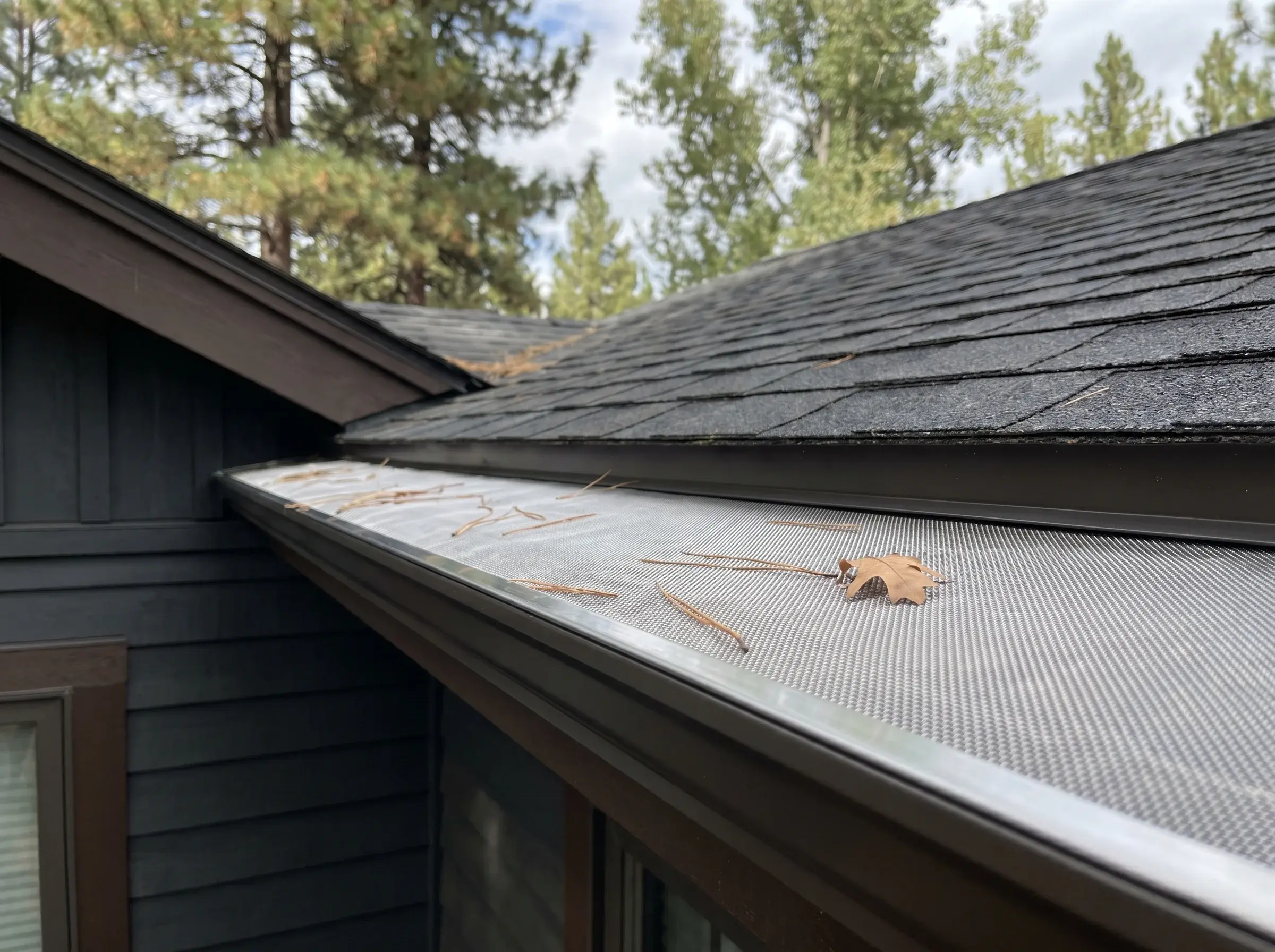
There are five real gutter guard categories on the market for Treasure Valley homes: micro-mesh (usually stainless), perforated metal and screen guards, surface-tension reverse-curve hoods, foam inserts, and brush inserts. Every one of them works in a brochure. Out here in the Treasure Valley — with ponderosa pine in the Foothills, hard spring and fall thunderstorms on the valley floor, and a winter that runs roof snow through dozens of freeze-thaw cycles — they sort out fast. This is how we rank them after years of installing and, more often, pulling out the ones that failed.
Quick orientation so you don't read the wrong post: this is the type ranking — the hub. If you want the deep dive on pine needles specifically, read our pine-needle breakdown. If you want to know which local outfit to hire rather than which product to buy, read our guide to gutter guard companies in Boise. And if your home backs the Foothills wildfire interface, the ember-resistant guard rules are their own conversation. Links to all three are at the bottom.
Section
1. Stainless micro-mesh — best gutter guard system overall
Micro-mesh lays a fine woven screen across the top of the gutter. Water passes through openings measured in microns; debris stays on top to dry out and blow or slide off. Industry sources put the openings across the category in a broad 50–400 micron range depending on the product — fine enough that on a good stainless mesh a ponderosa pine needle physically can't thread through. That's the whole reason it's our default recommendation in pine country.
Stainless matters specifically here. Pine and fir needles leach tannins, and tannin-rich water sitting on a guard through an Idaho winter corrodes aluminum mesh and aluminum frames at the perforations. Solid stainless wire on a stainless or anodized-aluminum frame doesn't degrade the same way, which is why we install it and why most premium stainless products carry long material warranties. We cover the stainless-versus-aluminum-mesh split in detail in the pine-needle post — short version: for any home you plan to keep, buy stainless.
- Best for: pine and fir canopy, shingle-grit shedding roofs, heavy-rain runs, long-term ownership.
- Watch out for: thin-gauge bargain mesh that deforms under wet snow, and skipping the existing-gutter clean-and-reseal before install (guards over a clog fail immediately).
- Maintenance: roughly one inspection and surface brush-off a year, usually late fall after the heavy needle drop.
Section
2. Perforated metal & screen guards — the budget middle
Screen and perforated-metal guards are the wide-hole tier: punched aluminum panels or coarser metal/plastic screens that snap or slide onto the gutter. They stop the obvious stuff — maple leaves, twigs, the cottonwood drift that buries a North End gutter every June. They're cheaper than micro-mesh and a real upgrade over a bare gutter on the right home.
Where they fall apart is fine debris. Pine needles thread tip-first through the perforations and pile up underneath, which turns a clog you could scoop into one you have to remove the panel to reach. Plastic versions go UV-brittle in Idaho sun within a few seasons and crack into needle-funnels. On a valley-floor home with only deciduous trees and no evergreen pressure, a quality screen is a defensible budget pick. Under any pine canopy, it's a callback waiting to happen.
- Best for: deciduous-only yards on the valley floor — think Nampa, Caldwell, or a Meridian subdivision with young trees and no pines.
- Skip if: you have any pine or fir within reach of the roof, or you're shopping a plastic screen for a sun-baked west-facing run.
Section
3. Surface-tension reverse-curve hoods — strong on leaves, weak on Idaho
Reverse-curve guards (the category brands like Gutter Helmet sit in) are solid curved hoods that cap the gutter and leave a narrow slot along the front. Water clings to the rounded nose and follows the curve back through the slot — the same Coanda effect that makes water hug the back of a spoon — while leaves ride over the front and drop. On a yard carpeted in big leaves, the shedding is genuinely good.
Two well-documented weak spots line up badly with our climate. In very heavy rain, water volume can exceed what surface tension pulls through the slot and it overshoots — the waterfall effect — which is exactly the scenario in a hard Boise spring thunderstorm. And in cold weather, several industry sources note the nose and slot can freeze over, blocking flow and feeding ice-dam formation through our long freeze-thaw winters. Fine debris like shingle grit and small needles can also ride the water through the front slot. We get into the full reverse-curve-versus-micro-mesh comparison in its own post.
- Best for: large-leaf debris in milder, lower-rainfall-intensity climates.
- The Idaho catch: heavy-rain overshoot and cold-climate slot freezing both work against it here — treat the freezing claim as industry-reported, not lab-tested by us.
Section
4. Foam inserts — skip them
Foam inserts are triangular foam blocks you wedge into the gutter so water seeps through and debris sits on top. They're cheap and you can install them from a ladder in an afternoon, which is the entire appeal. On a pine-canopy home they're the worst option on this list. Needles embed in the foam surface, water stops draining, and the foam itself breaks down into a tannin-stained sludge that holds the clog in place. They're a one-to-three-season product in our conditions.
- Best for: a temporary stopgap on a rental you're about to sell — nothing else.
- The failure: needles and seed catch in the foam, drainage dies, and removal is messier than the clog you were trying to prevent.
Want this handled by a local crew?
Free on-site estimate across the Treasure Valley — call or send a few details and we'll get back the same day.
Section
5. Brush inserts — the rental-special
Brush guards are oversized pipe-cleaner cylinders set in the gutter so debris catches on the bristles and water runs underneath. They do catch leaves. They also catch needles permanently — pine needles weave between the bristles and don't come out, so you end up replacing the whole brush instead of cleaning it. Like foam, they're a price decision, not a performance one. Easy to install, easy to regret.
Section
Best gutter guards by condition
The right pick changes with what your home actually deals with. Here's how the categories sort across the conditions that matter in the Treasure Valley.
| Condition | Micro-mesh (stainless) | Screen / perforated | Reverse-curve hood | Foam / brush |
|---|---|---|---|---|
| Pine needles (Foothills) | Strong | Weak | Weak | Fails |
| Heavy rain / thunderstorms | Strong | Fair | Overshoot risk | Fair |
| Snow & ice / freeze-thaw | Holds; sheds melt | Fair | Slot can freeze | Holds water, ices up |
| Big deciduous leaves | Strong | Strong | Strong | Fair |
| Metal roofs (fast runoff) | Strong | Fair | Overshoot risk | Poor |
| Upfront cost | Higher | Low–mid | High (brand) | Lowest |
| Expected service life | ~20 yr (stainless cited) | 5–10 yr | Hood lasts; fine debris enters | 1–3 seasons |
Section
Best gutter guards for metal roofs
Metal roofs are common on Foothills and Eagle Foothills builds, and they change the math. Standing-seam and metal panels shed water faster and harder than asphalt shingle, so runoff hits the gutter with more velocity. That's the same high-volume scenario where reverse-curve hoods overshoot. A flush-mounted stainless micro-mesh, or a low-profile screen sized to the runoff, keeps water entering the gutter instead of launching past it. Metal roofs also drop less grit than aging shingle, which means the mesh stays cleaner — one of the few cases where micro-mesh maintenance gets easier.
Section
Best gutter guards for heavy rain
Boise's rain is bursty — long dry stretches broken by hard spring and fall cells that dump fast. The failure mode in heavy rain isn't clogging, it's water that never makes it into the gutter. Solid hoods overshoot at the nose; foam and brush slow intake. Micro-mesh and open screens both pass water straight down through the opening, so volume isn't diverted anywhere it can run off. Pair either with correctly sized downspouts — undersized 2×3 outlets choke before the guard does. If your gutters overflow at the corners during a hard storm even when they're clean, that's a sizing and pitch problem a guard alone won't fix.
Section
Best gutter guards for snow and ice
For scale: NOAA's 1991–2020 normals for the Boise Air Terminal put average seasonal snowfall at 17.6 inches, but count about 108 nights a year at or below freezing and only about 16 days that stay frozen all day. Snow here comes and goes; the freezing and thawing never stops. If you're weighing roof snow retention or a metal roof, read snow guards vs gutter guards — a gutter guard doesn't hold snow on the roof.
Idaho winter is where cheap guards die. The valley runs roof snow through repeated freeze-thaw, and anything that holds water — foam, brush, a frozen reverse-curve slot — becomes part of the ice. Stainless micro-mesh sheds snowmelt and doesn't form the solid ice block that some hooded designs do (industry-reported, and consistent with what we see in the field). One honest caveat: no gutter guard prevents an ice dam caused by attic heat loss melting roof snow from above. That's an insulation and ventilation fix — see ice dam prevention in Boise for that side of it. Guards stop the secondary ice problem from clogged gutters; they don't reheat your attic.
Want a real number for your home instead of a per-foot range? Get a free estimate or call (208) 247-2660 — we'll do a dry-needle debris test on the mesh, not just a water test, before we recommend anything. We install across Boise, Meridian, Eagle, and the Foothills.
FAQ
Common questions on this topic.
What is the best type of gutter guard for Boise homes?
Are micro-mesh gutter guards worth the higher price?
What gutter guards are best for heavy rain?
Which gutter guards work best in snow and ice?
Are foam or brush gutter guards any good?
Do I still need to clean my gutters if I have guards?
About the author
Mark
Owner· Licensed Idaho Contractor RCE-6681702
Mark owns Boise Gutter Guards, a licensed Idaho contractor (RCE-6681702) serving Boise, Meridian, Eagle, Nampa, Caldwell, Kuna, Star, and Garden City. He started the company after seeing too many Treasure Valley homeowners get sold under-sized gutters, nailed-on hangers, and silicone-sealed seams that fail in the first hard freeze. Every estimate is done in person, every install is backed in writing, and every customer gets a job-site walkthrough before the crew leaves.