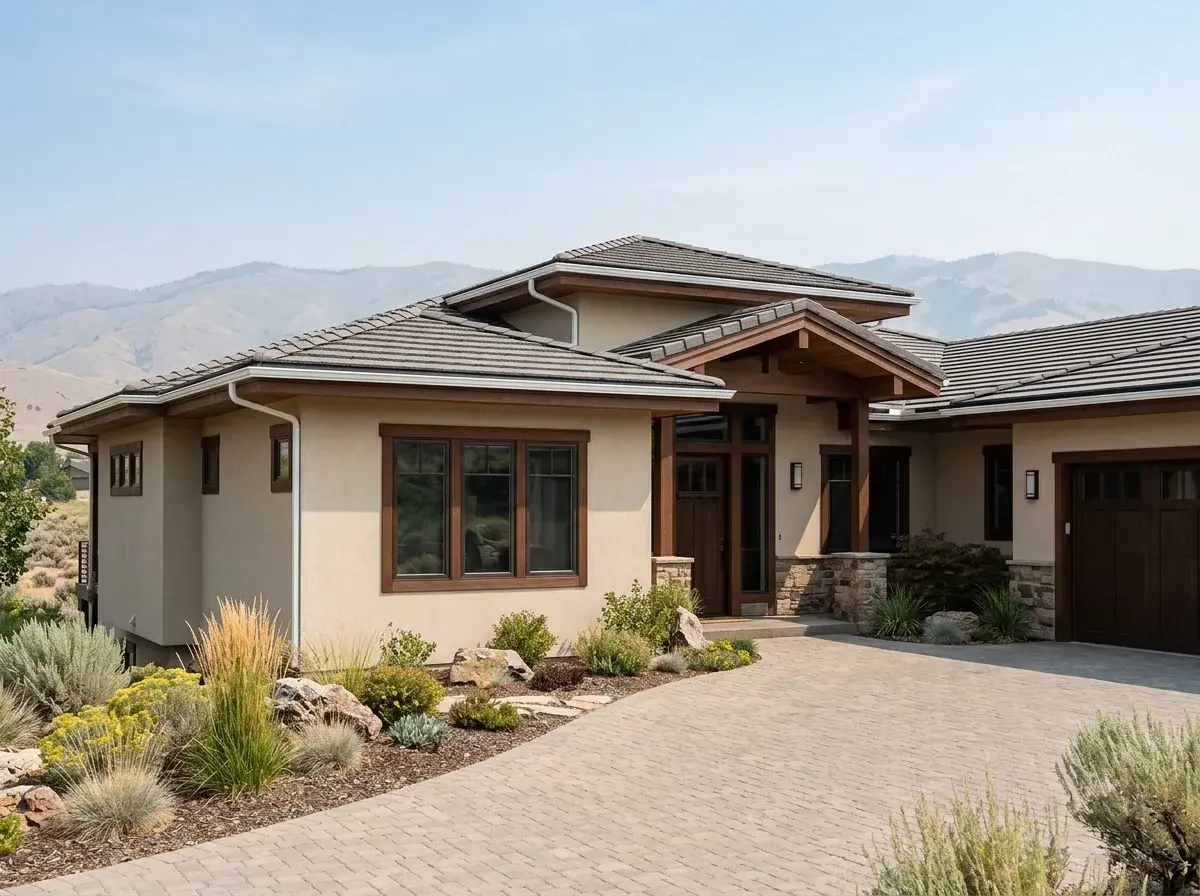
If your home sits in the Boise Foothills, the gutters running along your eaves are one of the most overlooked fire risks on the entire structure. The Insurance Institute for Business & Home Safety (IBHS) estimates that embers — not the wall of flame you picture — are responsible for igniting as many as 90% of the homes and buildings lost in wildfires. A gutter packed with dry pine needles is exactly the kind of fuel a wind-driven ember is looking for, and it sits inches from your roof deck and eaves.
Here's the part most Treasure Valley homeowners miss: the fire doesn't have to reach your street. Embers travel. The National Wildfire Coordinating Group models spotting distances of roughly a mile or more ahead of an active crown fire in western conifers, and NIST has documented embers carried several miles downwind to ignite structures far from the flame front. A foothills fire two ridges over can drop burning debris into your gutters while the sky still looks clear.
Section
Why are Boise Foothills homes a wildfire risk?
The Foothills are part of what fire agencies call the wildland-urban interface — the WUI — where houses meet unmanaged grass, brush, and conifer. It's the fastest-growing land-use category in the country. A 2025 USDA Forest Service study found the U.S. WUI grew 46% between 1990 and 2020, from 30 million to 44 million houses, and now covers roughly a third of all homes in the continental U.S. Idaho is squarely in that trend.
This isn't abstract for our area. Citing FEMA data, the Idaho State Bar notes that somewhere between 30% and 40% of Idaho houses sit in the WUI, and the City of Boise has carried a dedicated wildland-urban interface code (Boise City Code §5-12-46) for years, with Ada County maintaining its own (§8-3B-1). In 2024, Idaho burned roughly 826,000 acres across more than 1,400 wildfires — the most since 2012, according to the National Interagency Fire Center. And the NIFC, the command center for the entire nation's wildfire response, is headquartered right here in Boise. We don't live next to fire country. We live in it.
Section
How do embers ignite a home through the gutters?
The pathway is simple and well-documented. FEMA's U.S. Fire Administration lays it out as a chain: a wind-driven ember lands in a gutter full of dry debris, the debris smolders and then flames, and the fire moves directly into the roof edge, fascia, and eaves — the most vulnerable seam on the building. From there it's inside. Clearing and covering gutters is on every federal and state home-hardening checklist for exactly this reason.
We saw this logic play out on a Highlands home above Hill Road two summers ago. The owners called us after a red-flag week, spooked because a grass fire had jumped a greenbelt a mile south. Their gutters hadn't been touched in three seasons — a solid inch of compacted ponderosa needles, bone dry, running the full length of a south-facing eave. That's not a clog. That's a fuse laid along the most flammable part of the house. We cleaned it out, resealed the system, and installed noncombustible micro-mesh that week. The fire never came, but the point is they'd been carrying that risk for years without knowing it.
Section
What makes a gutter guard “ember-resistant”?
Two things: the material has to be noncombustible, and the mesh has to be fine enough to physically block embers and the debris they feed on. Santa Rosa Fire Department's home-hardening guidance — built on the same California Building Code Chapter 7A standard that drives wildfire construction nationwide — calls for noncombustible, corrosion-resistant metal mesh with openings no larger than 1/8 inch. Chapter 7A goes further and requires that gutters and downspouts themselves be noncombustible and fitted with a means to keep debris out.
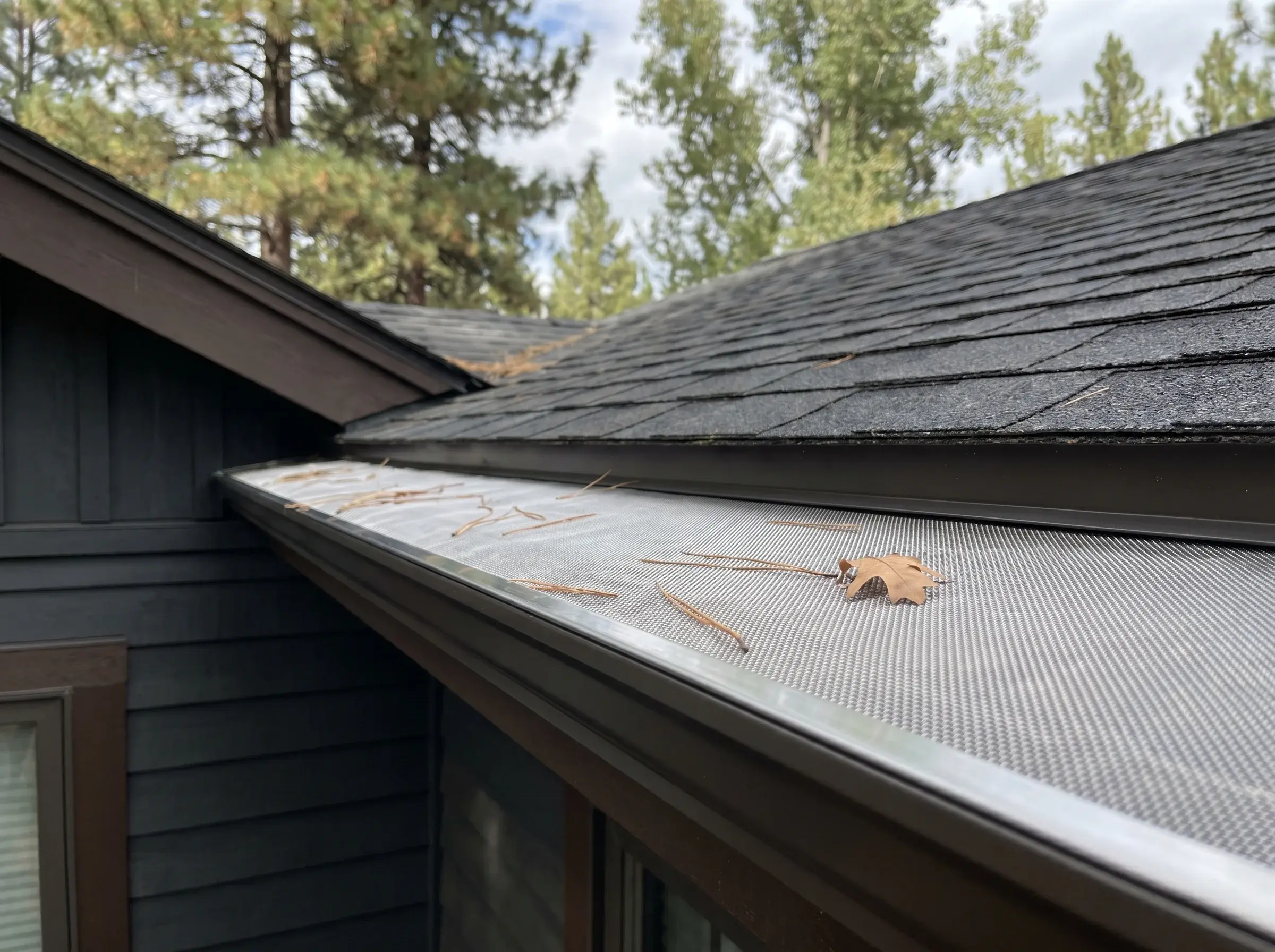
That standard rules out a whole shelf of products. Vinyl and plastic screens aren't noncombustible. Foam and brush inserts are fuel, not protection — they hold debris and burn. What's left is metal: corrosion-resistant steel or aluminum micro-mesh, mounted tight, with the gutter cleaned underneath first. It's the same stainless micro-mesh we already recommend for pine-needle country in the Foothills, which means on most of these homes, the fire-hardening guard and the pine-needle guard are the same product doing two jobs.
| Guard type | Noncombustible? | Blocks embers + debris? | WUI verdict |
|---|---|---|---|
| Stainless steel micro-mesh | Yes | Yes — 1/8" or finer weave | Recommended |
| Aluminum micro-mesh | Yes | Yes, if mesh is fine enough | Acceptable; confirm weave + frame |
| Perforated aluminum screen | Yes (metal) | Partial — large holes pass embers/needles | Weak — gaps defeat the purpose |
| Vinyl / plastic screen | No | No | Avoid — not code-compliant in WUI |
| Foam or brush inserts | No | No — holds debris | Avoid — adds fuel |
Section
Does my Boise neighborhood actually need this?
If you can see unmanaged grass, brush, or conifer from your property line, the answer is almost certainly yes. The clearest-cut zones in our service area:
- Boise Foothills — everything north of Hill Road, the Highlands, Hulls Gulch corridor, Quail Hollow, and the bench-top streets that back directly onto open Foothills terrain. Pine load and fire exposure together.
- Hidden Springs — a master-planned community built into foothill grassland and ponderosa. High WUI exposure by design.
- Eagle Foothills and the upper Eagle benches — fast-growing, brush-and-conifer interface, much of it newer construction on larger lots that abut open land.
- Star and Middleton at elevation — rural-residential parcels where homes sit among grass and scattered conifer rather than inside dense subdivisions.
- Mountain Home's foothill edge — sparse canopy but heavy grass-and-sage fuel, and a long fire season at the desert margin.
Want this handled by a local crew?
Free on-site estimate across the Treasure Valley — call or send a few details and we'll get back the same day.
Section
Gutter guards are one piece — what's the full defensible-space picture?
Ember-resistant guards protect a single vulnerable seam. They don't replace defensible space, which is the managed buffer between your house and the fuel around it. Idaho Firewise breaks it into three zones, and the gutters live at the boundary of the most critical one.
| Zone | Distance from home | What it means for you |
|---|---|---|
| Immediate | 0–5 ft | Noncombustible — no bark mulch, no wood fences touching the house, clean gutters, ember-resistant vents and guards. The zone that saves homes. |
| Intermediate | 5–30 ft | Break up fuels: spaced plantings, gravel paths, trimmed limbs, nothing that carries fire toward the house. |
| Extended | 30–100 ft | Thin and prune; reduce the fuel that feeds an approaching fire. Idaho Firewise recommends 100 ft minimum on flat ground, up to 200 ft or more on the slopes most Foothills homes sit on. |
Clean, covered gutters are a Zone 1 item — the highest-priority five feet. If you do nothing else this season, get the immediate zone right.
Section
What ember-resistant gutter guards don't do
- They don't make a home fireproof. Embers also enter through attic and crawlspace vents, under-eave gaps, and against combustible siding and decks. If your deck is wood, Valley Decks covers ignition-resistant decking for Foothills lots, including the boards and skirting Boise's wildfire overlay calls for. Guards are one layer in a system.
- They don't eliminate maintenance. Fine debris and pine duff still collect on top of the mesh — that surface layer is itself fuel. An annual clean-off, especially before fire season, is still required.
- They don't fix a roof shedding granules or a gutter full of old debris. Guards installed over an existing clog trap that fuel underneath where you can't reach it. Every install starts with a clean-out and reseal.
- They don't substitute for a Class A roof, ember-resistant vents, and the 0–5 ft noncombustible zone. Hardening is cumulative.
Section
How does this affect home insurance and resale?
Home-hardening is moving from optional to expected, and insurers are paying attention. IBHS runs a Wildfire Prepared Home designation with two tiers — a Base level covering the roof, the 5-foot noncombustible zone, and ember-resistant details, and a Plus level that specifically adds covering gutters and enclosing eaves. In states with active wildfire-insurance pressure, carriers have begun offering premium credits for that designation. Idaho isn't California, but the direction is clear: documented mitigation is becoming a factor in coverage and in what buyers expect from a foothills home.
We won't quote a specific discount, because that depends on your carrier and policy — ask them directly. What we can tell you is that a clean, metal-guarded gutter system is a visible, photographable mitigation step that shows up well in an insurance inspection and in a listing. If you want to run the cost before scheduling, our cost calculator at /cost-calculator gives a ranged estimate for guard installation across the Treasure Valley.
Section
How we install ember-resistant guards on Foothills homes
- Clean and reseal first — every gutter is hand-cleaned of needles and duff and the miters and end caps resealed before any guard goes on. No covering a clog.
- Noncombustible metal micro-mesh only — corrosion-resistant steel or aluminum mesh at a weave that blocks embers and ponderosa needles alike. No vinyl, foam, or brush in a WUI zone.
- Positive attachment on both edges — clip-in to the gutter lip or manufacturer-approved under-shingle mounting, never floating loose where wind or fire can lift it.
- Downspouts flushed and confirmed flowing — debris already in the vertical runs comes out during install.
- License on the estimate — RCE-6681702 appears on every written quote, and we'll walk your defensible-space Zone 1 with you, not just sell you mesh.
Section
Sources
- IBHS embers up-to-90% (PR Newswire press release, 2019-03-12) — https://www.prnewswire.com/news-releases/embers-cause-up-to-90-of-home--business-ignitions-during-wildfire-events-300811068.html
- FEMA/USFA blog: Protecting Structures from Wildfire Embers (ember->gutter->roof pathway) — https://www.usfa.fema.gov/blog/protecting-structures-from-wildfire-embers-and-fire-exposures/
- Santa Rosa Fire Department home hardening (1/8-inch noncombustible metal mesh) — https://www.srcity.org/m/newsflash/Home/Detail/2770?arc=9698
- Idaho Firewise defensible space zones (Zone 1 0-5ft, Zone 2 5-30ft, Zone 3 30-100+ft) — https://idahofirewise.org/firewise-landscapes/
- NIFC Wildfire Statistics (Total Wildland Fires and Acres 1983-2025) — https://www.nifc.gov/fire-information/statistics/wildfires
FAQ
Common questions on this topic.
Do gutter guards really make a difference in a wildfire?
What kind of gutter guard is fire-rated for the Boise Foothills?
Is my Boise or Eagle home in the wildland-urban interface?
Do ember-resistant guards still need cleaning?
Will metal gutter guards lower my home insurance?
Can the same guard handle both pine needles and embers?
About the author
Mark
Owner· Licensed Idaho Contractor RCE-6681702
Mark owns Boise Gutter Guards, a licensed Idaho contractor (RCE-6681702) serving Boise, Meridian, Eagle, Nampa, Caldwell, Kuna, Star, and Garden City. He started the company after seeing too many Treasure Valley homeowners get sold under-sized gutters, nailed-on hangers, and silicone-sealed seams that fail in the first hard freeze. Every estimate is done in person, every install is backed in writing, and every customer gets a job-site walkthrough before the crew leaves.