Two of the most common questions we get from Treasure Valley homeowners shopping gutter guards are some version of the same thing: should I get a hooded reverse-curve cover like Gutter Helmet, or a stainless micro-mesh screen? They're different categories that solve the debris problem in different ways, and the right answer depends heavily on what's dropping into your gutters and what your winters do.
A quick note on fairness before we get into it. "Gutter Helmet" is a specific brand inside the broader reverse-curve / surface-tension category, so we'll compare the categories — hooded reverse-curve versus micro-mesh — and attribute any brand-specific claim to its source rather than treating one company's marketing as a fact about every product. We install micro-mesh, so you're reading a contractor with a stated preference; we'll show our work and flag where the loudest pro/con claims come from companies selling one type or the other.
Section
How does a reverse-curve (hooded) guard work?
A reverse-curve guard — the category Gutter Helmet sits in — is a solid, curved cover, usually aluminum, that caps the gutter and leaves a narrow slot or aperture along the front edge. The principle is surface tension: water clings to the rounded "nose" and follows the convex curve down and back through the slot into the gutter (the same Coanda effect that makes water cling to the back of a spoon), while leaves and larger debris ride over the curve and fall off the front to the ground. Gutter Helmet markets a textured, ribbed aluminum surface and reinforced aluminum-alloy brackets, and states on its own site that the system resists clogging and handles downpours better than mesh — that's a vendor claim, attributed here to Gutter Helmet, not an independent finding.
The appeal is real: a solid hood resists large-debris buildup, and surface tension does a good job pulling ordinary rain off a roof carpeted in leaves. The category's well-documented weak spots show up in two situations — very heavy rain and very fine debris — which we'll get to.
Section
How does a micro-mesh guard work?
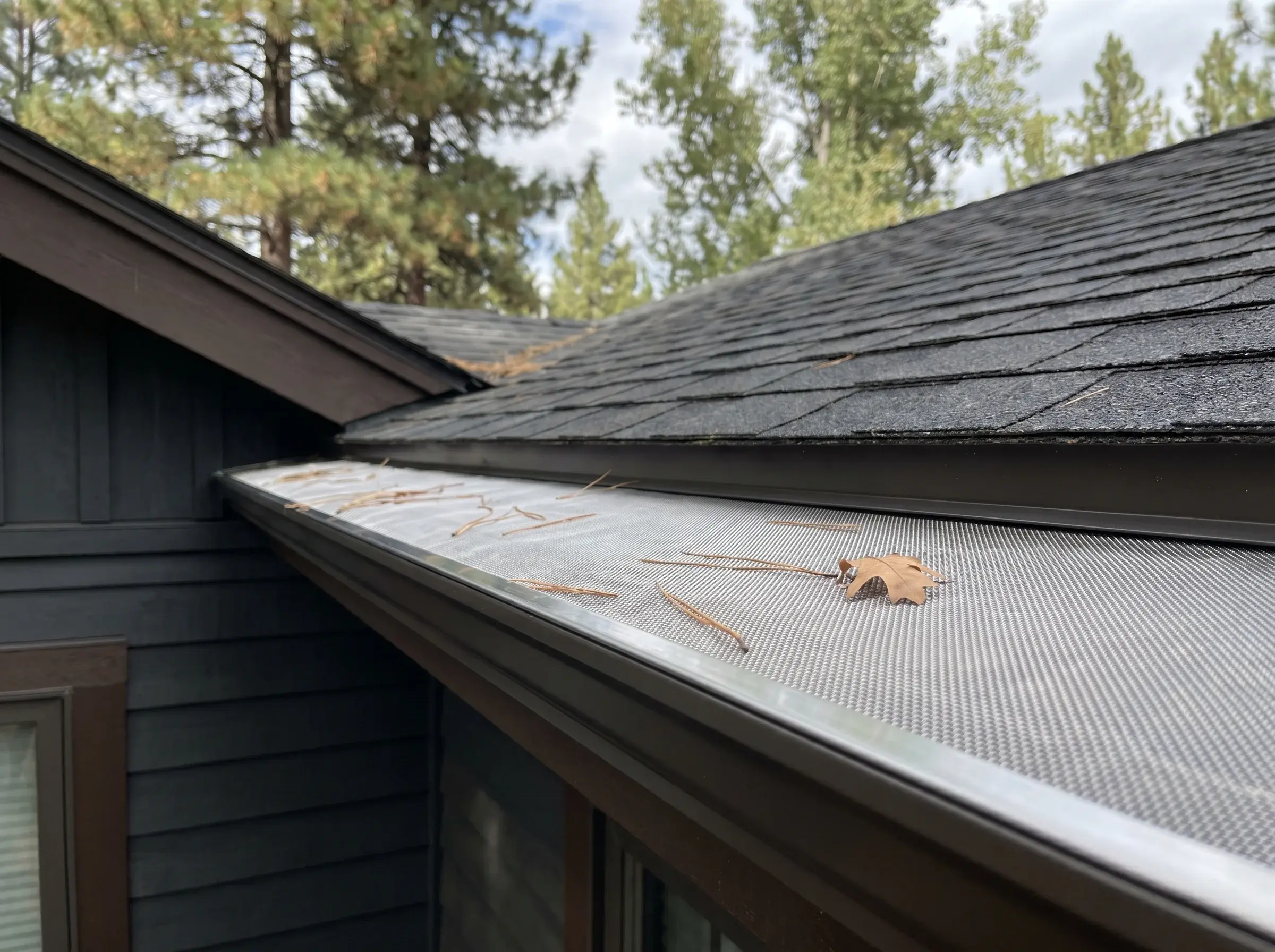
A micro-mesh guard is a fine stainless-steel (sometimes aluminum) screen, usually on a metal or PVC frame, that lies across the top of the gutter. Water passes through tiny openings — sources cite a broad range, roughly 50 to 400 microns depending on the product — while debris stays on top of the mesh to dry out and blow or slide off. The whole strategy is filtration rather than diversion: instead of carrying water around a hood, it lets water through a screen tight enough to exclude fine material.
Because the openings can be smaller than a pine needle is thick — Bob Vila's testing cites needles around 75 microns against mesh openings as fine as 50 — a good micro-mesh blocks the exact debris that gives hooded guards trouble. Stainless mesh also resists rust, and multiple sources cite roughly a 20-year lifespan for stainless micro-mesh. The cost is real, though: per an Angi figure surfaced in search, materials run about $1–$10 per linear foot with professional installs around $650–$2,400 and up, depending on the home.
Section
What are the pros and cons of reverse-curve guards?
- Pro — sheds leaves and large debris well. The solid hood and surface-tension design carry ordinary rain in while leaves ride off the front.
- Pro — solid cover resists large-debris buildup on top of the gutter, with no open screen surface for big material to mat into.
- Con — "overshoot" / waterfall effect in heavy rain. When water volume exceeds what surface tension can pull through the slot, momentum carries it past the nose and it spills to the ground (reported across multiple industry sources, some of them mesh vendors).
- Con — fine debris gets through. Shingle grit, roof sand, and small pine needles can cling to the water flow and ride through the front slot into the gutter; pine needles and seed tassels are commonly cited as problems for reverse-curve designs.
- Con — cold-climate freezing. Several sources state the nose/aperture can freeze over in freezing conditions, blocking the slot and contributing to ice-dam formation; some rate micro-mesh better than reverse-curve in cold zones. Treat this as industry/vendor-reported, not independently tested here.
Want this handled by a local crew?
Free on-site estimate across the Treasure Valley — call or send a few details and we'll get back the same day.
Section
Micro-mesh guards: honest pros and cons
- Pro — blocks fine debris. Openings fine enough to exclude pine needles, shingle grit, and dirt; Bob Vila's testing found fine mesh "nearly impossible for pine needles to slip through" while still passing water.
- Pro — stainless resists rust, with roughly a 20-year lifespan commonly cited for stainless micro-mesh.
- Pro — cold-climate edge (vendor-reported). Some industry sources say micro-mesh sheds snowmelt and avoids the solid ice block that can form on hooded designs. We flag this as a vendor/industry claim, not independently verified.
- Con — needs periodic surface clean-off. Fine "pine silt" or duff, pollen, and matted debris can build on top and must be brushed, blown, or hosed off; neglected, the mesh can clog and water sheets off it. Bob Vila confirms guards must be periodically brushed; specific cadences quoted around the web vary too much to state as fact.
- Con — thin-gauge products can be damaged by heavy wind/rain, and pine sap can mat needles to the surface (these are partly Gutter Helmet's claims about mesh, attributed, not asserted as neutral fact).
- Con — material and install cost; an Angi figure cites roughly $1–$10/ft materials and $650–$2,400+ installed.
Section
Gutter Helmet (reverse-curve) vs micro-mesh: how do they compare side by side?
| Criteria | Reverse-curve (hooded) | Micro-mesh (stainless) |
|---|---|---|
| How it works | Solid hood; water wraps the nose into a front slot by surface tension | Fine screen; water passes through, debris stays on top |
| Leaves + large debris | Sheds well off the front | Stays on top to dry and blow/slide off |
| Fine debris (pine needles, grit) | Weak — can ride through the slot | Strong — openings can be finer than a needle |
| Heavy-rain behavior | Can overshoot (waterfall) at high volume | Passes through screen; no diversion to overshoot |
| Cold-climate (per industry sources) | Nose/slot can freeze; ice-dam risk cited | Rated better in cold by some sources (vendor-reported) |
| Maintenance | Low on top; fine debris may enter gutter | Periodic top-surface brush/blow-off |
| Lifespan / material | Aluminum hood | Stainless ~20 yr per cited sources |
| Cost (cited) | Brand-dependent; confirm with seller | ~$1–$10/ft materials, ~$650–$2,400+ installed (Angi figure) |
Section
Which is better for Treasure Valley homes?
Here's where the local conditions break the tie. Ponderosa pine and Douglas-fir are common conifers in and around the Boise area, and conifer needles are exactly the fine debris that reverse-curve designs struggle with and micro-mesh is built to block. The tree facts are well-attested; the gutter implication is reasoning from the mechanism — a needle that can ride a reverse-curve water flow through the front slot is the same needle a tight mesh screens out — rather than a measured local test. But it's the same logic that makes pine-needle country the textbook case for fine mesh.
The second factor is winter. The National Weather Service describes Boise as a cold semi-arid climate with roughly 10–15 inches of annual precipitation, big day-to-night temperature swings, and winters that dip below freezing at night while often warming by day — in other words, repeated freeze-thaw cycling at the roofline. Industry sources warn that reverse-curve noses can freeze and feed ice dams in exactly those conditions, while citing micro-mesh as comparatively better in the cold. We can't independently verify the cold-climate comparison, so weigh it as industry-reported — but combined with the needle load, the case for fine mesh in the Treasure Valley is straightforward.
For the deeper pine-needle breakdown, see our guide at /blog/best-gutter-guards-pine-needles-treasure-valley. If you're in the Foothills or another wildland-urban interface zone, the noncombustible-material angle in /blog/ember-resistant-gutter-guards-boise-foothills matters too — and on most of those homes, the same fine stainless mesh does double duty against needles and embers.
FAQ
Common questions on this topic.
Is Gutter Helmet or micro-mesh better for pine needles?
What is a reverse-curve gutter guard and how does it work?
Do hooded gutter guards overflow in heavy rain?
Which gutter guard is better in a freeze-thaw climate like Boise's?
How much do micro-mesh gutter guards cost?
About the author
Mark
Owner· Licensed Idaho Contractor RCE-6681702
Mark owns Boise Gutter Guards, a licensed Idaho contractor (RCE-6681702) serving Boise, Meridian, Eagle, Nampa, Caldwell, Kuna, Star, and Garden City. He started the company after seeing too many Treasure Valley homeowners get sold under-sized gutters, nailed-on hangers, and silicone-sealed seams that fail in the first hard freeze. Every estimate is done in person, every install is backed in writing, and every customer gets a job-site walkthrough before the crew leaves.