
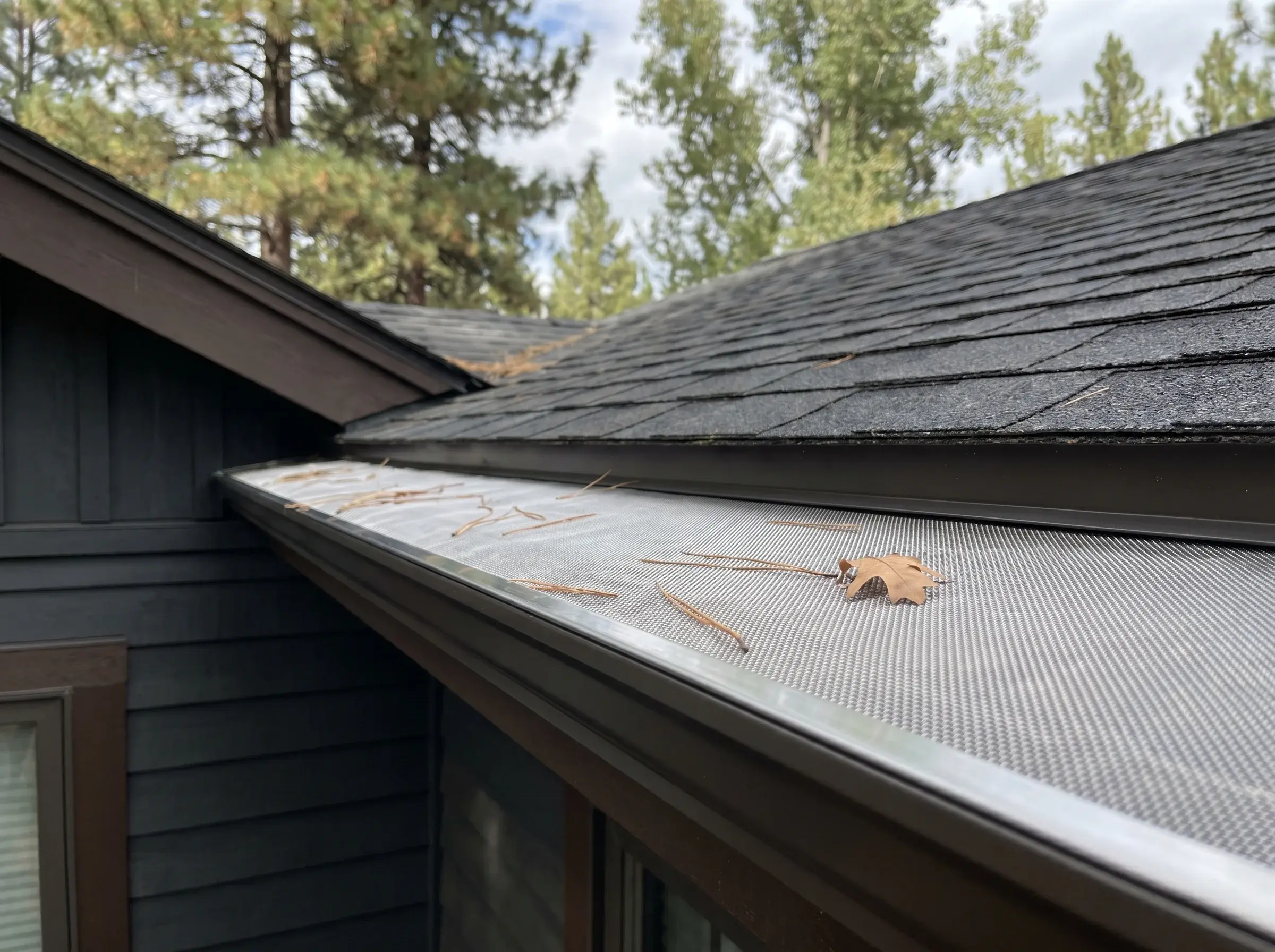
Gutter guards get sold with more marketing spin than almost anything else bolted to a house. Some of it is true, a lot of it is half-true, and a few lines are flat wrong in a way that costs Treasure Valley homeowners money. We install guards for a living and — just as often — pull failed ones off Boise and Meridian eaves, so we hear the same myths on repeat. Here are six of them, debunked, with the honest reality from the ladder.
Two quick boundaries so you read the right post. This isn't the "do gutter guards even work" question — we answer that in full in our honest installer's breakdown, and the short version is yes, the good ones, installed right. And it isn't a product ranking — that's our guide to the best gutter guards for the Treasure Valley. This post is narrower: it kills the specific marketing claims that lead people to buy the wrong thing or skip the right thing. Links to both are at the bottom.
Section
Myth 1: "You'll never clean your gutters again"
This is the headline claim on nearly every gutter guard ad, and it's the one we correct most. No gutter guard makes maintenance disappear. What a good one does is change the job from a clog you have to dig out three times a season into a quick top-surface inspection once a year. Big difference, but not the same as "never."
Here's the physics nobody puts in the ad: debris still lands on top of a guard. On stainless micro-mesh, pine duff, pollen, and shingle grit collect on the screen surface. Most of it dries and blows or rinses off — that's the whole design — but in a heavy pine year a film of fine duff can build up and slow the mesh until someone brushes it off. In the Boise Foothills and Hidden Springs, where ponderosa drop is relentless, we tell homeowners to plan on one late-fall brush-and-inspect, usually after the needle drop finishes. That's it. Compared to the bare-gutter homes around them climbing a ladder every few weeks in fall, it's a massive reduction. It's just not zero.
Section
Myth 2: "All gutter guards are basically the same"
This one usually comes from homeowners who got burned by a cheap guard and now assume the whole category is junk. The opposite is true: the performance spread between guard types is enormous. This isn't a small "you get what you pay for" gap. It's the difference between a guard that solves the clog problem and one that becomes the clog problem.
There are five real categories — stainless micro-mesh, perforated metal and screen guards, surface-tension reverse-curve hoods, foam inserts, and brush inserts — and they behave nothing alike under Idaho debris. Tight stainless micro-mesh stops a ponderosa needle cold because the needle physically can't thread the weave. A coarse perforated screen lets that same needle slide tip-first through the holes and pile up underneath, where it's harder to reach than a bare gutter. Foam lets needles embed in the surface; brush inserts catch them in the bristles and never let go. Same yard, same storm, four completely different outcomes. Which one is right for your roof depends on your trees — we rank them all for Treasure Valley conditions in our best-guards guide.
Section
Myth 3: "Gutter guards cause ice dams in Idaho winters"
This one is nuanced, and both the scare version and the dismissive version get it wrong. The scare version says guards cause ice dams. The marketing version says guards prevent them. Neither is honest. Here's the real mechanism: a true ice dam forms when heat escaping your attic melts snow on the upper roof, the meltwater runs down to the cold eave, and it refreezes there. That's an insulation and ventilation problem on the roof above the gutter. No gutter guard creates that heat loss, and no gutter guard fixes it.
Where the nuance lives is the guard type. A clean gutter with stainless micro-mesh keeps draining meltwater during a thaw, which actually helps with the secondary ice that builds when a clogged gutter backs up and freezes at the eave. But solid reverse-curve hoods are a different story — several industry sources note the curved nose and front slot can ice over through repeated freeze-thaw, and the Treasure Valley runs roof snow through dozens of those cycles a winter. So a hooded guard can contribute to ice at the eave in our climate, while a stainless mesh generally doesn't. We treat the freezing claim as industry-reported, not something we've lab-tested ourselves, but it lines up with what we see pulling iced-up hoods off houses in February.
Want this handled by a local crew?
Free on-site estimate across the Treasure Valley — call or send a few details and we'll get back the same day.
Section
Myth 4: "A DIY guard works as well as a professional install"
The box-store guards aren't all garbage — some snap-in screens are fine on a low, simple, deciduous-only roof you can safely reach. But the claim that a weekend DIY install performs like a professional one ignores where guards actually fail. It's almost never the screen material. It's the install.
A perfect guard installed wrong fails as fast as a cheap one. The details that separate a 20-year system from a one-season callback are boring and non-negotiable: the existing gutter has to be hand-cleaned and the miters and end caps resealed before anything goes on top, or you've sealed a clog in where you can't reach it. Hidden hangers have to be reinforced for the added weight of the guard plus surface debris, or the gutter sags within a season. Guards have to be cut to length on site so corners and outlets don't leave needle-funnels at every joint — pre-cut sections almost always do. And downspouts have to be flushed during the install, because the mesh keeps new debris out but can't push out a clog already sitting in the elbow. Most DIY jobs skip every one of those steps because the box doesn't mention them.
Section
Myth 5: "Gutter guards void your roof warranty"
This one floats around in both directions — some installers wave it off entirely, and some homeowners are scared off guards because they heard it could void their roof warranty. The honest answer is: it depends on how the guard is mounted and what your specific shingle warranty says, and we're not going to make a blanket legal promise either way. What we can tell you is the part that actually matters.
The risk, when there is one, comes from guards that are installed by lifting and tucking under the first course of shingles, or worse, fastened through the roof deck. Some shingle manufacturers have language about anything inserted under the shingles. The way to avoid the whole question is a mounting method that doesn't disturb the roofing — clipping to the front lip of the gutter or to the fascia, using manufacturer-approved methods, rather than going under the shingles or nailing through the deck. That's how we prefer to mount when the roof allows it. Don't take a sales rep's word for it on your warranty, and don't take ours as legal advice: ask your roofer, read your shingle warranty, and get any warranty-safe install claim in writing before the job.
Section
Myth 6: "Cheap foam or brush inserts are good enough"
They're cheap, you can install them from a ladder in an afternoon, and that's the entire appeal. On a pine-canopy Treasure Valley home, foam and brush inserts are the worst options on the market — and "good enough" is exactly the wrong way to think about them, because they often make the problem worse than having no guard at all.
Foam inserts are triangular blocks you wedge into the gutter so water seeps through and debris sits on top. Under pine, needles embed in the foam surface, drainage dies, and the foam itself breaks down into a tannin-stained sludge that holds the clog in place. Removing it is messier than the clog you were trying to prevent. Brush inserts — oversized bottle-brushes set in the channel — catch leaves but trap pine needles and seed permanently in the bristles, so you replace the whole brush instead of cleaning a gutter. In our conditions both are a one-to-three-season product. They're a price decision, not a performance one, and the price catches up with you fast.
Section
How to price guards without the myths
Once you strip the marketing out, pricing gets simpler. Gutter guards in the Treasure Valley generally run $8–$20 per linear foot, with most micro-mesh installs landing around $12/ft typical — the low-to-high spread depends on gutter height, roof pitch, and whether the existing gutters need cleaning, resealing, or re-hanging first. Stainless micro-mesh sits at the higher end because it's the only type that survives pine; that premium is the point, not a markup. Run your home's footage through our cost calculator at /cost-calculator before you book a single estimate so you can spot an inflated quote on sight.
FAQ
Common questions on this topic.
Do gutter guards really mean you never clean your gutters again?
Are all gutter guards basically the same?
Do gutter guards cause ice dams in Idaho winters?
Is a DIY gutter guard as good as a professional install?
Will gutter guards void my roof warranty?
Are cheap foam or brush gutter guards good enough?
What do gutter guards cost in the Treasure Valley?
About the author
Mark
Owner· Licensed Idaho Contractor RCE-6681702
Mark owns Boise Gutter Guards, a licensed Idaho contractor (RCE-6681702) serving Boise, Meridian, Eagle, Nampa, Caldwell, Kuna, Star, and Garden City. He started the company after seeing too many Treasure Valley homeowners get sold under-sized gutters, nailed-on hangers, and silicone-sealed seams that fail in the first hard freeze. Every estimate is done in person, every install is backed in writing, and every customer gets a job-site walkthrough before the crew leaves.