Pine needles are the single most common gutter clog we pull out of Treasure Valley homes — more than maple leaves, more than cottonwood seed, more than roof grit. Ponderosa pine, lodgepole pine, and Douglas fir all drop year-round, with heavy waves in fall and again in early summer. Any home anywhere near the Boise Foothills, Hidden Springs, the upper Eagle benches, or Mountain Home's foothill edge is dealing with needle load. And almost every off-the-shelf gutter guard fails on them.
Here's the short version: if your yard has pine canopy, stainless steel micro-mesh is the only system that holds up. Aluminum mesh corrodes at the perforations. Plastic screens warp and let needles thread through. Foam inserts turn into a slow-rotting sponge. After fifteen years of cleaning and replacing failed guards on Foothills homes, we install one thing — and we install it the same way every time.
Section
Why pine needles defeat most gutter guard systems
Pine needles are uniquely hostile to gutter protection for three structural reasons. They're long, thin, and straight (which means they slide through almost any perforation oriented the wrong way). They mat together when wet (which means they form a felt-like layer on top of fine mesh that water can't penetrate). And they decompose into a tannin-stained sludge that holds moisture and accelerates corrosion in anything aluminum.
- Perforated aluminum screens — needles thread tip-first through the holes and pile up underneath, creating a debris dam that's harder to clean than the original gutter.
- Plastic and vinyl screens — UV-brittle within 3-5 seasons in Idaho sun; once they crack, every gap becomes a needle-funnel.
- Aluminum micro-mesh — finer weave, but the aluminum frame and mesh corrode where pine tannins sit wet through fall and winter. Lifespan typically half of stainless.
- Foam inserts — the worst option for Foothills homes. Needles embed in the foam surface, water can't drain, and the foam itself decomposes into a sludge that holds the clog in place.
- Brush inserts — needles weave between the bristles and never come out. You end up replacing the brush, not just cleaning it.
Section
What actually works on pine needles
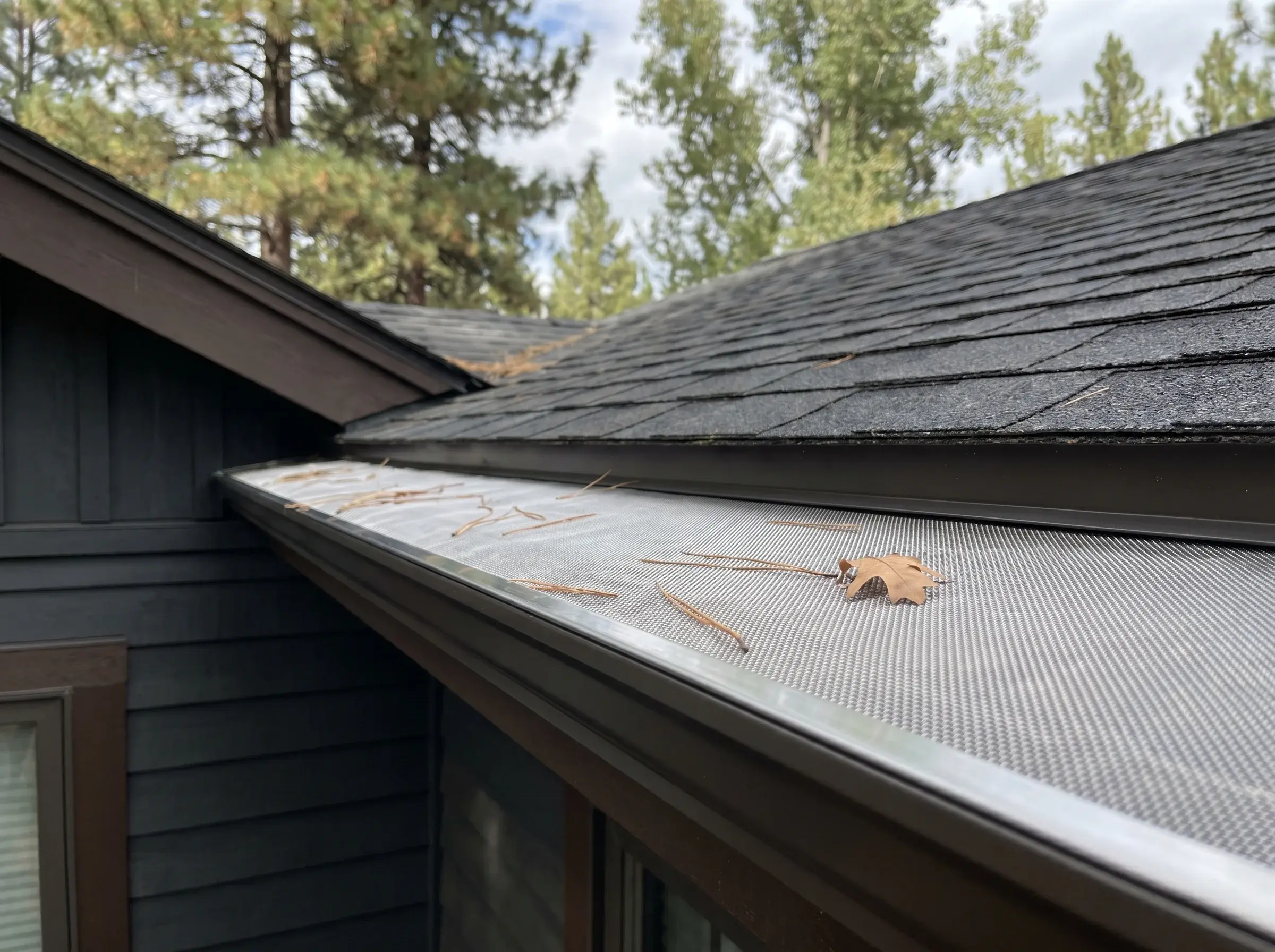
The only system we install on pine-canopy homes is stainless steel micro-mesh. Not aluminum. Not coated. Solid stainless wire woven tight enough that a pine needle physically can't pass through, mounted on a frame that doesn't corrode when tannin-rich water sits on it for a winter.
- Mesh density: a weave fine enough that pine needles, fir needles, and shingle grit all shed off the top rather than thread through. The exact micron rating varies by manufacturer, but the field test is a handful of dry needles dropped on the mesh — they should slide off, not stick.
- Frame material: stainless or anodized aluminum. Bare-aluminum frames will corrode at the fastener points within a few seasons under pine load.
- Mounting method: clip-in to the front lip of the gutter (non-invasive, no shingle disturbance) or under the first course of shingles using manufacturer-approved methods. Never nailed through the roof deck.
- Hidden hanger reinforcement: every 24 inches at minimum on pine-load homes, so the gutter doesn't sag under the added weight of mesh plus the inevitable surface debris.
- Existing-gutter cleaning and reseal before install: guards installed over clogs fail immediately. Every install starts with a hand-clean and butyl reseal of every miter and end cap.
Section
Stainless micro-mesh vs aluminum micro-mesh
Both are sold as 'micro-mesh' and they look nearly identical on the showroom floor. The difference shows up around year five.
| Spec | Stainless micro-mesh | Aluminum micro-mesh |
|---|---|---|
| Corrosion resistance under pine tannins | Excellent — no degradation across full lifespan | Moderate — visible oxidation within 5-7 years |
| Typical lifespan in Foothills install | 20-30+ years | 10-15 years |
| Mesh rigidity under snow load | Holds shape | Can deform under wet snow + debris weight |
| Cost premium over aluminum | Higher upfront | Lower upfront |
| Where it fits | Pine, fir, cottonwood, hail country, any home you plan to keep long-term | Lighter debris loads, valley-floor homes, shorter ownership horizon |
Section
Treasure Valley homes that need this
Not every Treasure Valley home needs stainless. If your only tree cover is a couple of maples and a flowering pear, aluminum micro-mesh or even a quality perforated screen does the job. The homes that absolutely need stainless are the ones with mature evergreen canopy within striking distance of the roof.
- Boise Foothills — every street north of Hill Road has ponderosa pine load. The Highlands, Hulls Gulch corridor, and Quail Hollow all sit under significant canopy.
- Hidden Springs — the entire master-planned community is built around foothill ponderosa pine. Year-round needle drop.
- Eagle Foothills and upper Eagle benches — fir mix replaces some of the pine but the debris profile is just as hostile.
- Star at elevation — properties on the rise above the Boise River corridor pick up mixed pine and Douglas fir.
- Mountain Home foothill edge — sparse canopy overall, but the homes that do sit under pine deal with the same problem as central Foothills homes.
- Older Bench and East End homes with mature white pine in the yard — less common but worth checking before going with a cheaper guard.
Want this handled by a local crew?
Free on-site estimate across the Treasure Valley — call or send a few details and we'll get back the same day.
Section
Installation matters as much as product
A perfect mesh installed wrong fails as fast as a cheap mesh installed right. These are the install details that separate a 20-year guard from a 5-year callback.
- Clip-in vs under-shingle mounting — both work; the choice depends on roof type and manufacturer. What matters is that the guard is positively attached on both sides, not floating loose.
- Hidden hanger reinforcement before guard install — the added weight of guards plus surface debris will sag any gutter that was originally hung on undersized hangers or nails.
- Existing gutter cleaned and resealed first — non-negotiable. Guards over a clogged gutter trap the existing debris under the mesh where you can't reach it.
- Color matching — most manufacturers offer black, bronze, and a few neutrals. Worth the match on visible runs; on back-of-house runs the standard black disappears at distance.
- Cut-to-length on site — pre-cut sections leave gaps at corners and outlets. Every length should be sized and trimmed to the run it's going on.
Section
What guards DON'T solve
- Clogged downspouts that already exist — the mesh keeps new debris out, but it can't push out a clog that's already sitting in the elbow or vertical run. Downspouts get flushed during install.
- Back-pitched gutters that hold standing water — guards on top of a gutter that doesn't drain just hide the problem. Re-pitching has to happen first.
- Ice dams caused by attic heat loss — gutter guards reduce the secondary ice-dam pattern from clogged gutters, but they don't address ice dams driven by warm attics melting roof snow. That's an insulation and ventilation conversation.
- Roof debris from torn shingles — a roof actively shedding granules at high rates will eventually load the top of the mesh. Guards don't replace roof maintenance.
Section
How long do they last in Idaho?
Properly installed stainless micro-mesh on a Foothills home in our climate routinely runs 20 to 30 years in service. The stainless mesh itself doesn't degrade — what eventually fails is the gutter underneath it (typically 25-40 year service life on .032 aluminum) or the mounting clips if they were undersized. Most premium manufacturers offer 20-25 year material warranties with transferable coverage on resale; we add a separate workmanship warranty on top of that. The combined coverage is what makes the math work on the upfront cost — you're buying a system, not a season.
Section
Cost vs ongoing cleaning math
The honest cost comparison: stainless micro-mesh runs more per foot than aluminum mesh or perforated screens, but a Foothills home that requires three cleanings a year without guards pays for the install in a finite number of seasons. The exact break-even depends on your home, but the directional math is straightforward.
| Without guards | With stainless micro-mesh |
|---|---|
| 3 cleanings/year (post-spring, mid-fall, post-fall) | 1 inspection/year |
| Recurring cleaning cost compounds annually | Upfront install + minimal ongoing |
| Risk of missed cleanings → ice dams, fascia rot | Risk dramatically reduced |
| Lifetime cost over 15 years: 45 cleanings | Lifetime cost: install + 15 inspections |
See our breakdown at /resources/gutter-guards-vs-cleaning for the longer-form math, or run your specific numbers through the /cost-calculator before scheduling an on-site quote.
Section
How to vet a guard installer
- Are you a licensed Idaho contractor? The license number should appear on the written estimate.
- What mesh density do you recommend for my specific tree mix, and why? A real installer can answer this without checking with the manufacturer.
- Will you clean and reseal the existing gutter before installing the guards? If the answer is anything other than 'yes', walk away.
- How are the guards secured — clip-in, screw, or under-shingle? All three can work; vague answers can't.
- What's the workmanship warranty length separate from the product warranty?
- Will you do a real debris test (dry pine needles on the mesh), or just water? Water passes through everything; needles don't.
- Bulk-buy clearance products with no installer training are a red flag, regardless of brand name.
FAQ
Common questions on this topic.
Will stainless micro-mesh really stop ponderosa pine needles in the Boise Foothills?
Do I need 6-inch gutters under micro-mesh guards on a Foothills home?
Can I install stainless micro-mesh myself?
How often do micro-mesh guards need maintenance?
What if I have a mix of pine and deciduous trees?
Will guards void my shingle warranty?
About the author
Mark
Owner· Licensed Idaho Contractor RCE-6681702
Mark owns Boise Gutter Guards, a licensed Idaho contractor (RCE-6681702) serving Boise, Meridian, Eagle, Nampa, Caldwell, Kuna, Star, and Garden City. He started the company after seeing too many Treasure Valley homeowners get sold under-sized gutters, nailed-on hangers, and silicone-sealed seams that fail in the first hard freeze. Every estimate is done in person, every install is backed in writing, and every customer gets a job-site walkthrough before the crew leaves.