
Yes — good gutter guards work. The honest version of that answer has two conditions attached: the type has to match your trees, and the install has to be done right. We've spent years pulling failed guards off Treasure Valley homes and installing systems that hold up for decades, and the gap between the two almost never comes down to the brand on the box. It comes down to whether someone matched the product to ponderosa pine versus maple leaves, and whether they cleaned and resealed the gutter before bolting anything on top of it.
So when a Boise or Meridian homeowner asks us "do gutter guards actually work, or is it a gimmick?" — the real answer is: the category works, but half the products sold and a lot of the installs don't. This is the candid, installer's-eye breakdown of which is which, written for Idaho weather specifically.
Section
How do gutter guards work?
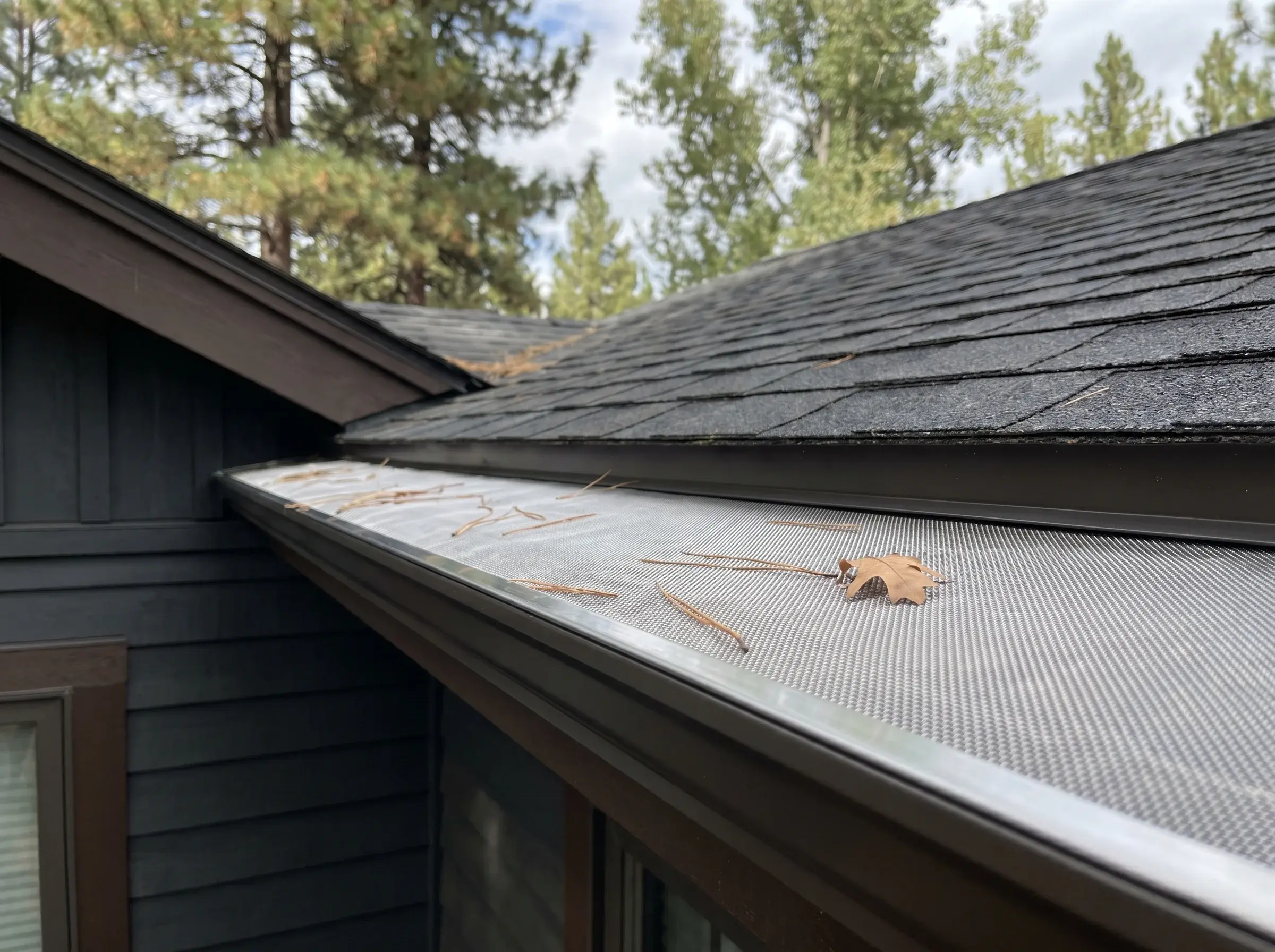
Every gutter guard does one job: let water into the gutter while keeping debris out. The systems differ entirely in how they pull that off, and that's where most of them fall down. Mesh and screen guards cover the gutter opening with a barrier — water passes through the holes, leaves and needles ride over the top and blow or rinse off. The finer the barrier, the more it stops. Surface-tension (reverse-curve) guards use a solid curved nose that water wraps around and follows into a slot, while debris keeps falling straight off the edge. Foam and brush inserts sit inside the gutter and try to block debris by filling the channel.
The mechanism matters because Idaho debris isn't generic "leaves." Ponderosa pine and Douglas fir needles are long, thin, and straight — they thread tip-first through any hole big enough to let them, and they mat into a wet felt on top of anything too fine to clear. Cottonwood seed fluff in the Garden City and Boise River corridor behaves like cotton candy and sticks to rough surfaces. That's why the same guard that works in a Midwest maple yard can fail in the Boise Foothills. The mechanism has to beat the specific debris on your roof.
Section
Do gutter guards really work, or is it marketing?
Both, honestly. The category is real — on the homes we service, properly installed stainless micro-mesh turns a gutter that used to clog three times a season into one that gets a quick fall inspection and nothing else. That's not marketing; that's what shows up when we come back a year later. But the industry also oversells. "Never clean your gutters again" is the line that gets people, and it's not true of any product. Surface debris still collects on top of every guard. The good ones make that debris blow or rinse off instead of clogging the channel underneath; they don't make it vanish.
Here's the distinction that actually predicts whether guards work for you: not "do they work in general," but "does this specific product, installed this specific way, beat the debris coming off my specific roof." An installer who can answer that for your trees is worth more than any national warranty.
Section
Do any gutter guards really work? Ranking the types
When people say "do any gutter guards really work," they've usually been burned by a cheap one. Fair. The performance spread between guard types is enormous — this isn't a small "you get what you pay for" gap, it's a "this one solves the problem and this one becomes the problem" gap.
- Stainless steel micro-mesh — works, and it's the only type we install on pine-canopy homes. Tight stainless weave stops needles and grit, the frame doesn't corrode under pine tannins, and a properly hung system runs 20+ years.
- Aluminum micro-mesh — works for a while. Same idea as stainless but the aluminum oxidizes where wet debris sits, so lifespan is roughly half. Fine on lighter, valley-floor debris loads; risky under heavy pine.
- Perforated aluminum screens — partial. Stops big maple and locust leaves, but pine needles thread straight through the holes and pile up underneath, which is harder to clean than a bare gutter.
- Reverse-curve / surface-tension — works in moderate debris but struggles in heavy rain (water overshoots the nose) and lets fine grit and needles ride the curve right into the gutter. Install angle is everything.
- Foam inserts — the worst option for Idaho. Needles embed in the foam, water can't drain through a saturated block, and the foam rots into a sludge that holds the clog in place.
- Brush (bottle-brush) inserts — needles and seed weave into the bristles and never come out. You end up replacing the brush instead of cleaning a gutter.
Section
Do gutter guards work in heavy rain?
This is where install quality and gutter sizing matter more than the guard itself. Treasure Valley spring and early-summer thunderstorms can dump a lot of water in a short window — May and June in Boise are the stress test. A good micro-mesh guard passes that volume fine as long as the gutter and downspouts under it are sized for the roof. The failure people blame on "guards not working in heavy rain" is usually one of three things: a reverse-curve guard whose nose lets fast water overshoot into the landscaping, a fine mesh that's matted over with surface debris that nobody brushed off, or a 5-inch gutter on a steep roof that was overflowing before the guards ever went on.
On steeper Foothills roofs we often pair micro-mesh with 6-inch gutters and oversized 3×4 downspouts for exactly this reason. The guard isn't the bottleneck — undersized drainage is. If your gutters overflowed in a downpour before guards, they'll overflow after, guard or not. Fix the sizing in the same job.
Want this handled by a local crew?
Free on-site estimate across the Treasure Valley — call or send a few details and we'll get back the same day.
Section
Do gutter guards work with pine needles?
Only one type does: tight-weave stainless micro-mesh. Pine needles are the single most common clog we pull out of Treasure Valley gutters, and they defeat almost everything else — they thread through screens, mat on top of fine aluminum mesh, embed in foam, and weave into brushes. If you're in the Boise Foothills, Hidden Springs, the Eagle Foothills, or anywhere under ponderosa or fir canopy, the guard question is really a stainless-or-don't-bother question. We go deep on this in our guide to the best gutter guards for pine needles in the Treasure Valley — if pine is your debris, read that one.
Section
Do gutter guards work in extreme weather and Idaho winters?
Mostly yes, with one honest caveat. Idaho's freeze-thaw cycles and occasional heavy wet snow are real, and a quality stainless guard handles them — the mesh holds its shape under snow load and the system keeps debris out so the gutter can actually drain meltwater during a thaw. A clogged, unguarded gutter is far more likely to back up and form ice along the eave. So in the freeze-thaw sense, guards help. For scale, NOAA's 1991–2020 normals for the Boise airport show about 108 freezing nights a year but only about 16 days that stay frozen all day, so the melt-and-refreeze cycle runs most of the winter. If sliding snow off a metal or steep roof is your worry, that's a roof snow-retention question, covered in snow guards vs gutter guards.
The caveat: gutter guards do not stop ice dams caused by attic heat loss. That's a different problem. When warm attic air melts snow on the upper roof and it refreezes at the cold eave, no gutter guard fixes it — that's an insulation and ventilation job. Guards reduce the secondary ice-dam pattern that comes from clogged gutters; they don't override the physics of a warm attic. Any installer who promises guards will end your ice dams either doesn't understand the cause or is overselling. We tell Idaho homeowners the truth on that one because it's the most common myth we hear.
Section
When gutter guards are NOT worth it
We'll talk people out of guards more often than you'd expect. The candor is the point — if guards won't pay off on your home, paying for them isn't a win for anybody.
- Almost no tree cover — if your roof catches a little roof grit and the rare windblown leaf, a guard's break-even may be longer than you'll own the house. An occasional cleaning is cheaper.
- Gutters that are about to be replaced — don't bolt premium guards onto a 30-year-old, back-pitched, leaking gutter. Re-pitch and re-hang first, or do both in one job.
- Standing-water gutters — guards on a gutter that doesn't drain just hide the problem. The pitch has to be fixed first or the guard traps stagnant water.
- Ice dams from attic heat — covered above, but worth repeating: that's an attic fix, not a gutter-guard fix.
- Bargain-bin foam or brush as a "solution" — these underperform enough that buying them is often worse than no guard at all, because they create a clog that's harder to clear.
Section
What "installed right" actually means
A perfect guard installed wrong fails as fast as a cheap guard. The install details that separate a 20-year system from a one-season callback are boring and non-negotiable:
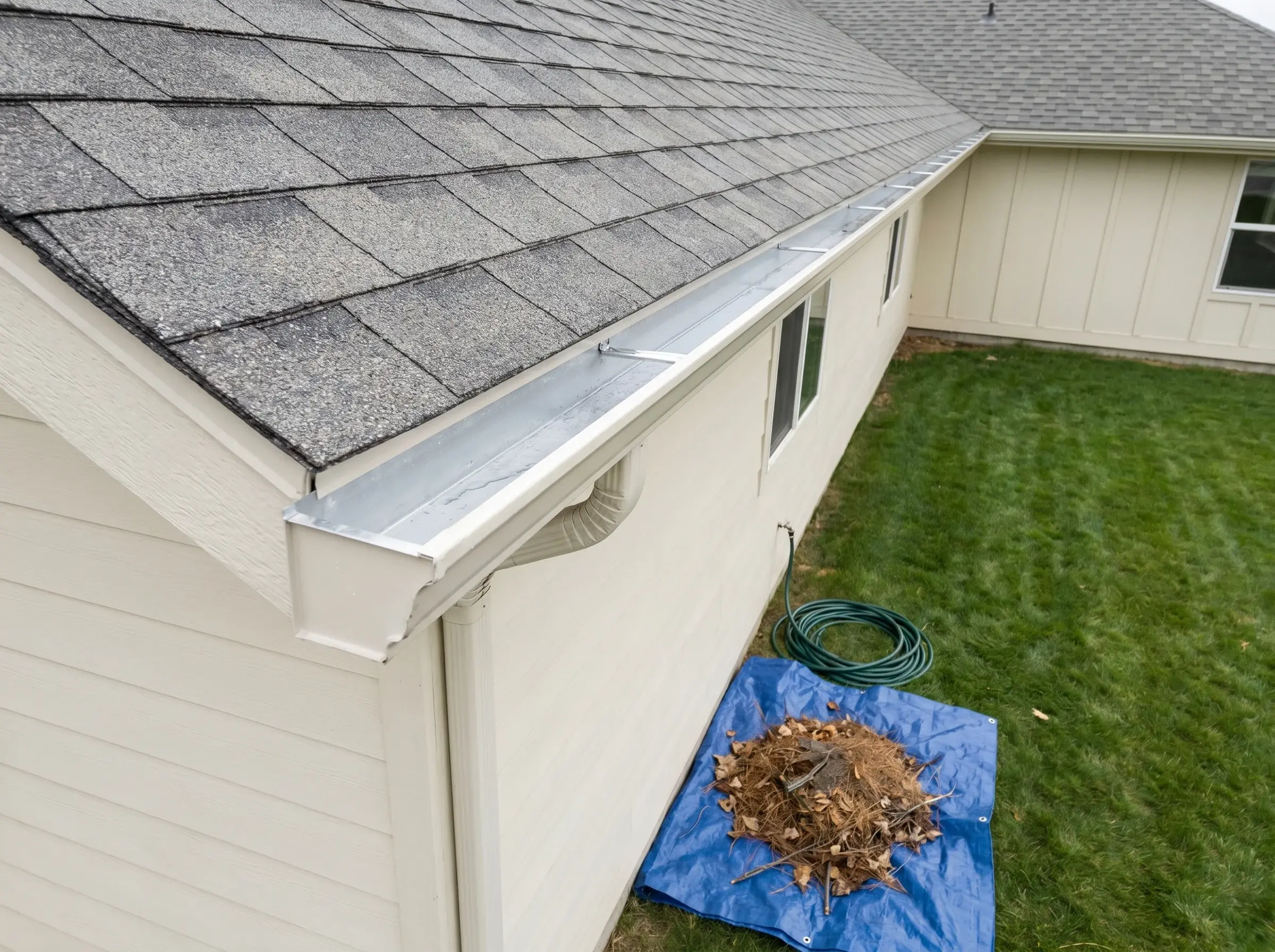
- The existing gutter is hand-cleaned and the miters and end caps are resealed before any guard goes on. Guards over a clog trap that debris where you can't reach it.
- Hidden hangers are reinforced for the added weight of the guard plus surface debris, so the gutter doesn't sag within a season.
- Guards are cut to length on site so corners and outlets don't leave gaps. Pre-cut sections leave needle-funnels at every joint.
- Mounting is positive on both sides — clipped to the front lip or tucked under the first shingle course using manufacturer-approved methods, never floating loose or nailed through the roof deck.
- Downspouts are flushed during install. The mesh keeps new debris out; it can't push out a clog already sitting in the elbow.
That's the same gutter guard installation process we run on every job, and it's why our guards still work years later. If a quote skips the clean-and-reseal step or can't tell you how the guards are secured, that's the quote to walk away from. Want a clean baseline first? A one-time gutter cleaning before guards is cheap insurance on the install.
Section
What do gutter guards cost — and do they pay off?
Most quality gutter guard installs in the Treasure Valley run $8–$20 per linear foot, with around $12 typical, depending on the guard type, the gutter underneath, and how much hanger and reseal work the existing system needs. Stainless micro-mesh sits at the higher end; that's the premium you pay for the only type that survives pine. The payoff math is simple on a debris-heavy home: a Foothills house that needs three cleanings a year is paying for the install in a finite number of seasons, and avoiding one missed cleaning that leads to fascia rot can cover the difference by itself. On a low-debris valley lot, the math is slower and sometimes doesn't pencil out — which is the honest answer.
Run your own roof through the /cost-calculator to see a real range for your linear footage and guard type before you book an on-site quote.
FAQ
Common questions on this topic.
Do gutter guards actually work?
Do gutter guards really work in heavy rain?
Do gutter guards work with pine needles?
Do gutter guards work in extreme weather and Idaho winters?
Do any gutter guards really work, or is it all marketing?
How do gutter guards work?
When are gutter guards NOT worth it?
About the author
Mark
Owner· Licensed Idaho Contractor RCE-6681702
Mark owns Boise Gutter Guards, a licensed Idaho contractor (RCE-6681702) serving Boise, Meridian, Eagle, Nampa, Caldwell, Kuna, Star, and Garden City. He started the company after seeing too many Treasure Valley homeowners get sold under-sized gutters, nailed-on hangers, and silicone-sealed seams that fail in the first hard freeze. Every estimate is done in person, every install is backed in writing, and every customer gets a job-site walkthrough before the crew leaves.