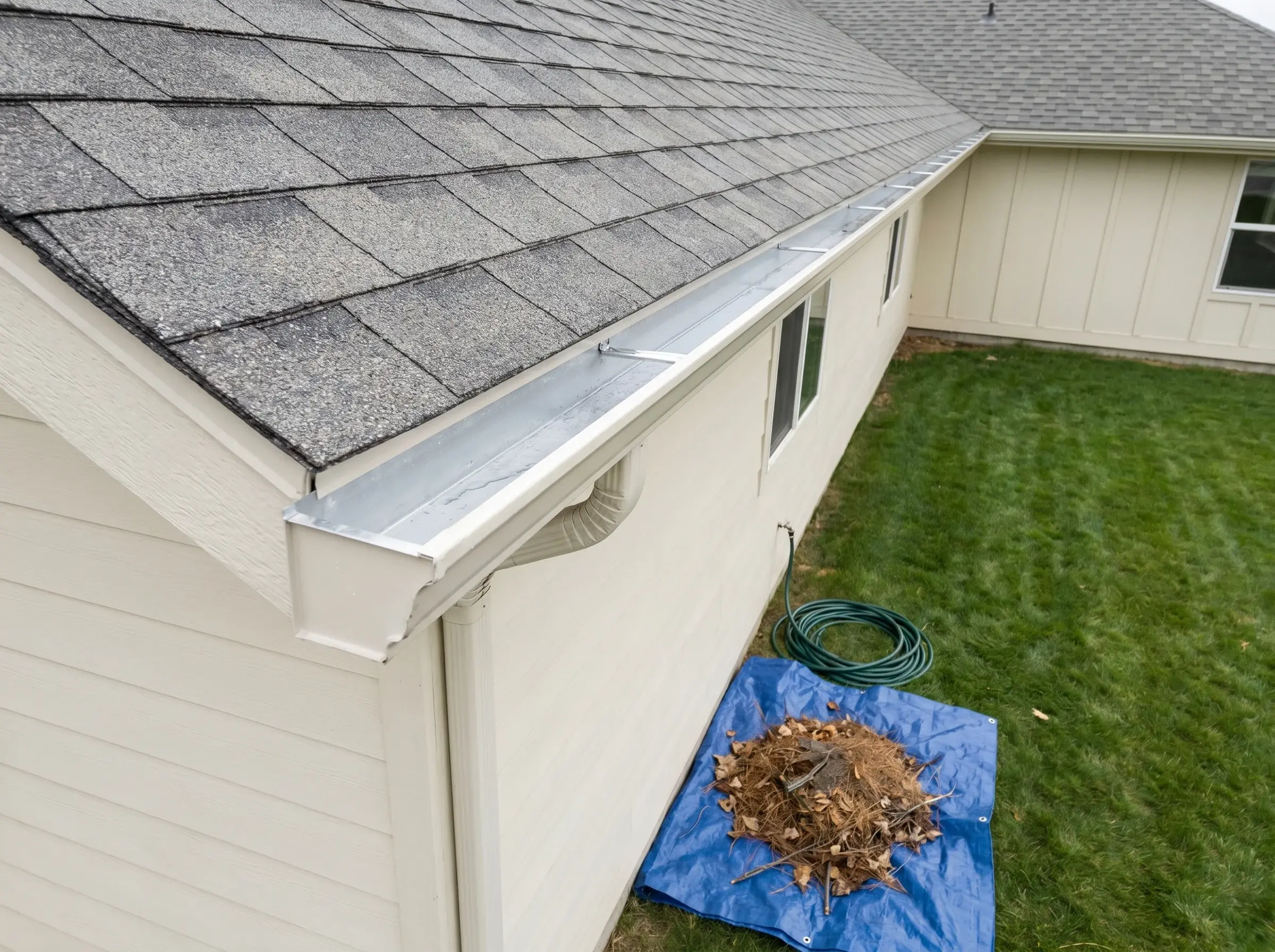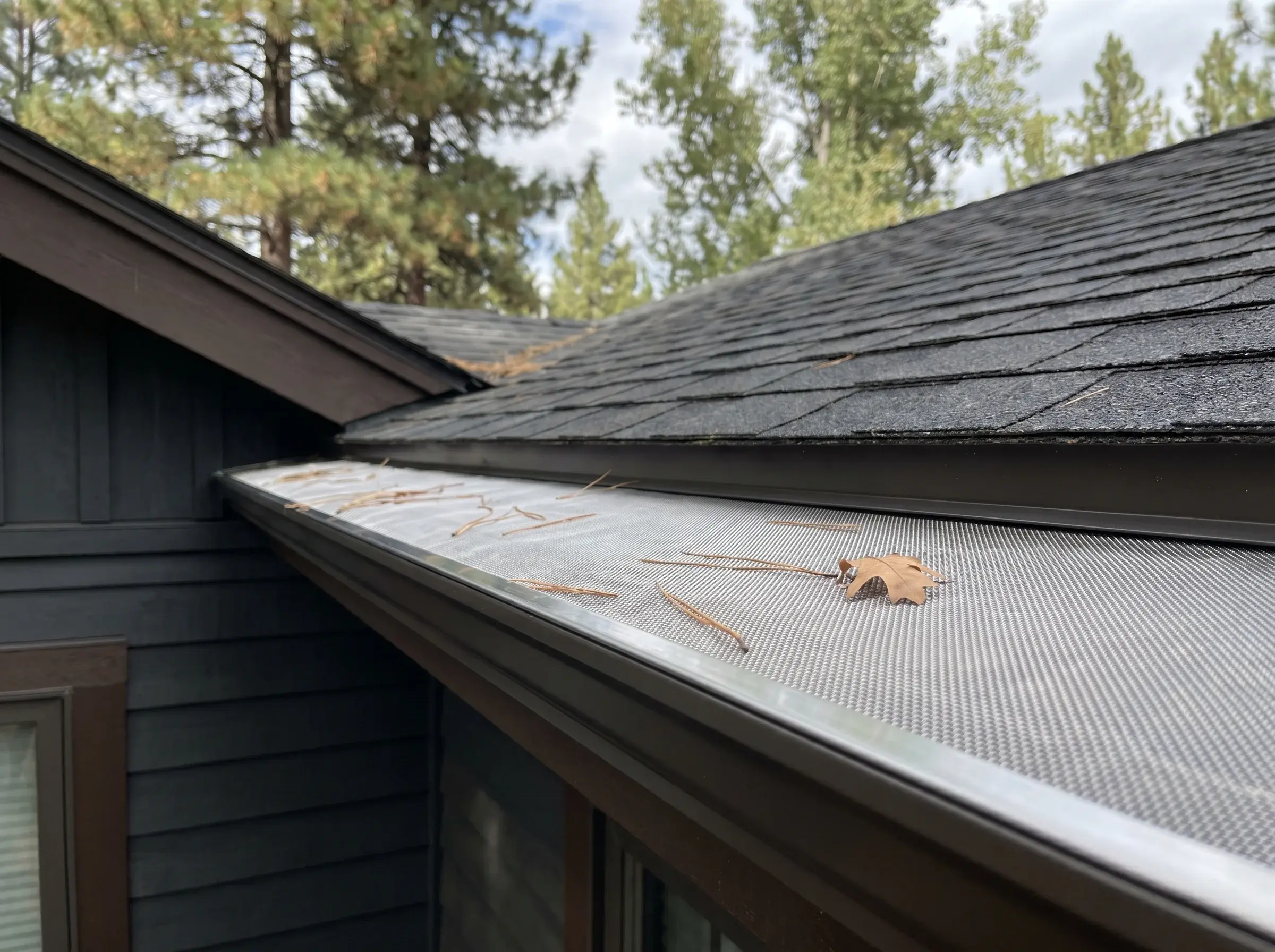

Every gutter clog has a tree behind it. We've cleaned and re-hung gutters across Boise, Garden City, Eagle, Meridian, and the rest of the Treasure Valley for years, and the debris we pull out tells you exactly what's growing in the yard. Some trees are easy — flat leaves you can flush out once a year. Others are gutter killers that mat down, thread through screens, or rot into sludge that holds water against the metal all summer. This is the field guide we wish every homeowner had before they planted, bought, or skipped a cleaning.
We've ranked nine of the worst offenders for Southwest Idaho gutters by how much grief they cause — not by how pretty they are. For each one: what it drops, roughly when, why it's a problem on valley homes specifically, and what to actually do about it. Two of these trees get the short treatment here because we've already written full deep-dives on them, and we link straight to those.
Section
1. Cottonwood — the valley's worst gutter offender
Cottonwood is the tree that makes our phone ring every June. The seed clusters land as fluff, mat down dense when wet, and decompose into a stringy sludge that plugs downspout elbows faster than anything else in the valley. We see the fluff peak from roughly the last week of May into mid-June, heaviest anywhere near the Boise River corridor — Garden City along the Greenbelt, Eagle Island, the river side of Star, and Boise's East End and Warm Springs.
Because cottonwood is its own season, we gave it a full guide instead of cramming it in here. If you're river-adjacent, read the cottonwood deep-dive: it covers the Garden City debris map, the three-cleaning schedule that actually works, and why micro-mesh shrugs cottonwood off. The fix in one line: river-corridor homes need either a disciplined cleaning cadence or stainless micro-mesh — open gutters lose every time.
Section
2. Ponderosa pine and Douglas fir — needles that defeat cheap guards
Pine needles are the single most common debris we pull out of Treasure Valley gutters, edging out even cottonwood. Ponderosa pine, lodgepole, and Douglas fir drop year-round with heavy waves in fall and again in early summer. The needle is long, thin, and straight, so it threads tip-first through perforated screens and mats into a felt layer on coarse mesh that water can't get through. Anything aluminum corrodes under the tannin-rich sludge.
This is a Foothills and bench problem above all — every street north of Hill Road, Hidden Springs, the upper Eagle benches, and Star at elevation. We wrote the full breakdown on which guards survive pine and which fail in three seasons, so we'll keep it short here: the only system we install under pine or fir canopy is solid stainless micro-mesh. Aluminum mesh, foam inserts, and brush inserts all fail on needles.
Section
3. London plane / sycamore — big leaves and shedding bark
London plane (the city's go-to street sycamore) and true sycamore are double trouble. The leaves are large, leathery, and slow to break down, so they blanket a gutter and shed water over the front edge instead of into it. On top of that, sycamores shed bark in plates all season — those curls of bark wedge into downspout elbows and don't flush out the way a soft leaf will. You'll find them on older Boise streets, the North End, and as planted boulevard trees around Meridian and Eagle.
Fix: a fall cleaning is mandatory, and check downspout flow specifically — the bark plates are what plug the outlet. Micro-mesh handles the leaves easily; the bark mostly stays on top of the mesh and rinses or blows clear.
Section
4. Silver maple — helicopters by the thousand
Silver maple is fast-growing, brittle, and everywhere in older valley neighborhoods because builders planted it for quick shade decades ago. It drops two debris loads: the spinning seed pods (the 'helicopters' or samaras) in late spring, and a heavy leaf load in fall. The seed pods are the gutter problem — they settle flat into the bottom of the gutter, sprout in the silt, and we've literally pulled little maple seedlings out of gutters that hadn't been cleaned in two seasons.
Fix: silver maple is a two-cleaning tree on most homes — once after the helicopters drop in late spring, once after leaf fall. Because it sheds twice and grows so fast over the roofline, it's one of the better candidates for guards in the central valley, not just the Foothills.
Section
5. Siberian elm — the messiest tree nobody planted on purpose
Siberian elm seeded itself across the valley decades ago and now grows like a weed in alleys, fence lines, and old yards across Nampa, Caldwell, Garden City, and the Boise Bench. It's a constant shedder: papery seed wafers in spring, small leaves all summer, brittle twigs in every windstorm. The seed wafers are the trap — they're small and light enough to slip through coarse screens and pile into a dense layer that holds water.
Fix: if you've got a Siberian elm hanging over the roof (or your neighbor does), assume year-round debris. Open gutters need a spring and a fall cleaning at minimum, plus a downspout flush after big wind events. Fine stainless mesh is the only guard tight enough to keep the seed wafers out.
Want this handled by a local crew?
Free on-site estimate across the Treasure Valley — call or send a few details and we'll get back the same day.
Section
6. Honey locust and black locust — small leaflets, long pods
Locust is a popular valley street and yard tree because the fine, ferny leaflets cast light shade and seem like they'd be easy on gutters. They're not as bad as cottonwood, but those tiny leaflets are deceptive: they're small enough to wash straight down to the downspout and accumulate at the elbow, and honey locust adds long seed pods in fall that snag across the outlet like a grate. We see plenty in Meridian and Eagle subdivisions and along Boise boulevards.
Fix: locust is usually a one-good-cleaning tree, but the cleaning has to include flushing the downspouts — the leaflets and pods collect down low, not in the gutter trough where you can see them. Guards are optional unless the canopy sits right over the roof.
Section
7. Ash — heavy fall leaf load
Ash was one of the most-planted shade trees in Treasure Valley subdivisions through the 1980s and 90s, so mature ash canopy hangs over a huge share of established Boise, Meridian, and Nampa neighborhoods. The good news: ash leaves are compound but break apart into manageable leaflets and drop in a fairly concentrated window in fall. The bad news is volume — a mature ash can blanket a roof and fill a gutter in a single windy week.
Fix: ash is a textbook one-fall-cleaning tree. Get it done after the leaves are down — usually late October into November here — and you're set for the year. Guards aren't strictly necessary, but they turn an annual chore into a once-every-few-years inspection if you'd rather not be on a ladder.
Section
8. Fruit and flowering trees — blossoms in spring, fruit in fall
Flowering pear, crabapple, cherry, plum, and the valley's many backyard fruit trees punch above their size for gutter mess. They drop a fine carpet of blossom petals in spring that pastes itself into a thin water-blocking film, then small fruit and leaves in fall. The petals are sneaky — they don't look like much, but a wet petal layer over the bottom of a gutter behaves like cottonwood-lite and slows drainage right when spring storms hit.
Fix: a quick spring clear after the blossom drop plus the standard fall cleaning covers most fruit trees. They're small enough that micro-mesh is overkill on a single tree — but if the yard is an orchard or the tree overhangs the eave, guards earn their keep.
Section
9. Oak — late drop and stubborn leaves
Oak is less common in the valley than maple or ash, but mature oaks show up in older Boise neighborhoods like the North End and East End and in some established Eagle and Meridian yards. Oak's quirk is timing: it holds its leaves late and drops them well into late fall and even winter, often after you've already done your 'fall' cleaning. The leaves are thick, curl up, and break down slowly, so they sit in the gutter rather than washing through.
Fix: if you've got oak, push your fall cleaning later — late November or even December — or you'll clean once and then watch the oak fill the gutter back up. Guards handle the leaf, but oak's late drop is the case where even guard owners want one well-timed inspection.
Section
Quick reference: what each tree drops and the fix
| Tree | What it drops | Peak season | The fix |
|---|---|---|---|
| Cottonwood | Sticky seed fluff that mats and rots | Late May–mid June | 2–3 cleanings or stainless micro-mesh |
| Ponderosa pine / Douglas fir | Long needles, year-round | Fall + early summer waves | Stainless micro-mesh only |
| London plane / sycamore | Big leathery leaves + bark plates | Fall (bark all season) | Fall cleaning + downspout flush; mesh works |
| Silver maple | Helicopters then heavy leaves | Late spring + fall | Two cleanings or guards |
| Siberian elm | Papery seed wafers + constant litter | Spring seed, debris all year | Spring + fall cleaning; fine mesh |
| Honey / black locust | Tiny leaflets + seed pods | Fall | One cleaning with downspout flush |
| Ash | Heavy compound-leaf load | Late Oct–Nov | One fall cleaning |
| Fruit / flowering trees | Blossom petals then small fruit | Spring + fall | Spring clear + fall cleaning |
| Oak | Thick slow-rotting leaves, late | Late Nov–Dec | Push fall cleaning later |
Section
Cleaning cadence vs. gutter guards: how to decide
The honest math is simple. If your debris trees are the forgiving kind — ash, locust, a fruit tree or two, an oak you can time around — a scheduled cleaning once or twice a year is the cheaper path and there's no reason to spend on guards. If your roof sits under cottonwood, pine or fir, silver maple, sycamore, or Siberian elm, you're either cleaning two to three times a year forever or installing stainless micro-mesh once and skipping the ladder. For most of those high-load homes, the cleaning bills break even on guards inside a few seasons — and that's before you count the water damage one missed clog can cause.
Whichever way you lean, the on-site visit gives you a written quote for both paths so you can compare real numbers for your roof, your trees, and your gutter length — not a guess off a national average.
FAQ
Common questions on this topic.
What is the worst tree for gutters in the Treasure Valley?
Do I need gutter guards or can I just clean more often?
When should I schedule gutter cleaning based on my trees?
Will gutter guards keep all tree debris out?
Why do my downspouts clog before my gutters look full?
Are there trees that are actually safe for gutters?
About the author
Mark
Owner· Licensed Idaho Contractor RCE-6681702
Mark owns Boise Gutter Guards, a licensed Idaho contractor (RCE-6681702) serving Boise, Meridian, Eagle, Nampa, Caldwell, Kuna, Star, and Garden City. He started the company after seeing too many Treasure Valley homeowners get sold under-sized gutters, nailed-on hangers, and silicone-sealed seams that fail in the first hard freeze. Every estimate is done in person, every install is backed in writing, and every customer gets a job-site walkthrough before the crew leaves.