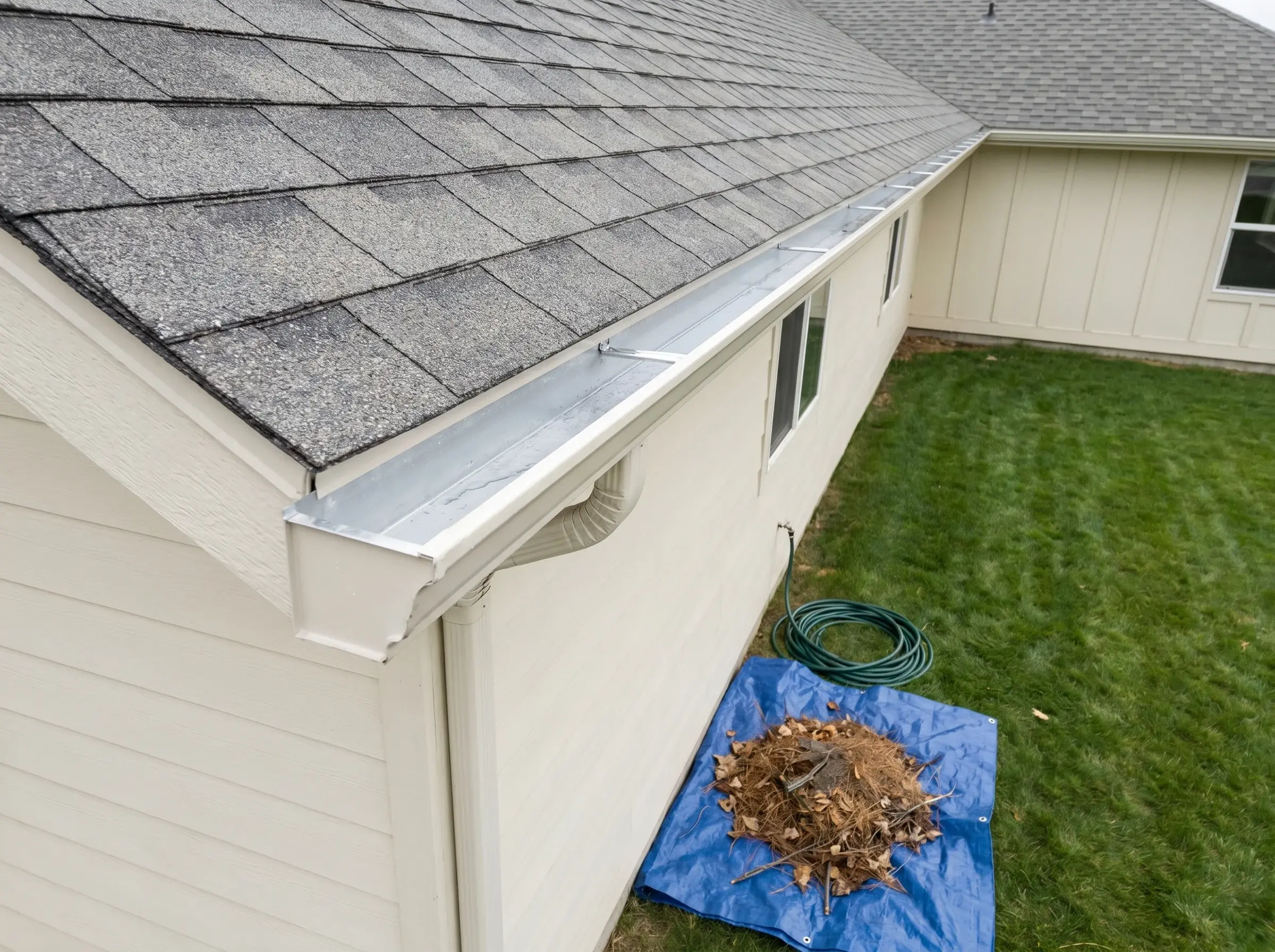

If you live within a few blocks of the Boise Greenbelt or the river itself, you know what's coming. Late May through the first weeks of June, Garden City turns into a cotton-fluff blizzard. The cottonwoods drop their seed clusters in dense, sticky waves that coat lawns, screens, AC condensers, and — most expensively — gutters. By the second week of June, the gutters along Riverside Drive look like someone packed them with insulation. By the first heavy summer thunderstorm, the downspouts are blocked at the elbow and water is sheeting off the corners.
Cottonwood is harder on gutters than fall leaves. The seed cluster is fluffy when it lands, matts down dense when it gets wet, and then decomposes into a stringy sludge that holds water and blocks downspouts faster than maple leaves ever do. Here's the honest survival plan.
Section
Why cottonwood is harder on gutters than leaves
A maple leaf is flat, dries out, and either blows out of an open gutter or sits visibly on top. A cottonwood seed cluster is a tangled mass of fluff and seed that grabs onto everything it touches — shingle grit, twigs, mud, other seed clusters — and packs together into a felt-like mat. When that mat gets wet from the next rain, it doesn't dry out. It sits in the gutter through summer, decomposing into a stringy organic sludge that holds water against the gutter walls and accelerates corrosion. The same mat that's loose and pickable at the start of June is a wet, heavy, glued-down problem by mid-July.
Section
Garden City's specific cottonwood map
Not every Garden City street has the same load. The heaviest cottonwood pressure runs in a band along the Boise River corridor where mature trees line the Greenbelt, with secondary clusters wherever older cottonwoods were left in place as the neighborhood developed.
- Greenbelt-adjacent streets — Riverside Drive and the streets backing the path between 36th and 50th get hit hardest. The mature trees along the Greenbelt drop directly onto roofs and into gutters.
- Plantation — the older neighborhood streets here have mature cottonwoods left from the original tree planting. Heavy load on the homes that sit closest to the river side.
- Live-Work-Create District near Riverside Drive — mixed-use buildings with flat-roof scuppers and parapet drains pick up cottonwood the same way pitched-roof homes do, sometimes worse because the seed sits on the roof membrane.
- Older Garden City cottage streets — pre-1970 streets with intact mature canopy from the original neighborhood development.
Section
When cottonwood season actually hits
Typical Treasure Valley timing: the heaviest drop runs from about the last week of May through the first two weeks of June. There's usually a secondary, lighter drop through late June and into July as the later-flowering trees and weather variations spread the cycle out. A cool spring can push the start later by a week; a warm dry spring can pull it forward. The point is, you have a roughly four-week window where cottonwood is actively landing, and another two to three weeks where the residue is still mobile in wind and rain. Plan around the window, not a single date.
Section
What cottonwood does to standard gutters
- Gutter matting — seed clusters bind together into a felt layer on top of the water surface that water can't penetrate fast enough during heavy rain. Result: overflow at the corners.
- Downspout blockage at the elbow — the first 90-degree bend at the top of the downspout is where cottonwood plus debris reliably catches and forms a plug. Water backs up into the gutter and overflows.
- Splash-down at downspout outlets in heavy rain following the drop — when the downspout is partially blocked, water comes out the outlet seam instead of the bottom of the spout. You'll see staining streaks down the siding where it's happening.
- Accelerated corrosion on aluminum gutters that are already 15+ years old — the constant wet-organic load through summer eats at the bottom of the gutter where the mat sits longest.
Want this handled by a local crew?
Free on-site estimate across the Treasure Valley — call or send a few details and we'll get back the same day.
Section
Cleaning approach for cottonwood season
For river-adjacent Garden City homes without guards, the cleaning schedule that actually works:
- Pre-season clear (early-to-mid May) — clean out anything left from spring rains and fall residue. Confirm downspouts are flowing freely before cottonwood arrives. This is the cleaning that gets skipped most often; it's the most valuable one.
- Mid-season check (mid-to-late June) — peak debris load. Hand-clean the visible mat from gutters and flush every downspout. Don't skip the flush — most of the damage happens when the downspout is partially blocked and the gutter overflows.
- Post-season full clear (late October or early November) — remove the final cottonwood residue plus any fall leaf load. Reseal any miters or end caps that have failed during the summer. This is the cleaning that resets the system for winter.
Skip the mid-season check and you'll find out the hard way during the next heavy summer thunderstorm. Skip the post-season clear and the residue freezes in place over winter, multiplying any ice-dam risk.
Section
How stainless micro-mesh handles cottonwood
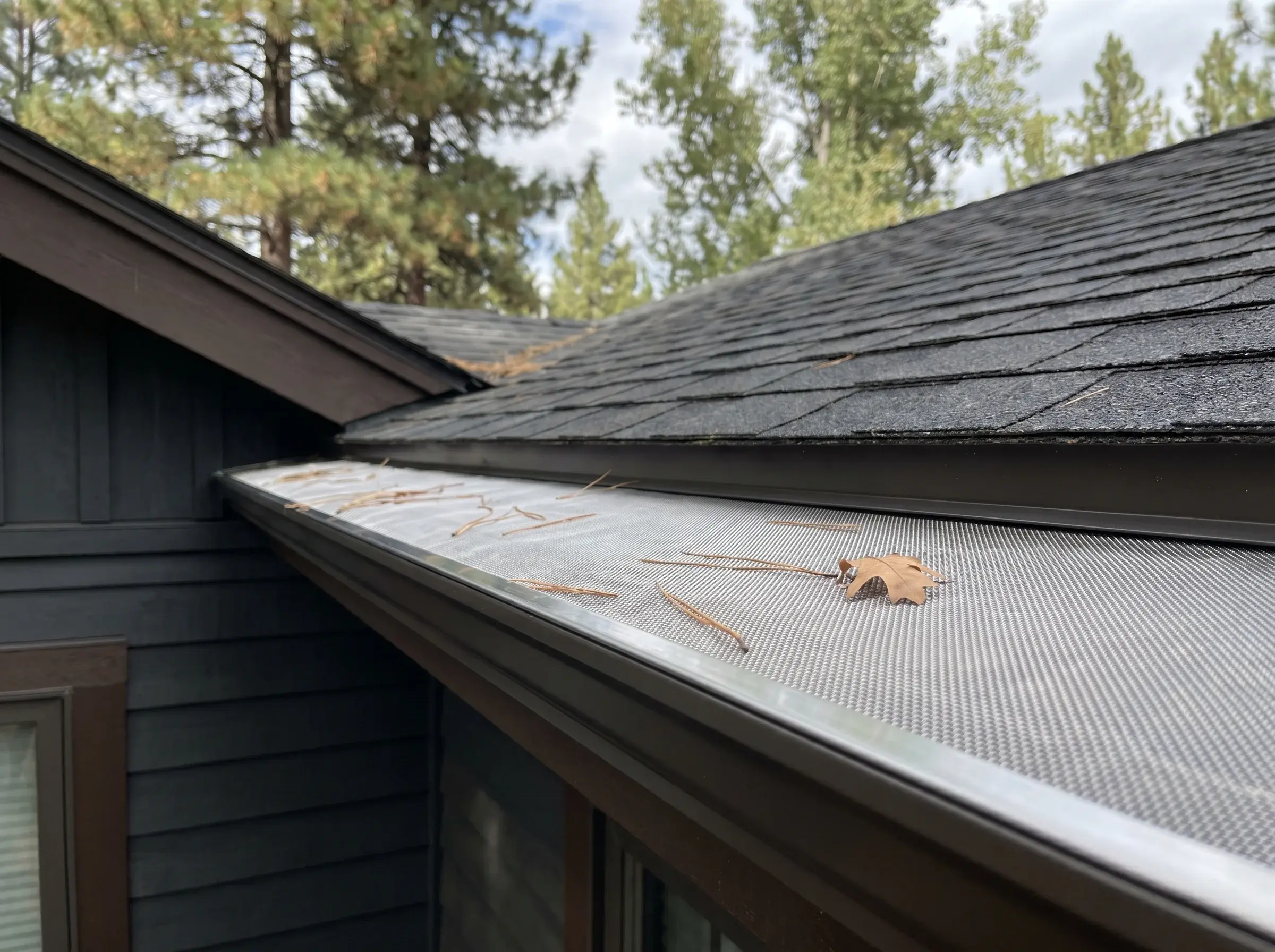
Cottonwood is one of the easier debris loads for stainless micro-mesh because the fluffy cluster catches on the mesh surface and either blows clear on the next breeze or rinses off with the next rain. It doesn't mat down the way pine needles can on coarser screens, and it doesn't decompose into the inside of the gutter because it never gets in there. The mesh keeps the seed out of the system entirely, and the seed clears the mesh on its own most of the time. The annual inspection brushes off whatever sat through the summer.
Section
Other Garden City gutter issues
- Mature deciduous load in fall — beyond cottonwood, Garden City has significant maple, locust, and mixed deciduous canopy that drops a heavy fall load. The October-November leaf drop is the second-biggest debris event of the year.
- Mixed-use building scupper drains — Live-Work-Create District buildings with flat or low-slope roofs use scupper drains and internal downspouts that need their own seasonal flush. Different access, different equipment, same principle.
- River-adjacent foundation downspout routing — homes within 100 feet of the river benefit from extended downspouts that carry water 6-8 feet from the foundation, sometimes tied into surface drains. Standard splash blocks aren't enough when the lot grading already runs toward the river.
Section
Boise River corridor outside Garden City
- Eagle Island — surrounded on three sides by the river; cottonwood load on the island itself is among the heaviest in the Treasure Valley.
- Parts of Star — properties along the river through downtown Star and the River Birch area pick up significant cottonwood plus willow debris.
- Boise's East End and Warm Springs neighborhoods near the river — the streets closest to the Greenbelt east of downtown share the Garden City load profile.
- Harris Ranch and Surprise Valley in Southeast Boise — newer development built into the river corridor, mature cottonwoods adjacent.
Section
Cost considerations
Three cleanings a year on a river-adjacent home adds up. Run your specific numbers through /cost-calculator/gutter-cleaning for a ranged estimate, then compare against a one-time stainless micro-mesh install. For most Garden City homes with significant cottonwood and fall leaf load, the cleaning math breaks even on guards inside a small number of seasons. The on-site visit gives you the written quote for either path.
FAQ
Common questions on this topic.
Is cottonwood really worse for gutters than fall leaves?
When should I schedule pre-cottonwood gutter cleaning in Garden City?
Do gutter guards really keep cottonwood out completely?
Can I just leaf-blow cottonwood out of my gutters?
Why are my downspouts the first thing to clog with cottonwood?
About the author
Mark
Owner· Licensed Idaho Contractor RCE-6681702
Mark owns Boise Gutter Guards, a licensed Idaho contractor (RCE-6681702) serving Boise, Meridian, Eagle, Nampa, Caldwell, Kuna, Star, and Garden City. He started the company after seeing too many Treasure Valley homeowners get sold under-sized gutters, nailed-on hangers, and silicone-sealed seams that fail in the first hard freeze. Every estimate is done in person, every install is backed in writing, and every customer gets a job-site walkthrough before the crew leaves.