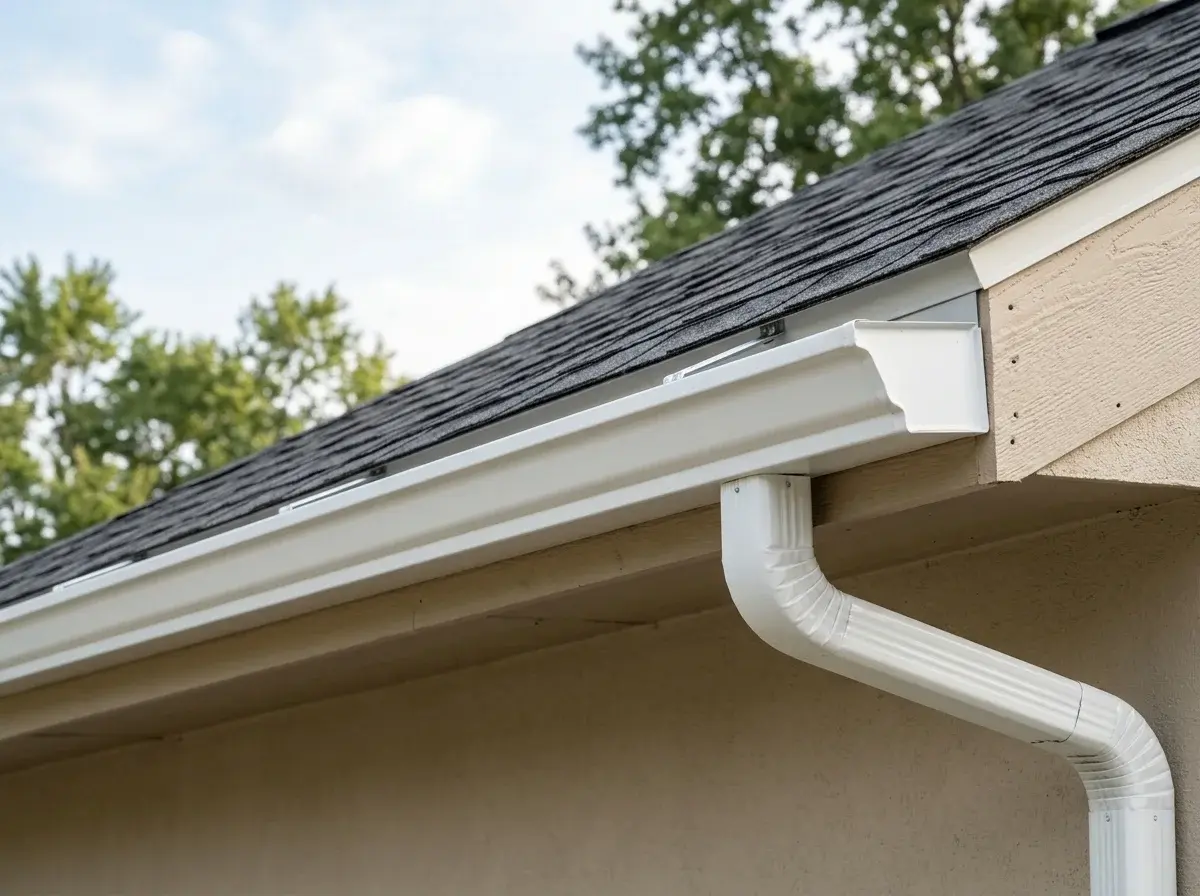
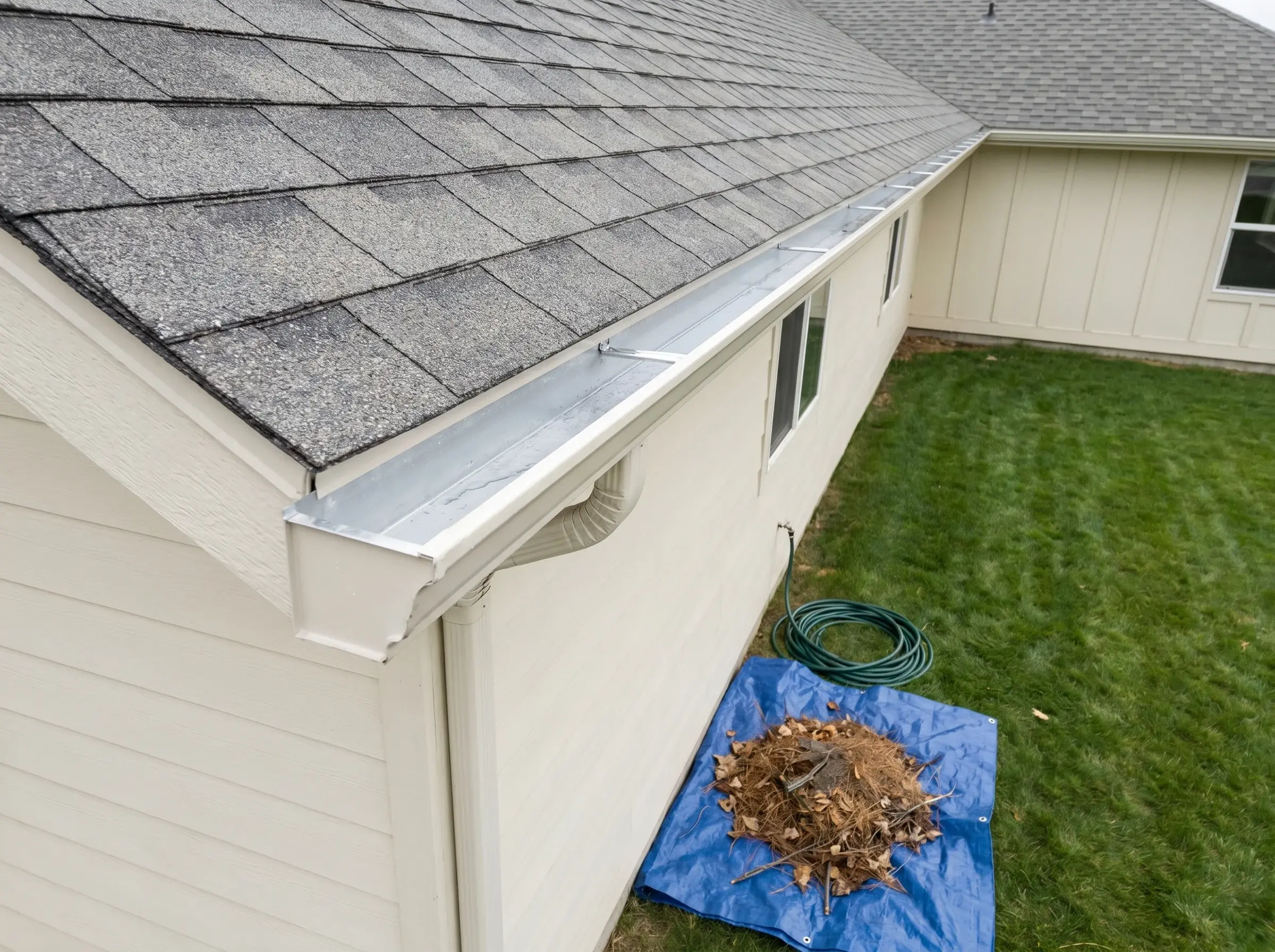
Cleaning your own gutters is fine work for a lot of Treasure Valley homeowners — a single-story ranch in Meridian, a stable ladder, an hour on a calm Saturday. The problem isn't doing it yourself. It's the handful of mistakes we get called to fix afterward, the ones that turn a free afternoon into a repair invoice. Most of them have nothing to do with effort and everything to do with method. Below are the eight we see most, what each one actually costs, and how to avoid it. None of this is hard once you know it's coming.
If you want the schedule side of this — how often to clean for your specific tree cover and neighborhood — that's a separate question we cover in /blog/gutter-cleaning-frequency-boise-idaho. This post is purely about the how, and specifically about the ways the how goes wrong.
Section
Mistake 1: Pressure-washing debris through the seams
This is the one that costs the most and feels the most productive while you're doing it. A pressure washer blasts a season of packed leaves out of a gutter in seconds, which is exactly why people reach for it. The trouble is that the same pressure that moves the clog also drives water and grit into every seam, end cap, and miter joint in the run. On sectional gutters those seams are sealed with butyl or silicone, and high-pressure water finds the weak spots and opens them up. We've replaced sealant on plenty of Treasure Valley homes where the gutter was watertight until someone pressure-washed it clean. Seamless gutters fare better because there are fewer joints, but the end caps and corners are still vulnerable. Hand-remove the bulk first, then flush with a regular garden hose. The hose has enough flow to move the rest without enough force to wreck a joint.
Section
Mistake 2: Dumping debris down the downspout
When you're standing on a ladder with a fistful of wet leaves, the downspout opening sitting right there looks like a convenient drain. It isn't. Shoving debris toward the outlet — or just sweeping it that direction and hoping water carries it off — packs the downspout instead of clearing it. A clog low in a vertical downspout or, worse, in a buried drain line is far harder to reach than the trough you can see. Pull debris up and out into a bucket or a bag hung on the ladder. Leave the outlet open, then flush it from the top with a hose at the end and watch for full flow at the bottom. If water backs up at the outlet instead of running clear, you've got a downspout clog to deal with before you call the job done.
Section
Mistake 3: Cleaning the gutters but not the downspouts
A clean trough that drains into a packed downspout is still a clogged system. This is probably the most common gap we find when we get called out after a DIY clean — the gutters look spotless from the ground, but water still overflows in a storm because the downspout or an underground drain line is choked. The gutter is just the visible half of the job. Every downspout needs a hose flushed through it at the end of the clean to confirm it actually carries water away, not just that the trough above it is empty. A downspout that gurgles, backs up, or runs at a trickle isn't draining, and that's exactly where overflow and foundation water start.
Section
Mistake 4: Unsafe ladder work
Every season we hear about a homeowner who came off a ladder cleaning gutters, and it's almost always avoidable. The usual culprits: setting the feet on soft spring soil or a sloped flowerbed, leaning the top against the gutter itself (which dents the trough and gives you nothing solid to push against), and the big one — overreaching sideways instead of climbing down and moving the ladder. Belt-buckle stays between the rails, always. On a two-story home, on a steep grade, or anywhere you can't set a ladder on firm level ground, this is the point where doing it yourself stops being a good trade. No gutter clean is worth a fall. If the access is bad, that's a fine reason to hand the job to someone who sets up for it for a living.
- Set ladder feet on firm, level ground — not soft spring soil, mulch, or a sloped bed. Use a stabilizer or a board under the feet if you have to.
- Use a standoff or ladder stabilizer so the ladder rests on the roof or fascia, not on the gutter itself. Leaning on the gutter dents it and shifts under your weight.
- Keep your hips between the rails. If you can't reach a section, climb down and move the ladder — every time.
- Skip ladders entirely on wet, windy, or icy days. Spring runoff and early-fall storms make for the worst footing.
- Two stories or a steep lot with no firm ladder footing is the line where hiring out is the smart call, not the lazy one.
Want this handled by a local crew?
Free on-site estimate across the Treasure Valley — call or send a few details and we'll get back the same day.
Section
Mistake 5: Ignoring slope and pitch
A gutter that's been cleaned spotless will still pool water and overflow if it's lost its pitch. Gutters are hung with a slight slope toward the downspouts — a rough rule of about a quarter inch of fall for every ten feet of run — so water moves instead of sitting. Over the years, hangers loosen, fascia softens, and sections sag, especially on older Bench and North End homes where the original spikes have worked loose. While you're up there with the debris cleared out, run water through and watch where it goes. If it puddles in the middle of a run or sits at the wrong end, the gutter has lost its slope, and no amount of cleaning fixes that. That's a re-hang or a hanger replacement, not a cleaning problem — and catching it from the ladder is a lot cheaper than catching it after the fascia behind it rots.
Section
Mistake 6: Cleaning at the wrong time relative to the tree drop
Timing decides whether one clean holds or whether you're back up there in three weeks. The Treasure Valley has two debris peaks worth planning around: the late-spring seed-pod and cottonwood drop, and the late-fall leaf drop. Cleaning in early October, before the deciduous canopy has finished letting go, means a second wave fills the gutters right back up. Cleaning under ponderosa pine or Douglas fir is its own problem — needles drop year-round, so there's no single right window, just a steady load. The move is to clean after the bulk of a given drop has finished, not in the middle of it. For Garden City and Greenbelt-adjacent homes drowning in cottonwood, and for Foothills and Hidden Springs homes under pine, this timing question is the whole reason we cover those neighborhoods separately in /blog/cottonwood-garden-city-gutter-survival.
Section
Mistake 7: Skipping the foundation-drainage check
Clearing the gutter and flushing the downspout gets the water moving — but moving it three feet from the wall and dumping it there just relocates the problem to your foundation. Treasure Valley soil is clay-heavy, and clay holds water against a foundation far longer than our low rainfall totals suggest. While you're finishing the clean, walk the perimeter and look at where every downspout actually discharges: is there an extension carrying water out past the backfill, or is it pouring at the base of the wall and pooling? Splash blocks that have slid out of place, extensions that got kicked off mowing, buried lines that surface in a flowerbed — these are easy to miss and easy to fix. We cover the grade rule and discharge distances in detail in /blog/downspout-foundation-drainage-boise, but the short version: the clean isn't finished until you've confirmed the water actually ends up away from the house.
Section
Mistake 8: Assuming gutter guards mean zero maintenance
Good gutter guards are the single best way to cut cleaning frequency, and on a pine-heavy or cottonwood-heavy lot they earn their keep fast. But "low maintenance" and "no maintenance" are different claims, and the marketing on a lot of guard products blurs that line. Quality stainless micro-mesh keeps the trough clear, but fine debris — pine needle fragments, cottonwood fluff, shingle grit, ag dust off the Canyon County fields — still settles on top of the mesh and needs an occasional brush-off so water can pass through. The realistic expectation with a properly installed system is an inspection and light top-surface clear every couple of years, not the two or three full cleanings a year you'd otherwise be doing. Anyone selling a guard as truly maintenance-free is overselling it, and we'd rather you go in with the honest version. The full breakdown of what guards do and don't do in our climate is in /blog/do-gutter-guards-work-idaho.
Section
When DIY stops making sense
Plenty of single-story Treasure Valley homes are perfectly reasonable to clean yourself if you're comfortable on a ladder and you avoid the eight traps above. The honest line where hiring out starts to pay is a two-story or complex roofline, a lot with no firm ladder footing, a system that's lost its slope and needs re-hanging, or simply a debris load heavy enough that you're up there four times a year fighting it. A professional clean in the Treasure Valley typically runs in the $175–$425 range depending on size and access, with around $250 being common for a standard single-story home — and a proper one includes hand removal, a downspout flush at every drop, a written note on any sags or pulled hangers spotted from the ladder, and haul-away. If you're cleaning that often, guards usually pencil out within a few seasons. Either way, we'd rather you make the call with real numbers in front of you.
If you'd rather have it handled — or you found a sag, a blown seam, or a downspout you can't clear — we're a licensed Idaho contractor (RCE-6681702) serving the whole Treasure Valley. Call (208) 247-2660 or request a free estimate and we'll get you a real quote for a clean done right the first time.
FAQ
Common questions on this topic.
What's the most common gutter cleaning mistake?
Can I use a pressure washer to clean my gutters?
Is it safe to clean gutters yourself in the Treasure Valley?
When is the best time to clean gutters in Boise?
Do gutter guards mean I never have to clean again?
How much does professional gutter cleaning cost in the Treasure Valley?
About the author
Mark
Owner· Licensed Idaho Contractor RCE-6681702
Mark owns Boise Gutter Guards, a licensed Idaho contractor (RCE-6681702) serving Boise, Meridian, Eagle, Nampa, Caldwell, Kuna, Star, and Garden City. He started the company after seeing too many Treasure Valley homeowners get sold under-sized gutters, nailed-on hangers, and silicone-sealed seams that fail in the first hard freeze. Every estimate is done in person, every install is backed in writing, and every customer gets a job-site walkthrough before the crew leaves.