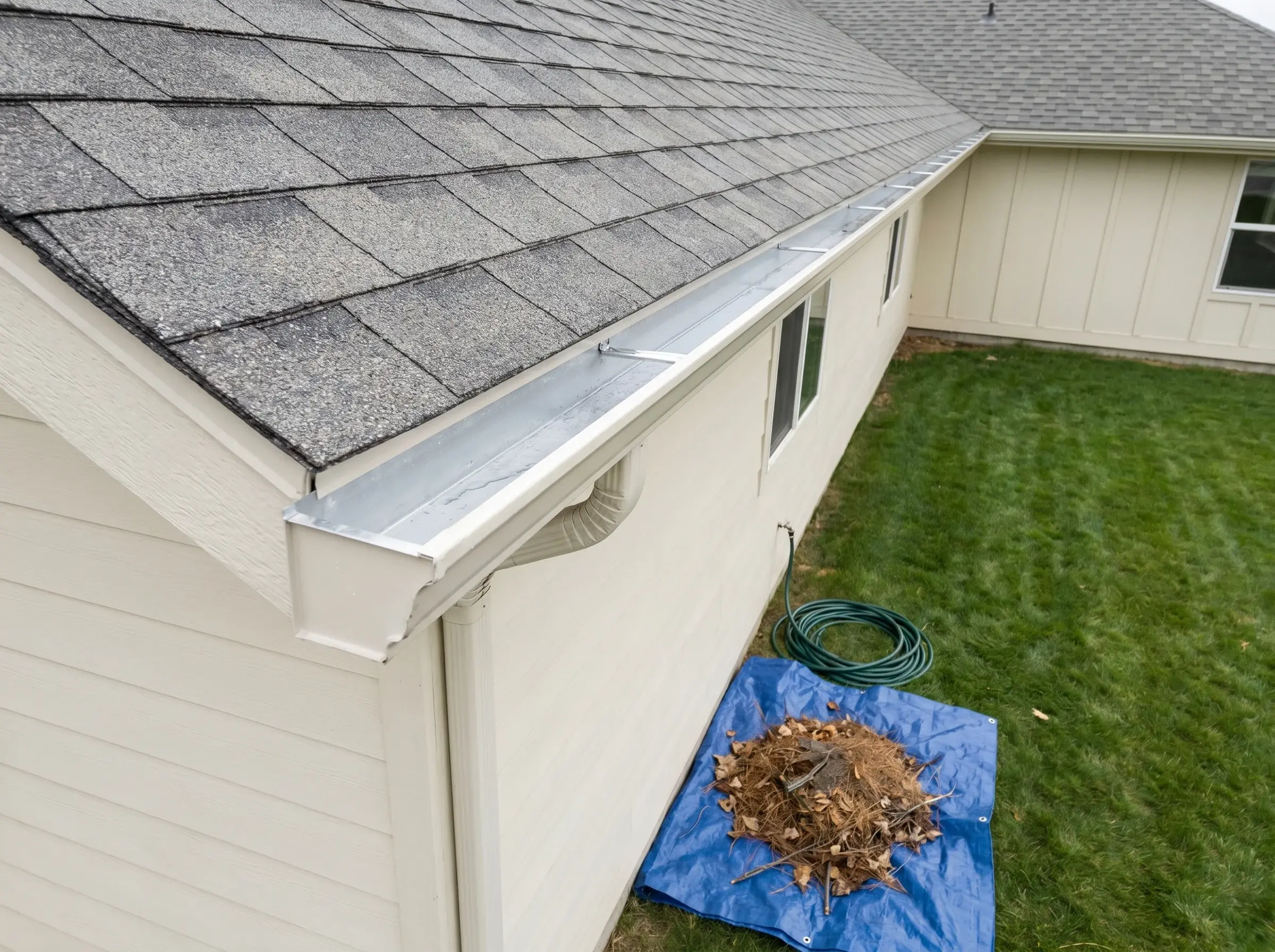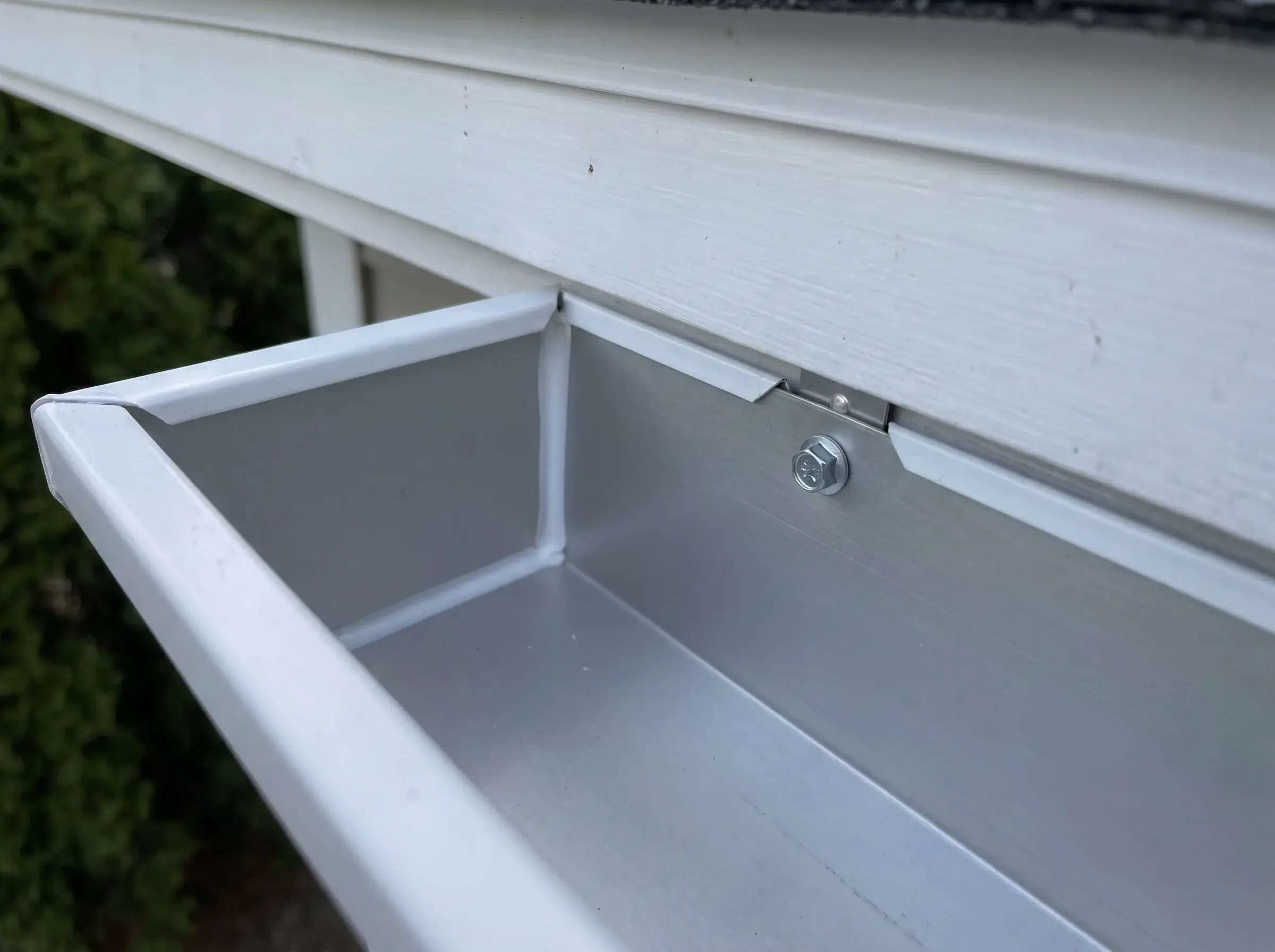
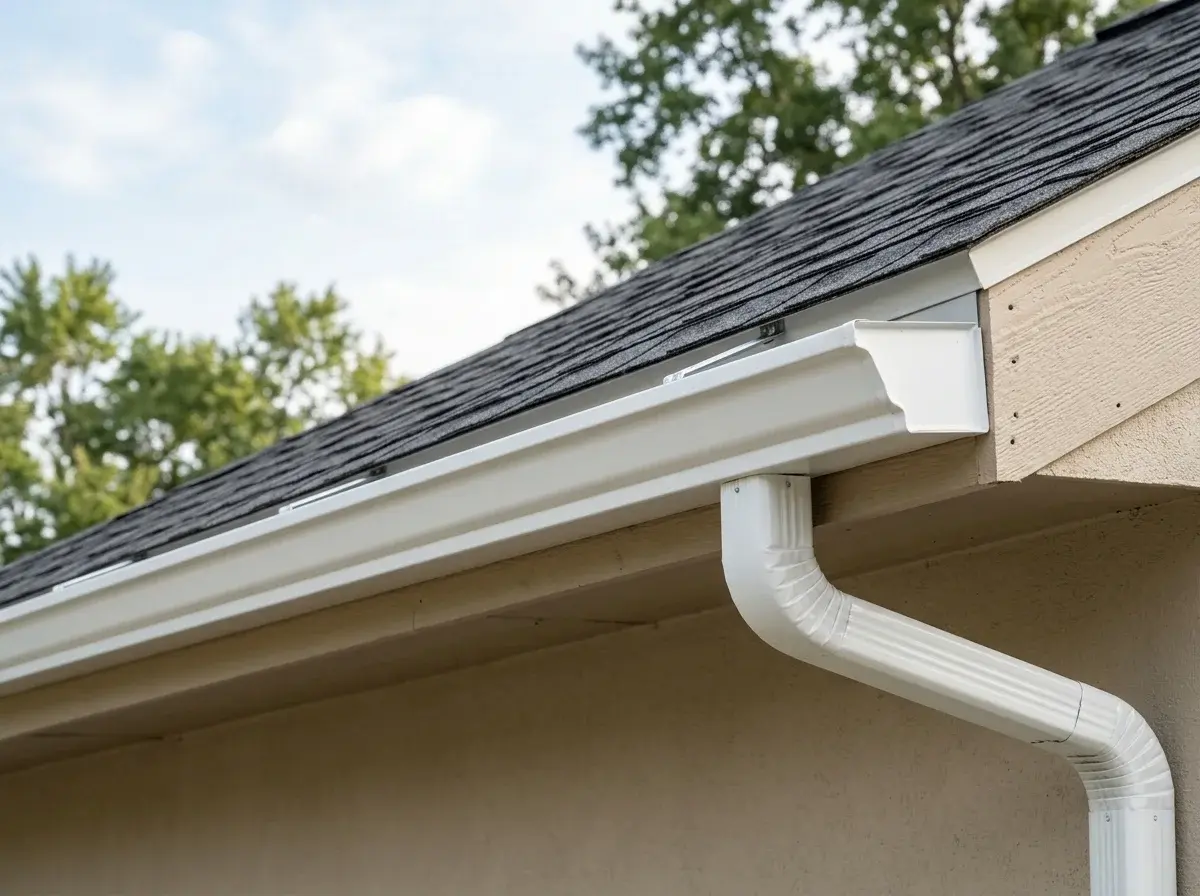
Gutters catch the water. Downspouts decide where it goes — and in the Treasure Valley, where it goes is the whole ballgame. A roof sheds an enormous amount of water in a short time: about 600 gallons for every inch of rain that falls on 1,000 square feet of roof, per University of Arizona Cooperative Extension figures. If your downspouts dump that volume right at the base of the wall, you're pouring hundreds of gallons against your foundation a few feet from where you don't want it.
Here's the local twist most homeowners miss: Boise's low rainfall makes this feel like a non-issue, and it isn't. We average only about 12 inches of precipitation a year, but the soil under most of the Treasure Valley works against you. The USDA's official Ada soil series is clay-rich and slow-draining — a smectitic, shrink-swell clay that holds water against a foundation instead of letting it percolate away. Low rainfall, high retention. That combination is why drainage matters more here than the rain gauge suggests.
Section
Why is foundation drainage a bigger deal here than the rainfall suggests?
Because of the soil, and because of how the water arrives. The Ada series soils common across Ada County are clay-rich with slow permeability, according to the USDA Natural Resources Conservation Service. Clay doesn't drain — it holds. When roof water pools against a clay-soil foundation, it sits there, and shrink-swell clays expand when wet and contract when dry, working on the foundation from both directions across the seasons.
And our water doesn't come as gentle, year-round rain. The National Weather Service's Boise data shows precipitation concentrated in winter and spring, which means our heaviest loads are spring snowmelt and sudden summer thunderstorms — high-volume, short-duration events that overwhelm a marginal drainage setup all at once. A system that looks fine during a light fall drizzle can sheet water straight at the foundation during a July downpour or an April thaw.
We pulled into a Southeast Boise job last spring expecting a routine gutter re-hang and found the real problem at ground level. Both back downspouts emptied onto splash blocks right at the wall, and a landscaper had graded that bed dead flat years earlier. The homeowner had been chasing a damp basement corner for three winters and blaming the foundation. We extended both downspouts about eight feet out to the downslope and re-cut the grade along that wall in an afternoon. The corner dried out by the next thaw. The foundation was never the problem — the water was.
Section
How much water do your gutters actually move?
More than people picture. Using the University of Arizona Extension's figure of roughly 600 gallons per inch of rain per 1,000 square feet of roof, even a modest storm on an average home moves a serious volume of water to a handful of discharge points.
| Rainfall | Water shed per 1,000 sq ft | On a 2,000 sq ft roof |
|---|---|---|
| 0.5 inch | ~300 gallons | ~600 gallons |
| 1 inch | ~600 gallons | ~1,200 gallons |
| 2 inches | ~1,200 gallons | ~2,400 gallons |
All of that funnels to your downspouts and out the bottom. The only question that matters is whether it lands somewhere safe or pools against the wall.
Section
Where should downspouts discharge?
Away from the house, onto ground that carries the water farther away — not at the base of the wall. The reliable, code-anchored rule isn't about the downspout itself; it's about the grade. The International Residential Code (R401.3) calls for the ground to fall at least 6 inches within the first 10 feet from the foundation, and home-inspection authority InterNACHI cites the same standard. Get that slope right, then extend the downspout out onto it.
- Add extensions so water discharges several feet out from the wall, onto the downslope — not into a splash block that dumps it right at the corner.
- Confirm the grade: at least 6 inches of fall over the first 10 feet away from the foundation (IRC R401.3). If the ground slopes back toward the house, fix the grade before anything else.
- Avoid discharging onto a hardscape that drains back toward the foundation, or onto a neighbor's lot.
- On tight lots where there's nowhere for water to go, a buried drain line to daylight or a dry well may be the answer — but the surface fixes come first.
Want this handled by a local crew?
Free on-site estimate across the Treasure Valley — call or send a few details and we'll get back the same day.
Section
Does your home have enough downspouts?
Often, no — under-drained homes are common. Industry sizing standards (the SMACNA sheet-metal manual that gutter sizing derives from) put one standard downspout at roughly 600 square feet of roof drainage, and gutter guides like This Old House recommend a downspout for about every 600 square feet of roof, spaced no more than 20 to 40 feet apart. A long gutter run with a single downspout at one end is a classic overflow setup: the far end fills faster than the lone outlet can drain it.
| Downspout size | Roof area it drains | Notes |
|---|---|---|
| 2×3 inch | ~600 sq ft | Standard residential; fine on smaller, simpler roofs |
| 3×4 inch | ~1,200 sq ft | Better for large, steep, or high-volume roofs |
| Spacing | Every 20–40 ft | Minimum two per home; more on long runs |
On a steep Foothills roof that dumps volume fast, upsizing to 3×4 downspouts and adding outlets is often a bigger improvement than anything else you can do to the system.
Section
What are the signs your drainage is failing?
- Pooling or standing water against the foundation after a storm or during snowmelt.
- Soil eroded into a trench or splash pit directly under a downspout outlet.
- Water stains, efflorescence, or dampness on basement or crawlspace walls — roughly 60% of U.S. homes experience some basement moisture, per figures published by the Journal of the National Institute of Building Sciences.
- Mulch, gravel, or soil washed away from beds along the house.
- Gutters overflowing at the far end of a long run during heavy rain — a sign of too few downspouts, not just clogs.
- Cracks in the foundation or a sticking door/window that appears seasonally as clay soil swells and shrinks.
Section
What does it cost to fix drainage versus ignore it?
This is the math that makes the case. Downspout extensions and regrading are among the cheapest work you can do on a house. Foundation repair is among the most expensive: HomeAdvisor puts the national average around $5,174, with a typical range of about $2,225 to $8,133 and bad cases well past that. Water-damage restoration averages another $3,864. Moving a downspout discharge point a few feet is a rounding error against either number.
| Item | Typical cost | Source |
|---|---|---|
| Downspout extensions / minor drainage fix | Low — often a same-visit add-on | Boise Gutter Guards |
| Foundation repair (national average) | ~$5,174 (range $2,225–$8,133) | HomeAdvisor, 2025 |
| Water-damage restoration (average) | ~$3,864 | HomeAdvisor, 2025 |
Section
Sources
- USDA NRCS Official Series Description — ADA series (Clayey-skeletal, smectitic, mesic Typic Argixerolls; 25-55% clay; slow permeability) — https://soilseries.sc.egov.usda.gov/OSD_Docs/A/ADA.html
- InterNACHI — Foundation Load Paths & Water Paths (IRC R401.2 & R401.3): grade should fall at least 6 inches within first 10 feet — https://www.nachi.org/foundation-load-water.htm
- University of Arizona Cooperative Extension (Water Wise) — Harvest Rain: 1-inch rain = 600 gallons from a 1,000 sq ft roof — https://waterwise.arizona.edu/ways-save-water/harvest-rain
- HomeAdvisor — Foundation Repair Cost (avg $5,174) — https://www.homeadvisor.com/cost/foundations/repair-a-foundation/
- Journal of the National Institute of Building Sciences — Foundation Waterproofing (60% damp basements) — https://www.journalofthenationalinstituteofbuildingsciences.com/do-you-need-to-waterproof-foundations
If your gutters are due for work anyway, drainage is the part to get right while the crew is on-site. Run your project through /cost-calculator for a ranged estimate, or have us assess discharge points and grade during a free on-site visit.
FAQ
Common questions on this topic.
How far should downspouts discharge from the foundation?
Why does drainage matter in Boise if it barely rains here?
How many downspouts does my house need?
Can poor gutter drainage really damage my foundation?
Are downspout extensions worth it?
About the author
Mark
Owner· Licensed Idaho Contractor RCE-6681702
Mark owns Boise Gutter Guards, a licensed Idaho contractor (RCE-6681702) serving Boise, Meridian, Eagle, Nampa, Caldwell, Kuna, Star, and Garden City. He started the company after seeing too many Treasure Valley homeowners get sold under-sized gutters, nailed-on hangers, and silicone-sealed seams that fail in the first hard freeze. Every estimate is done in person, every install is backed in writing, and every customer gets a job-site walkthrough before the crew leaves.