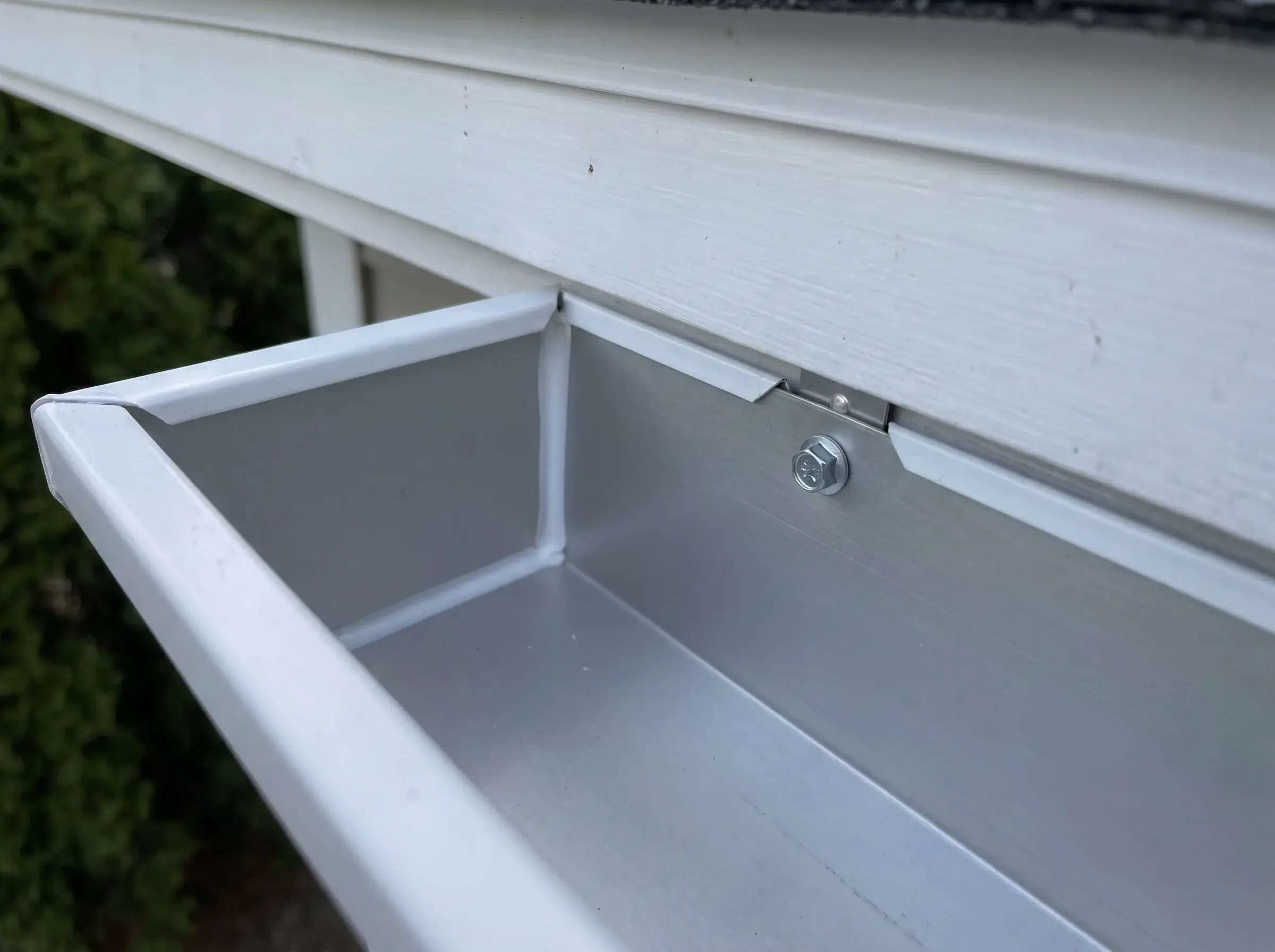
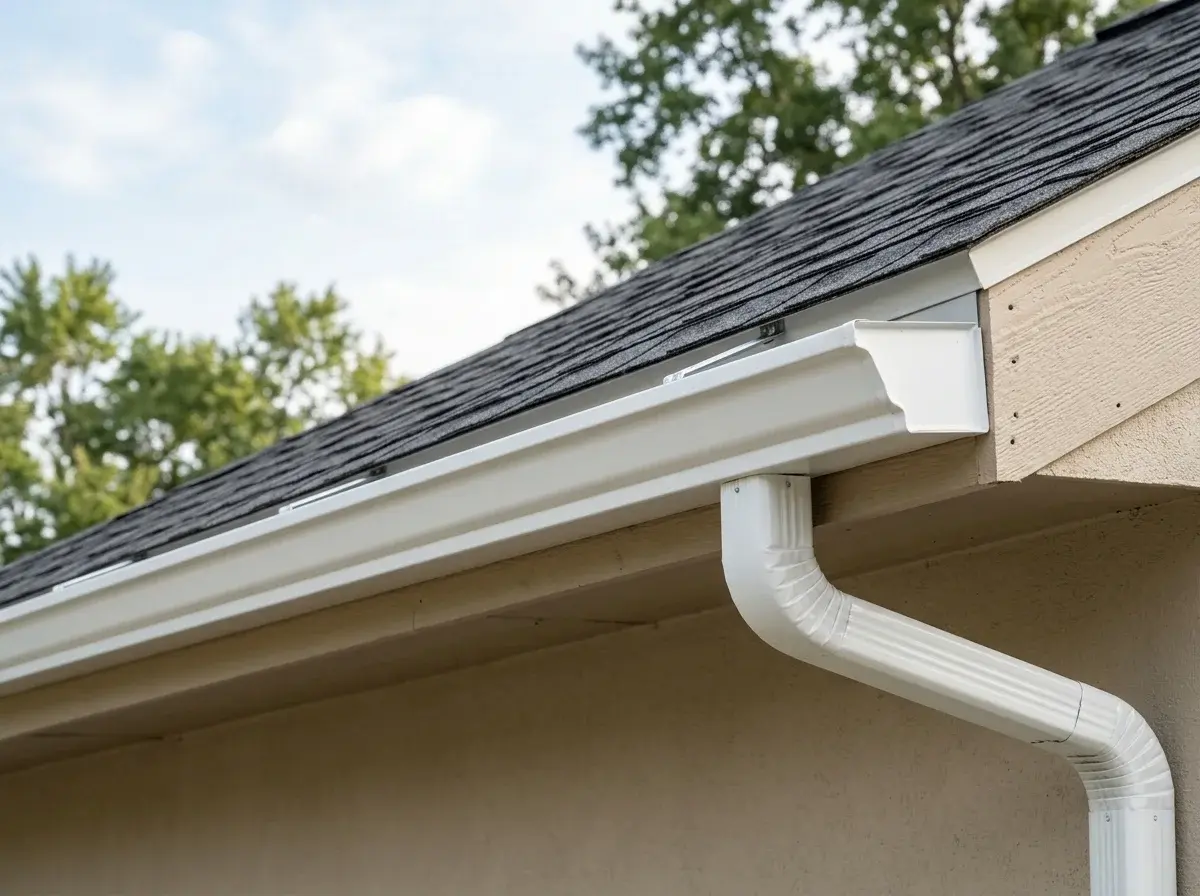
Most gutter problems show themselves long before the system actually quits. You don't need a ladder or a contractor to catch the early warning signs — most of them are visible from the ground on a slow walk around the house. This is a symptom-spotting guide: seven things we look for on every Treasure Valley estimate, and what each one usually means. Spot two or three of these together and you're probably past the point where another bead of sealant buys you anything.
Worth saying up front: not every problem here means a full replacement. Some are repairs. This guide is about reading the symptoms accurately. Once you know what you're looking at, our companion guide on repair vs replace walks through the actual decision — when a patch makes sense and when it's throwing money at a system that's done.
Section
1. The gutters are sagging or pulling away from the fascia
A gutter that dips in the middle of a run, tilts forward at the lip, or has visibly separated from the fascia board is the most common sign we get called for. A healthy gutter sits tight against the fascia and holds a straight, slightly-pitched line across the whole run. When it sags, the hangers have failed — usually because the original install used nails instead of screws, and the nails have worked loose over years of freeze-thaw and wind. One isolated sag can be re-hung. Sagging across three or four sections usually means the system is undersized, the fascia behind it is failing, or the whole run was nailed and is letting go all at once.
On the Bench and in the North End, we see this on older homes where winter ice load has physically yanked runs off-level. On Meridian and West Boise production homes, it's the year-20 nailed-hanger problem showing up across the whole house at once.
Section
2. Seams are separating or leaking at multiple joints
If you have sectional gutters — pieces joined every ten feet with a slip connector and a bead of caulk — the seams are the weak point, and they fail from the inside out. The first sign is a stain or drip line under a joint. The telling sign is more than one or two joints doing it. Sectional systems fail at the seams in sequence: once two or three have let go, the rest are usually weeks or months behind, because they all aged under the same sun and the same caulk.
Seamless aluminum has joints only at the corners and downspout outlets, so a single leaking miter is a normal repair. But if you can count separated seams every ten feet across a flat run, you have a sectional system reaching the end of its life — and chasing each joint with fresh caulk is a season-by-season game you eventually lose.
Section
3. Peeling exterior paint or rust streaks down the fascia and siding
Look at the wood and siding directly below and behind the gutter. Peeling, bubbling, or blistered paint on the fascia means water is getting back there and staying — the gutter is overflowing behind itself or leaking at the back edge. Orange or brown rust streaks running down the face of the gutter or staining the siding below tell you the metal itself is corroding. On steel gutters that's system-wide rot from the inside; on aluminum, streaking usually means the finish has failed and water is wicking where it shouldn't.
These stains matter because they point past the gutter to what it's protecting. Persistent water behind the fascia rots the board, and rotted fascia is why the hangers in sign #1 are pulling loose in the first place. Paint and rust are the visible part of a problem that's already moved into the wood.
Section
4. Water pooling around the foundation after it rains
Walk the base of the house during or right after a rain. If you see water pooling against the foundation, eroded channels in the mulch under a downspout, or standing water that doesn't drain away within an hour, your gutters aren't doing the one job that actually protects the structure — moving roof water away from the wall. This matters more in the Treasure Valley than the low rainfall suggests, because the clay-rich soil under most of the valley holds water against the foundation instead of letting it drain.
Pooling can be a downspout-extension fix rather than a new-gutter job — but it can also be the symptom of gutters so overflowed, off-pitch, or undersized that they never get the water to the downspouts in the first place. Either way, it's a sign the system isn't functioning, and a damp basement corner or a foundation crack is a far more expensive problem than the gutters that caused it. Our guide on downspouts and foundation drainage covers the discharge side in detail.
Want this handled by a local crew?
Free on-site estimate across the Treasure Valley — call or send a few details and we'll get back the same day.
Section
5. Shingle granules collecting in the troughs
This one needs a peek into the gutter, but it's worth it. If you find a sandy, gritty buildup of dark granules in the bottom of the trough, those are the protective mineral granules washing off your asphalt shingles. A little shedding is normal on a new roof. A steady accumulation usually means the roof is aging — and an aging roof and aging gutters often reach the end together, since they were typically installed the same year.
Granules don't condemn the gutters by themselves, but they're a clock. If you're seeing granules pile up alongside any of the other signs on this list, you're looking at a system that's old enough that replacement — and timing it with the roof — is worth pricing out rather than patching piece by piece.
Section
6. Cracks, splits, or holes you can see in daylight
Stand under a run on a bright day and look up at the gutter from below, or shine a light. Hairline cracks, split corners, and pinholes let water through where it shouldn't — and unlike a failed seam, you can't reseal your way out of a hole in the metal. Cracks tend to start small at stress points (corners, around fasteners, where a downspout drops) and spread with every freeze-thaw cycle. Vinyl gutters are especially prone to this; Idaho UV makes them brittle and they crack at the joints and along the runs.
A single small crack at one corner might be a section replacement. Cracks and pinholes showing up in more than one place mean the material has fatigued, and once metal starts failing in multiple spots, it keeps going. There's no economical patch for a system that's cracking system-wide.
Section
7. Fasteners pulling out, or a system older than about 20 years
Look for spikes, screws, or hangers that have backed out and are sitting proud of the fascia, and for the rust stains or holes they leave behind. Loose fasteners across the whole house tell you the hangers can't hold the gutter to the wood anymore — either the wood has softened or the original nailed install has run its course. A few loose fasteners get re-driven with screws into solid wood. Loose fasteners everywhere are a different story.
Age ties the whole list together. Seamless aluminum hung with screws and properly sealed typically runs 25 to 40 years in Treasure Valley conditions. Sectional aluminum with nailed hangers and caulked seams runs more like 10 to 20 years before the joints start failing across the system. If your gutters are pushing 20-plus years and you're seeing the third or fourth issue this season, the system isn't having bad luck — it's wearing out. At that point you're usually better off pricing a new seamless system than spending another year chasing leaks.
Section
What to do once you've spotted the signs
Spotting the symptoms is step one. Deciding whether it's a repair or a replacement — and what that costs — is step two, and it's a different conversation. Here's the order we'd run it:
- Do both walks — the dry walk for structural signs and the wet walk for flow problems — and note how many signs you found and where.
- Read our repair vs replace guide. It turns the symptoms above into an actual decision framework: when a patch is the right call and when it isn't.
- If replacement looks likely, run rough numbers on our cost calculator at /cost-calculator. Seamless aluminum installation runs $10–$22 per linear foot in the Treasure Valley, with $14 typical, so you'll get a realistic range before anyone visits.
- Get a free on-site estimate. A real diagnosis means walking the full perimeter and checking pitch, fasteners, fascia, and downspout flow — not just eyeballing the section you noticed. We give a straight repair-or-replace answer, in writing.
Section
Sources
- This Old House — How to Size Gutters and Downspouts — https://www.thisoldhouse.com/gutters/21014888/how-to-size-gutters-and-downspouts
- InterNACHI — Foundation Load Paths and Water Paths (IRC R401) — https://www.nachi.org/foundation-load-water.htm
FAQ
Common questions on this topic.
How do I know if my gutters need to be replaced instead of repaired?
What are the first signs of gutter damage I can spot from the ground?
How long do gutters last in the Treasure Valley?
Are shingle granules in my gutters a problem?
My gutters overflow but look fine. Do I need new ones?
Can I just keep repairing my old gutters?
About the author
Mark
Owner· Licensed Idaho Contractor RCE-6681702
Mark owns Boise Gutter Guards, a licensed Idaho contractor (RCE-6681702) serving Boise, Meridian, Eagle, Nampa, Caldwell, Kuna, Star, and Garden City. He started the company after seeing too many Treasure Valley homeowners get sold under-sized gutters, nailed-on hangers, and silicone-sealed seams that fail in the first hard freeze. Every estimate is done in person, every install is backed in writing, and every customer gets a job-site walkthrough before the crew leaves.