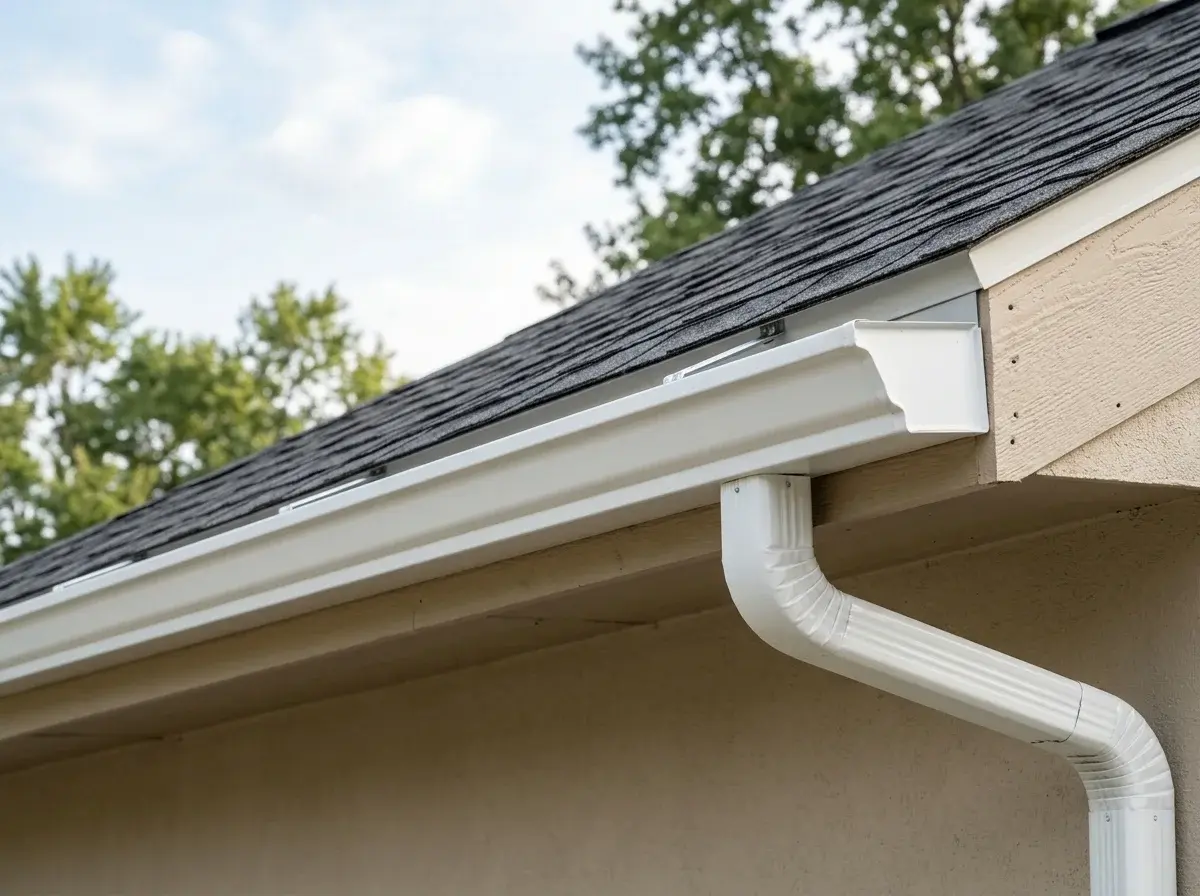

If your Meridian home is five to fifteen years old and the gutters have started leaking at the corners, sagging between hangers, or pulling away from the fascia, you're not imagining it and you're not unlucky. Production-builder gutter systems across Paramount, North Meridian, South Meridian, and the developments around The Village were spec'd to a price point that delivers a five-to-ten-year service life under Treasure Valley conditions. Year seven is right in the meat of that failure curve — the year when fasteners loosen, end-cap sealant cracks, downspouts begin overflowing, and homeowners start searching for repair quotes.
Section
What production builders typically install
To understand why these systems fail on schedule, it helps to look at what's actually hanging on your fascia. Production builds across Meridian — and across Treasure Valley subdivisions generally — share a remarkably consistent gutter spec because builders source from a small number of regional installers who all install to the minimum acceptable standard. That spec almost always includes:
- 5-inch K-style aluminum gutters (the entry-level residential profile)
- .027-gauge aluminum coil (thinner of the two common gauges; .032 costs more)
- Hidden hangers attached with NAILS rather than screws into the fascia or rafter tail
- Minimum-spec 2x3 downspouts regardless of the actual roof area they're draining
- Basic silicone or hybrid sealant at end caps, miters, and downspout outlets
Every one of those choices is defensible at the time of build — the homeowner isn't paying line-item attention to gutter spec, the builder needs to hit a number, and the gutter installer is competing against other installers on the same volume contract. The problem isn't that production builders are doing anything malicious; it's that the system they install is engineered for the first five years of the home's life, not the first thirty.
Section
Why each of those choices fails on a Treasure Valley timeline
The Treasure Valley climate is unusually hard on gutter systems. November through March we cycle above and below freezing repeatedly — sometimes several times in a single day on south-facing runs. That thermal cycling is the main driver of joint and sealant failure. Add in dry summer UV exposure, wind across newer subdivisions, settling foundations, and surrounding ag-land dust, and the failure timeline gets predictable enough to plot.
| Component | Failure mode | Typical year |
|---|---|---|
| Silicone end-cap sealant | Hardens, cracks, separates from aluminum | Year 4–7 |
| Nailed hidden hangers | Nails work loose under snow load and wind cycling | Year 5–10 |
| Undersized 2x3 downspouts | Corner overflow during heavy rain — present from install | Year 1+ (intermittent) |
| 5-inch K-style on steep-pitch roof | Overflow during peak runoff — present from install | Year 1+ (intermittent) |
| .027 aluminum at impact points | Dents and front-lip damage from hail and falling debris | Year 3+ |
| Foundation-dumping downspouts | Soil erosion and basement seepage | Year 5–15 |
Hangers are usually the first thing to go visibly wrong. Nails driven into fascia have nothing to grip — fascia wood dries out and shrinks as the home ages, the nail loses its bite, and the next snow load or wind event starts pulling the hanger forward. Once one hanger pulls, the run dips, water pools, weight increases, the next hanger pulls. The cascade is mechanical, not random.
Section
Meridian-specific stressors
Meridian sees a few stressors that aren't as pronounced in central Boise or the Foothills, and they accelerate the builder-grade timeline. The newer subdivisions tend to sit on what was open ag land a decade ago, with limited tree windbreaks. That changes the load on the system in ways most homeowners don't think about until something gives.
- Wind across newer subdivisions — open sightlines from south and west pull on south-facing runs and stress every nailed hanger.
- Ag-land dust from surrounding farmland accumulates in gutters faster than tree debris alone, creating a sludge layer that holds water against the aluminum and accelerates corrosion at hanger points.
- Settling foundations on newer subdivisions can pitch gutters off-level a few years after install, creating standing water in sections that were originally pitched correctly.
- North-facing runs ice up in winter because of incomplete attic insulation in production-build eaves — the warm air leakage melts roof snow, the meltwater hits a cold gutter, and ice dams form right at the gutter line.
Section
Subdivisions where this is most common
The pattern shows up across most of Meridian's growth-era subdivisions, but a few areas generate the most repair-vs-replace calls right now:
- Paramount and North Meridian for early-2000s production homes — these are now solidly in year-20-plus territory with original systems well past service life.
- South Meridian for 2010-era subdivisions — homes hitting the year-12-to-15 window where fasteners are clearly failing and end-cap sealant is visibly cracked.
- The Village area and adjacent newer developments where 2014-2018 builds are now showing first-cycle failures right on schedule.
Want this handled by a local crew?
Free on-site estimate across the Treasure Valley — call or send a few details and we'll get back the same day.
Section
Builder warranty vs out-of-warranty fix
If your home is still inside the original builder's warranty window (usually one to two years for general work, with longer terms on structural items), the first call is to the builder — not to a third-party contractor. Gutter issues that show up in year one or year two are typically covered as part of the install warranty, and you should not be paying out of pocket to fix something the original installer should stand behind. Get the builder back on-site and put the request in writing. If they respond slowly or push back, that's when an independent quote becomes useful as leverage and a comparison point.
If you're past the warranty window — which is where most year-five-and-up failures sit — the cost is yours, and the conversation shifts to whether the right fix is repair, partial replacement, or a full system swap. The honest answer depends on what's actually failing.
Section
The fix: what real replacement looks like
A proper Meridian replacement isn't just "same thing again, but new." If you spend the money to take builder-grade gutters off the home, the upgrade is in the spec — the same install crew can put a system on your house that lasts two to three times as long for a modest premium over basic re-replacement. The components that matter:
- 6-inch K-style upgrade where the roof load justifies it — steep-pitch homes, larger square footage, and homes near open ag land that funnel debris benefit from the larger profile.
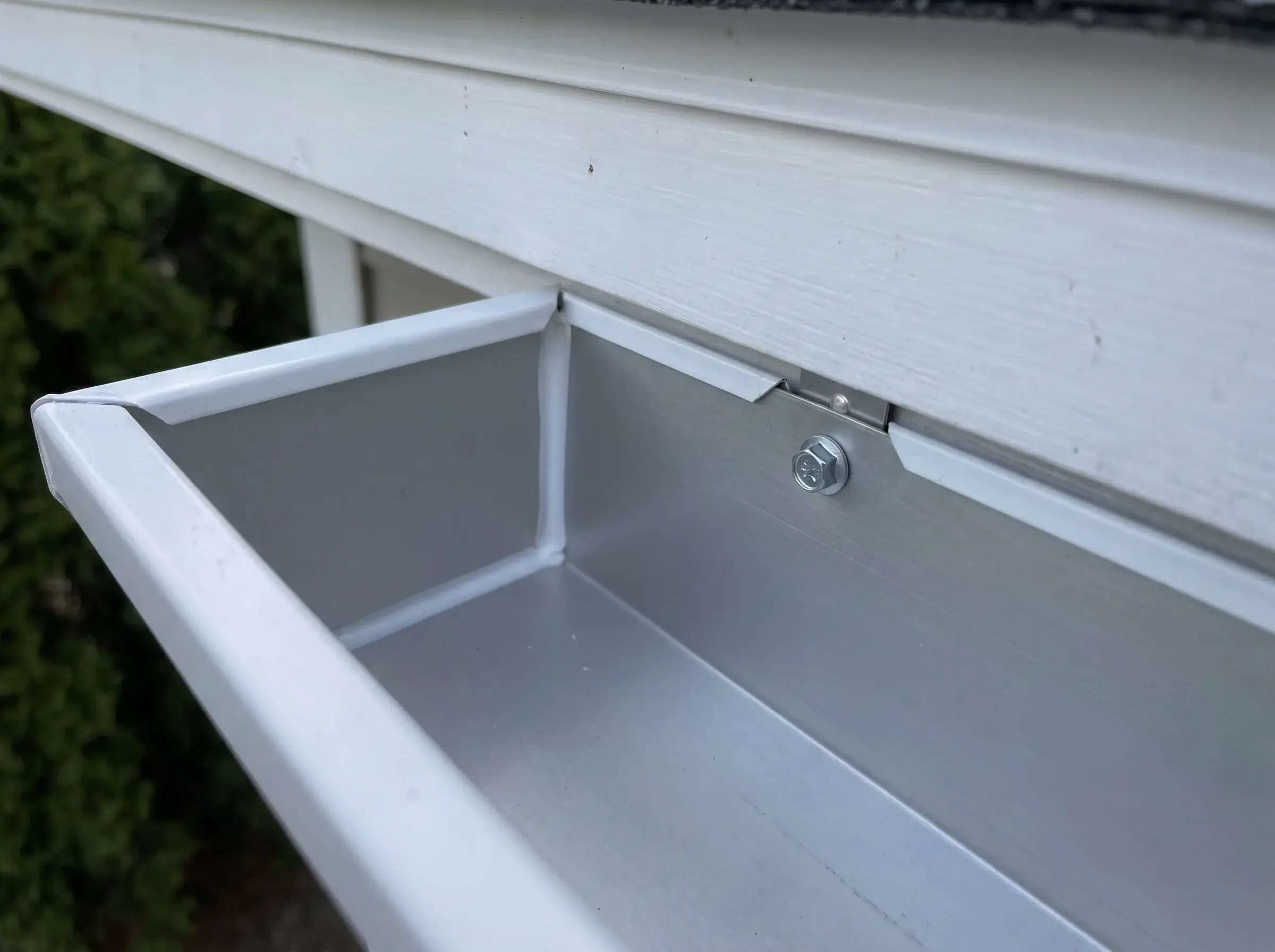
- Hidden-hanger SCREWS into rafter tails or solid fascia, not nails — this single change eliminates the most common year-5-to-10 failure mode.
- Butyl sealant at end caps and miters, not silicone — butyl stays flexible through freeze-thaw cycles; silicone hardens and cracks.
- Downspouts sized to the actual roof area, not the builder-default 2x3 on every run — undersized downspouts cause corner overflow that no amount of gutter quality fixes.
- .032 aluminum gauge on high-debris or wind-exposed runs — modest cost increase, meaningful dent and load resistance improvement.
- Downspout extensions or underground drains that move water 4-6 feet minimum from the foundation, not the 12-inch stub the builder installed.
Section
Repair vs full replacement decision
Not every year-7 failure is a replacement call. If the system is fundamentally sound — gutters hold their shape, aluminum isn't corroded, only one or two corners leak — targeted repair is the right answer. We'll reseal failed corners with butyl sealant, replace specific stripped fasteners with screws into solid material, and water-test before leaving. That's a few hundred dollars instead of a few thousand. If the failures are spread across the system — multiple leaking corners, sagging sections in different runs, fasteners loose on several elevations, downspouts that have never been sized correctly — repair becomes a stopgap and replacement is the more economical call. We walk through the repair-vs-replace decision in more detail in our dedicated guide at /resources/repair-vs-replace-gutters.
Section
Cost expectations
Meridian gutter replacement typically prices per linear foot, with variables for profile choice, story count, downspout count and sizing, and color matching. Most Meridian single-story homes need somewhere between 150 and 220 linear feet of gutter; two-story custom homes can run 250 to 350 feet plus. Our cost calculator at /cost-calculator/gutter-installation gives you a quick ranged estimate based on home size; the on-site visit produces a written quote with every component itemized. We don't quote gutters over the phone — measuring on-site is the only way to size the downspouts correctly and check the fascia condition.
Section
Other Treasure Valley cities with the same pattern
Meridian is the most visible example of the year-7 builder-grade failure cycle because of the volume of mid-2010s production builds, but the same pattern repeats across most of the Treasure Valley's growth corridors:
- Kuna's early-2010s production homes in Falcon Crest and the Indian Creek area — same builders, same spec, same failure window.
- Parts of Nampa, especially Sunny Ridge and Karcher, where early-2000s production builds are now hitting end-of-life across the system.
- Star's semi-custom 2010-era builds along River Birch and Meadow Lakes — slightly better spec on average, but still hitting year-12 sealant failure.
FAQ
Common questions on this topic.
How long should good gutters actually last in Meridian?
Can I just repair the failing corners and skip replacement?
Why did the builder use nails instead of screws if screws are clearly better?
My downspouts dump right at the foundation. How urgent is that?
Should I add gutter guards at the same time as replacement?
Does insurance ever cover gutter replacement?
About the author
Mark
Owner· Licensed Idaho Contractor RCE-6681702
Mark owns Boise Gutter Guards, a licensed Idaho contractor (RCE-6681702) serving Boise, Meridian, Eagle, Nampa, Caldwell, Kuna, Star, and Garden City. He started the company after seeing too many Treasure Valley homeowners get sold under-sized gutters, nailed-on hangers, and silicone-sealed seams that fail in the first hard freeze. Every estimate is done in person, every install is backed in writing, and every customer gets a job-site walkthrough before the crew leaves.