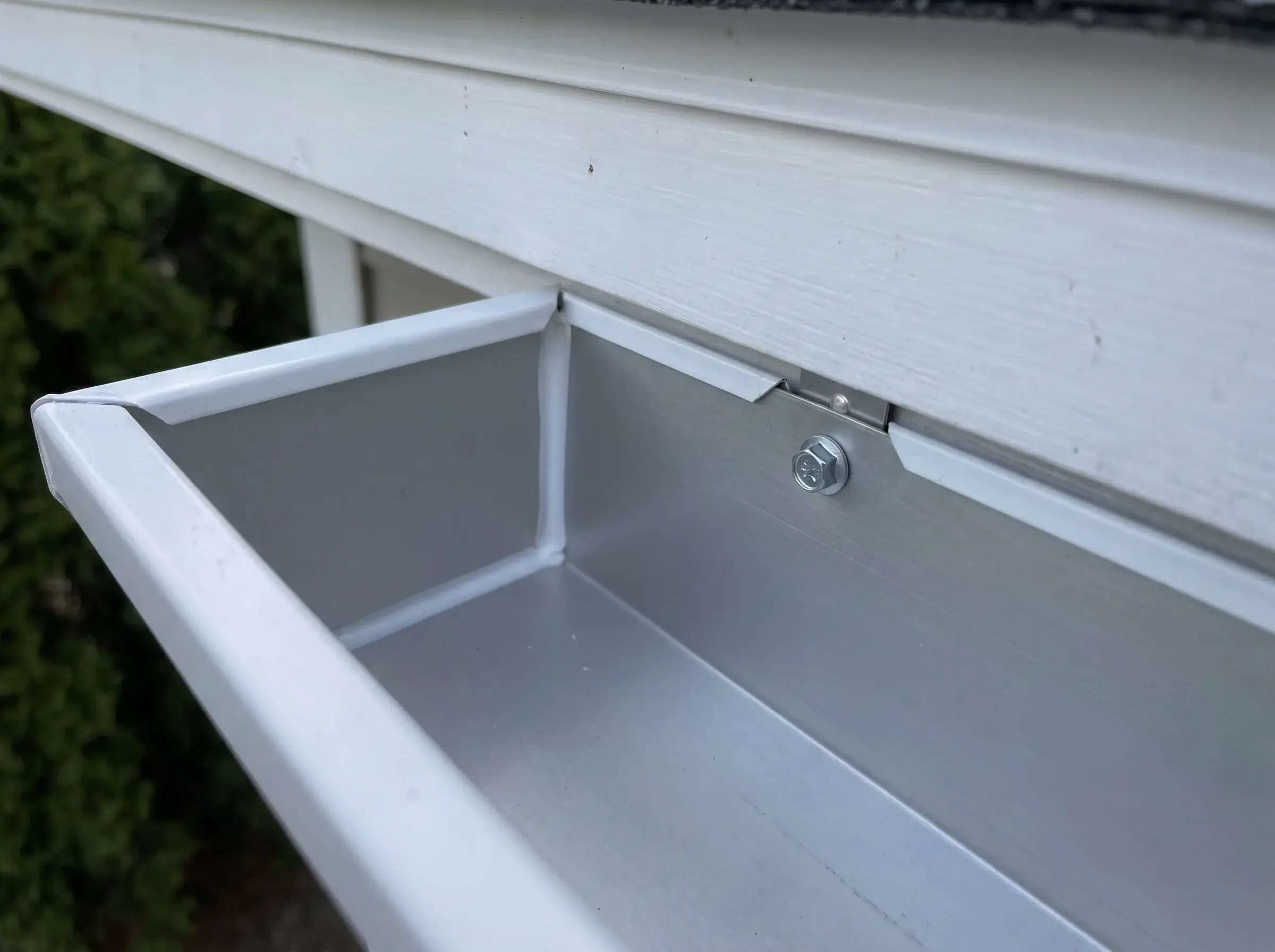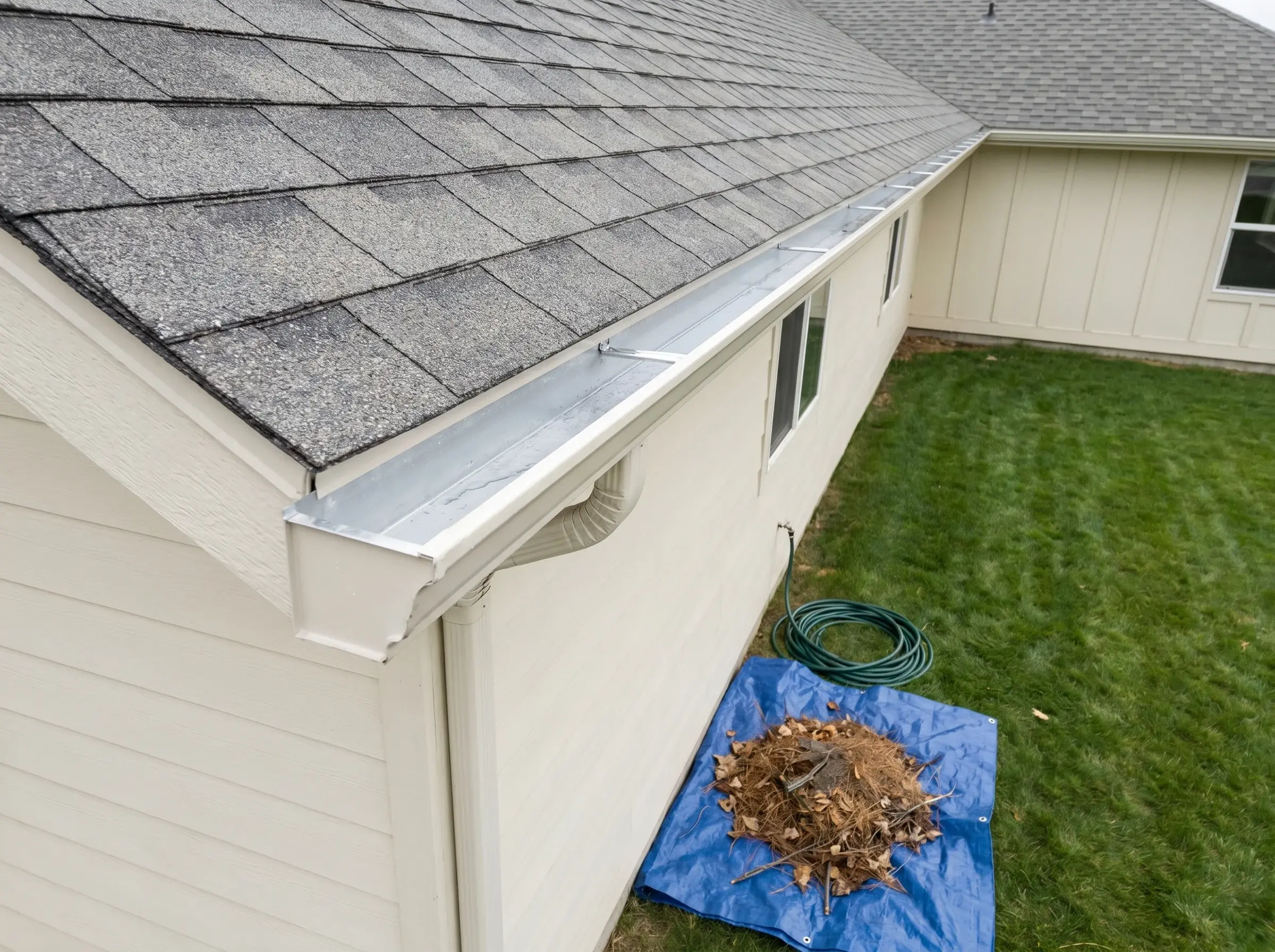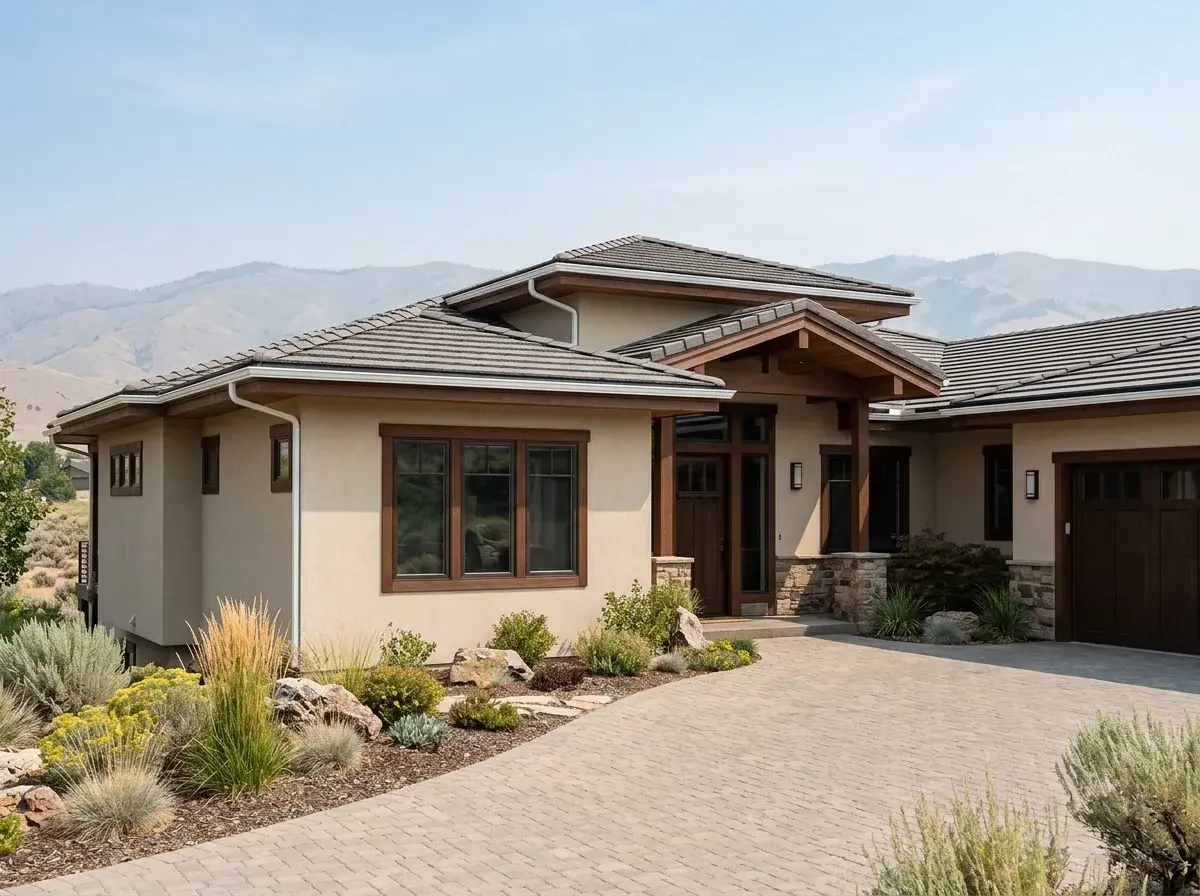
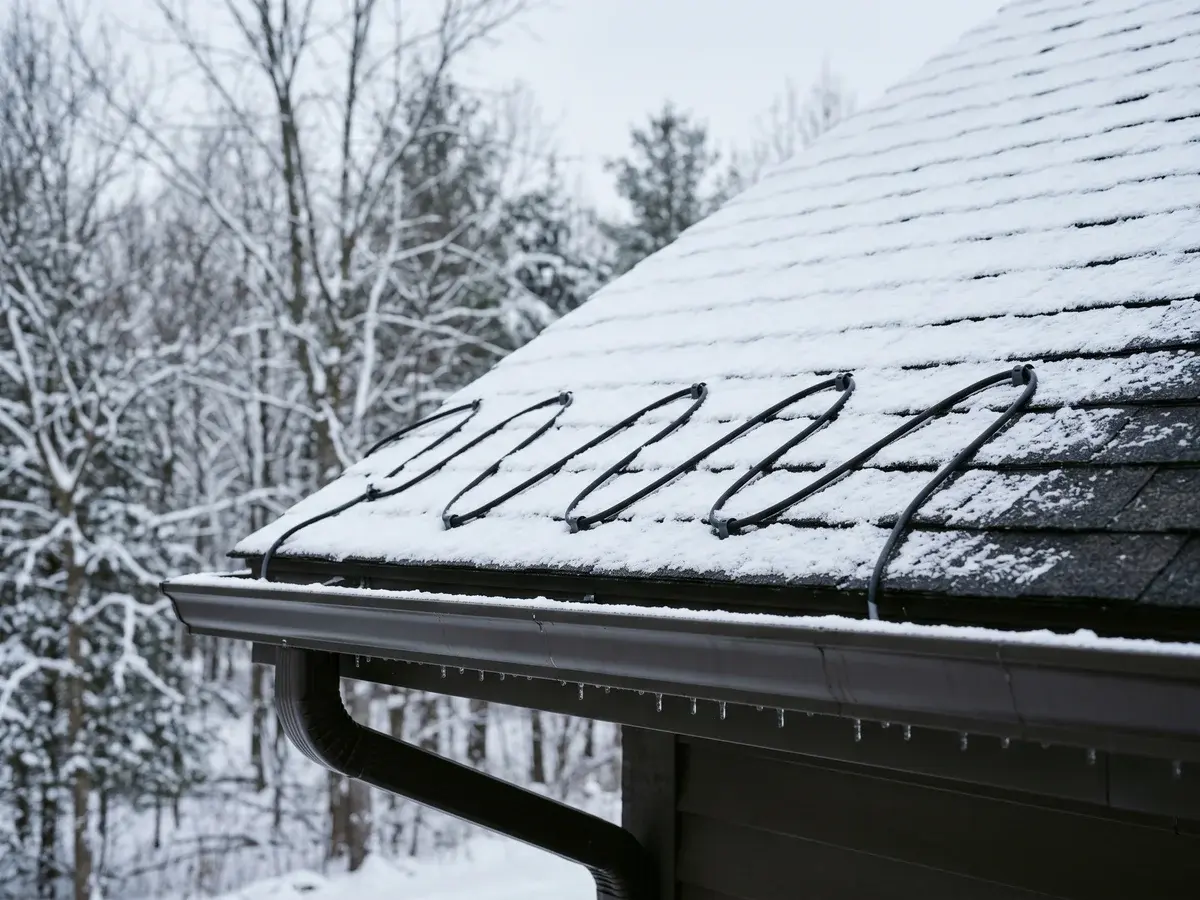
Heated gutters are ordinary gutters with an electric heat cable run through them, usually clipped in a zigzag along the bottom edge of the roof, laid in the gutter, and dropped down the downspout. The cable doesn't melt the roof. It keeps a channel open so meltwater can drain instead of refreezing at the eave. On most Boise homes that's needed on a few runs, not the whole house: shaded north-facing eaves, valleys that dump onto a short gutter, low-slope sections, and downspouts that freeze solid. It never fixes the attic heat loss behind most ice dams.
Section
What are heated gutters, heat tape, and heat cable?
The terms get used interchangeably, which is half the confusion. Heat cable, or heating cable, is the electric cable itself. Heat tape is the older hardware-store name, usually for a constant-wattage product that plugs into an outlet. Heated gutters describes the result: a gutter and downspout with cable installed in them. Some gutter guards are sold as heated guards that pair a guard with a cable; the cable does the de-icing either way.
What matters is what the cable is made for. Roof and gutter de-icing cable is built and listed for that job; Raychem's IceStop datasheet, for example, describes it as providing drain paths for roofs, gutters, and downspouts made from standard materials. Cable sold to keep water pipes from freezing is a different product. Check that the package says roof and gutter de-icing before it goes on a roof.
Section
Does a Boise home need heat cable?
Usually not everywhere. NOAA's 1991–2020 normals for the Boise Air Terminal put average seasonal snowfall at 17.6 inches, with about 6 days a year bringing an inch or more of new snow. What Boise has a lot of is freeze-thaw: about 108 nights a year at or below freezing, but only about 16 days that stay below freezing all day. Most winter snow melts in the afternoon and refreezes overnight. Where that meltwater can't reach the downspout before dark, it freezes in the gutter, and the next day's melt backs up behind it.
| Month | Nights at or below 32°F | Normal snowfall |
|---|---|---|
| Oct | 3.7 | 0.1 in |
| Nov | 16.3 | 2.0 in |
| Dec | 25.2 | 5.6 in |
| Jan | 25.5 | 5.3 in |
| Feb | 20.1 | 3.3 in |
| Mar | 11.2 | 1.2 in |
That pattern makes heat cable a targeted fix. The runs that ice up every winter are almost always the same ones:
- North-facing and tree-shaded eaves that never get afternoon sun, where meltwater from the warmer side of the roof refreezes.
- Roof valleys that pour meltwater from two roof planes onto a short stretch of gutter.
- Low-slope eaves and porch roofs where water moves slowly.
- Downspouts that freeze from the bottom up, especially ones that empty onto shaded concrete or into a buried drain.
- Foothills and Hidden Springs homes at elevation, which hold snow on the roof longer than the valley floor.
Sunny south- and west-facing eaves on a clean, well-pitched gutter rarely need cable in Boise. Neither does a gutter that only ices because it's full of leaves; that's a fall gutter cleaning problem, and cable laid in wet leaves just warms a puddle.
Section
Self-regulating cable or constant-wattage heat tape?
Self-regulating cable has a conductive polymer core between two bus wires. Raychem's IceStop datasheet says the core regulates its own heat output in response to ambient conditions, which avoids hot spots on roof and gutter materials, and it rates that cable at a nominal 12 watts per foot in ice or snow. Constant-wattage cable puts out the same heat per foot whenever it's energized, whether the gutter is packed with ice or bone dry. Many plug-in kits add a thermostat that switches them on and off, but while they're on, they run at full output.
| Self-regulating cable | Constant-wattage heat tape | |
|---|---|---|
| Heat output | Adjusts along its length to conditions | Same output any time it's on |
| Length | Cut to length on site (parallel circuit) | Usually sold as fixed-length kits |
| Running cost | Lower: draws less as conditions warm | Higher: full draw whenever switched on |
| Our take | What we install on chronic runs | We don't recommend it on roofs |
Section
How much does heat cable cost to run in Boise?
You can do the math with the label on the cable and your Idaho Power bill. Watts per foot times feet of cable, divided by 1,000, gives kilowatts. Multiply by the hours it runs for kilowatt-hours, then by your rate.
Idaho Power's standard residential rate (Schedule 1, effective January 1, 2026) charges a base 9.9332¢ per kWh for the first 800 kWh in non-summer months, which run October 1 through May 31. Usage from 801 to 2,000 kWh is 10.4305¢, and anything above 2,000 kWh is 11.0052¢, plus a $15 monthly service charge. Riders and adjustments on the bill, such as the power cost adjustment and energy efficiency rider, move the final number, so treat these as base rates.
| If it runs | Energy used | Cost |
|---|---|---|
| 1 hour | 0.72 kWh | About 7.5¢ |
| 24 hours | 17.3 kWh | About $1.80 |
| Nonstop through December and January (62 days) | 1,071 kWh | About $112 (about $118 at the 11.0052¢ tier) |
Treat that as a ceiling, not a forecast. The 12 W/ft figure is the cable's rating in ice or snow, and self-regulating cable turns its output down as conditions warm, so its real draw is lower. A controller, or a switch you only flip on during snow and ice, cuts the hours further. The expensive mistake runs the other way: constant-wattage tape left plugged in all winter, running at full output on dry, sunny days.
Section
What does heat cable cost to install?
Our ice dam prevention cost guide has the full breakdown. In short, self-regulating cable typically runs $12–$25 per linear foot installed across the roof edge, gutter, and downspout. Cable on one or two chronic runs usually lands between $600 and $2,500, and a whole-eave system with a new circuit can reach $2,500–$6,000 or more. If there's no suitable power near the run, a licensed electrician adds a dedicated circuit with ground-fault equipment protection, typically $150–$600 or more per our cost guide (a GFEP breaker can add to that).
The pre-freeze drainage audit and cleaning, $175–$425, comes first either way. It's the step that tells you whether you need cable at all.
Want this handled by a local crew?
Free on-site estimate across the Treasure Valley — call or send a few details and we'll get back the same day.
Section
What makes a heat cable install safe?
- Ground-fault equipment protection on the circuit. Raychem's datasheet says ground-fault equipment protection must be used on each heating-cable branch circuit, because arcing from a damaged cable may not be stopped by conventional circuit protection. The National Electrical Code's Article 426, which covers fixed outdoor de-icing equipment, requires ground-fault equipment protection (a GFEP breaker or the system's built-in device), per NEC 426.28.
- The manufacturer's clips and connection kits. IceStop, for example, carries its c-UL-us listing only when installed with the maker's approved connection kits and accessories.
- A continuous drain path. Cable that stops at the bottom of the gutter leaves the downspout to freeze shut; run it down the downspout to the outlet so meltwater has somewhere to go.
- A clean, correctly pitched gutter underneath. Cable can't move water out of a gutter that holds it.
- Install before deep cold. The IceStop datasheet lists 0°F as the minimum installation temperature, and the work is easier and safer before snow is on the roof.
- Power only when it's needed: a switch, thermostat, or snow-and-moisture controller, not a cord left plugged in from November to March.
Section
Heat cable or attic insulation?
The U.S. Department of Energy's Building America Solution Center explains that ice dams form when there is snow on the roof and the roof deck under it gets above freezing; meltwater runs down to the colder eave and refreezes. Its fix list is air sealing the ceiling, insulating the attic, and ventilating the roof. Heat cable does none of that. It keeps a path open through the ice.
So if ice builds along the whole length of the roof every winter, on a house with clean gutters, the attic is the likelier cause and cable is a bandage. We install gutters, guards, and heat cable, not insulation, and when the pattern points to heat loss we say so in writing. The full fix order is in how to stop ice dams on Idaho homes.
Section
Do heat cable and gutter guards work together?
Yes, and they handle different halves of the winter problem. A gutter guard keeps leaves and needles out so the channel stays open; heat cable keeps that open channel from freezing shut on a shaded run. The cable still has to be installed the way its manufacturer specifies, guard or no guard. How guard types handle snow and ice is in do gutter guards work in Idaho winters, and sliding snow under metal roofs is in snow guards vs gutter guards.
Section
When should heat cable go in?
Before the freezing nights stack up. The median first 32°F night at the Boise airport is October 21, the median first hard freeze (28°F) is October 31, and November already averages 16.3 freezing nights before December's 25.2. Book the drainage audit and cleaning in late October or November, after the leaves are down, and have cable on the chronic runs before December. Then switch it on and check it before the first real snow, not during it.
Section
Getting heat cable installed in the Treasure Valley
We install self-regulating cable as part of ice dam prevention, and only on the runs that need it: ice dam prevention in Boise, Meridian, Eagle, Garden City, Nampa, Caldwell, and Middleton. If the gutter itself is the problem (sagging, back-pitched, or pulling off the fascia), start with gutter repair in Boise. Call (208) 247-2660 or request a free estimate, and tell us which side of the house ices up.
Section
Sources
- NOAA NCEI U.S. Climate Normals 1991–2020, Boise Air Terminal (USW00024131), annual/seasonal normals — https://www.ncei.noaa.gov/data/normals-annualseasonal/1991-2020/access/USW00024131.csv
- NOAA NCEI U.S. Climate Normals 1991–2020, Boise Air Terminal, monthly normals — https://www.ncei.noaa.gov/data/normals-monthly/1991-2020/access/USW00024131.csv
- Chemelex (Raychem) — IceStop self-regulating roof and gutter de-icing heating cable data sheet (H56428): output, minimum installation temperature, approvals, ground-fault protection — https://cdn.chemelex.com/Product%20Documents/Data%20Sheets/RAYCHEM-DS-H56428-IceStopRoofGutterDeicing-EN.pdf
- Idaho Power — Schedule 1, Residential Service Standard Plan, effective January 1, 2026 — https://docs.idahopower.com/pdfs/aboutus/ratesregulatory/tariffs/156.pdf
- EC&M — Article 426: Fixed Outdoor Electric Deicing and Snow-Melting Equipment (NEC 426.28 ground-fault protection) — https://www.ecmweb.com/national-electrical-code/article/20900801/article-426-fixed-outdoor-electric-deicing-and-snow-melting-equipment
- U.S. DOE Building America Solution Center (PNNL) — Construct Roofs and Attics for Ice Dam Prevention — https://basc.pnnl.gov/resource-guides/construct-roofs-and-attics-ice-dam-prevention
- Boise Gutter Guards ice dam prevention cost guide — our installed heat cable and electrical ranges
FAQ
Common questions on this topic.
Are heated gutters worth it in Boise?
How much does it cost to run gutter heat cable?
Is heat tape the same as heat cable?
Do I need a special outlet or circuit for gutter heat cable?
Will heat cable stop ice dams?
About the author
Mark
Owner· Licensed Idaho Contractor RCE-6681702
Mark owns Boise Gutter Guards, a licensed Idaho contractor (RCE-6681702) serving Boise, Meridian, Eagle, Nampa, Caldwell, Kuna, Star, and Garden City. He started the company after seeing too many Treasure Valley homeowners get sold under-sized gutters, nailed-on hangers, and silicone-sealed seams that fail in the first hard freeze. Every estimate is done in person, every install is backed in writing, and every customer gets a job-site walkthrough before the crew leaves.