A gutter estimate shouldn't read like a foreign language. But it usually does — K-style, .032 gauge, hidden hangers, miters, back-pitch, drip edge. This glossary defines every gutter term you're likely to see on a quote or hear from an installer, grouped the way the work actually breaks down: the shape of the gutter, what it's made of, the parts that bolt together, the guards that sit on top, the wood it hangs on, the problems that send people looking for us, and how the gutter gets built.
Use it however helps. Skim the group that matches what's on your estimate, or jump straight to a word with the table of contents. Every definition is written so a homeowner can act on it — what the term means, and why it matters for a house in the Treasure Valley's freeze-thaw, pine-needle, semi-arid climate.
Section
Profiles and shapes
The profile is the cross-section shape of the gutter — what you'd see if you cut it and looked at the end. It sets how much water the gutter holds and how it looks against the roofline.
| Term | What it means |
|---|---|
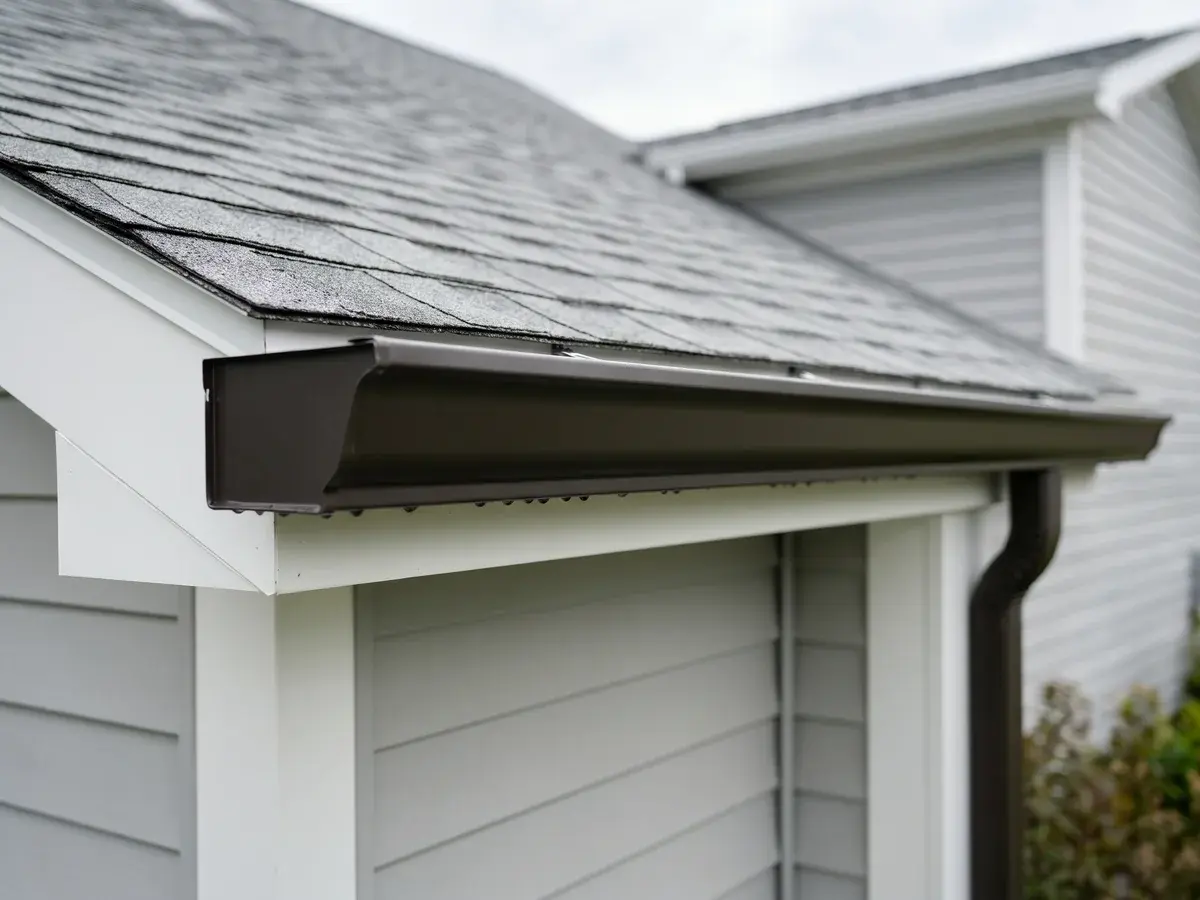
| K-style | The most common residential gutter profile in the US, with a flat back and a decorative front face that resembles crown molding (its silhouette loosely looks like the letter K). It holds more water than a half-round of the same width, which is why it dominates Treasure Valley new-construction and replacement jobs. |
| Half-round | A semicircular, tube-shaped gutter often paired with older, historic, or higher-end homes. Its smooth interior sheds debris and resists corrosion better than K-style but carries less water for a given width. |
| Fascia gutter | A gutter style with a tall, flat front face that mounts directly to the fascia board and often serves as the visible fascia trim itself. Common on certain modern and West Coast home styles. |
| Box gutter | A large rectangular gutter, often built into the roofline or behind a parapet rather than hung on the eave, used on commercial buildings and some older or architectural homes for high water capacity. |
Section
Materials and gauge
Material decides cost, lifespan, and how the gutter handles ladder contact, snow load, and ice. Gauge is the thickness of that material — a small number with a big effect on how long the gutter stays straight.
| Term | What it means |
|---|---|
| Aluminum | The dominant gutter material: lightweight, rust-proof, available in many baked-on colors, and well suited to seamless on-site forming. The standard choice for most Treasure Valley homes. |
| .032 vs .027 gauge | Aluminum thickness measured in inches; .032 is a heavier, more dent- and sag-resistant grade than the builder-standard .027. The thicker .032 better withstands ladder contact, snow load, and ice, which matters under Idaho freeze-thaw conditions. |
| Copper | A premium gutter metal that never needs painting and develops a protective green-brown patina over time. It is durable and long-lived but costs substantially more than aluminum and is typically installed on high-end or historic homes. |
| Galvanized steel | Steel coated with zinc for corrosion resistance; stronger and more impact-resistant than aluminum but heavier, and it will eventually rust where the coating wears through. Often chosen for strength on commercial or heavy-snow applications. |
| Coil | The flat roll of painted aluminum (or other metal) stock that a seamless gutter machine feeds and forms into finished gutter on-site. Coil stock determines the color and gauge of the final gutter. |
Section
Components
These are the parts that make up a working gutter system — the pieces a line-item estimate counts and prices. Several of them, especially miters and end caps, are the spots that leak first when sealant fails.
| Term | What it means |
|---|---|
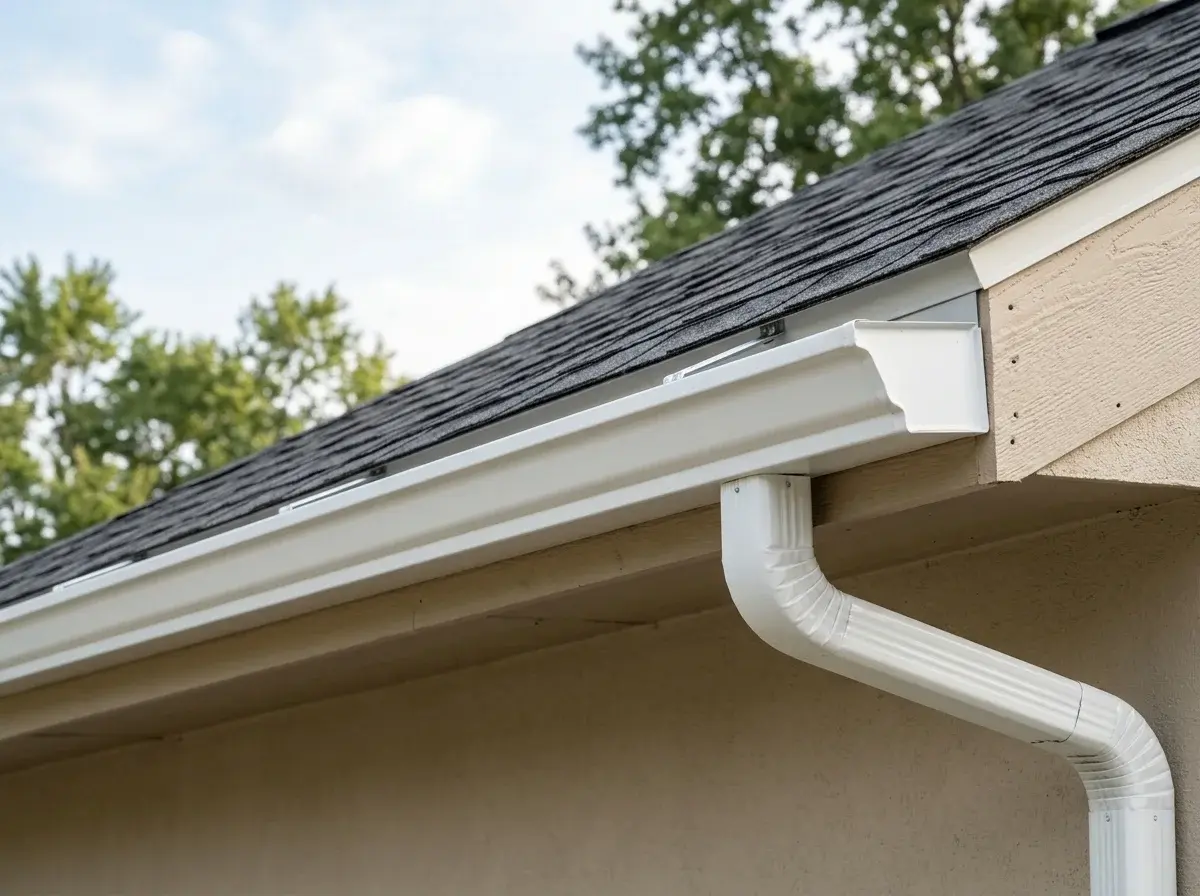
| Downspout | The vertical pipe that carries water from the gutter down to the ground or drainage system. Sizing and number of downspouts determine how fast a gutter can shed heavy rain or snowmelt. |
| Elbow | A pre-formed angled fitting that redirects a downspout, typically to route water around the eave overhang and toward the foundation drainage point. |
| Miter | The corner joint where two gutter runs meet at an inside or outside angle; it can be a factory-made strip miter or a field-cut and sealed joint. Miters are a frequent leak point and a key place to check sealant. |
| End cap | The piece that closes off the open end of a gutter run to hold water in and direct it toward the outlet. End caps are a common spot for leaks if the sealant fails. |
| Hidden hanger | A bracket that clips inside the gutter and screws into the fascia to support the gutter without visible fasteners on the front face. It is the modern standard, holding more securely than older spikes under snow and ice load. |
| Spike-and-ferrule | An older mounting method using a long nail (spike) driven through a tube spacer (ferrule) and into the fascia. Spikes tend to work loose over time, especially under freeze-thaw and snow load, which is why hidden hangers have largely replaced them. |
| Drip edge | A metal flashing installed along the roof edge that directs runoff into the gutter and away from the fascia. Proper drip edge keeps water from wicking behind the gutter and rotting the fascia or soffit. |
| Splash block | A sloped block or tray placed under a downspout outlet to disperse water and steer it away from the foundation. A low-cost way to reduce soil erosion and basement-moisture issues. |
| Conductor head / leader head | A funnel-shaped collector box mounted on a wall that catches water from a roof scupper or upper downspout and channels it into a lower downspout. Used decoratively and to handle high water volume; more common on commercial and architectural buildings. |
| Outlet / drop | The hole and fitting cut into the bottom of a gutter where water exits into the downspout. Outlet placement and count directly affect how well a gutter drains. |
Want this handled by a local crew?
Free on-site estimate across the Treasure Valley — call or send a few details and we'll get back the same day.
Section
Gutter guards
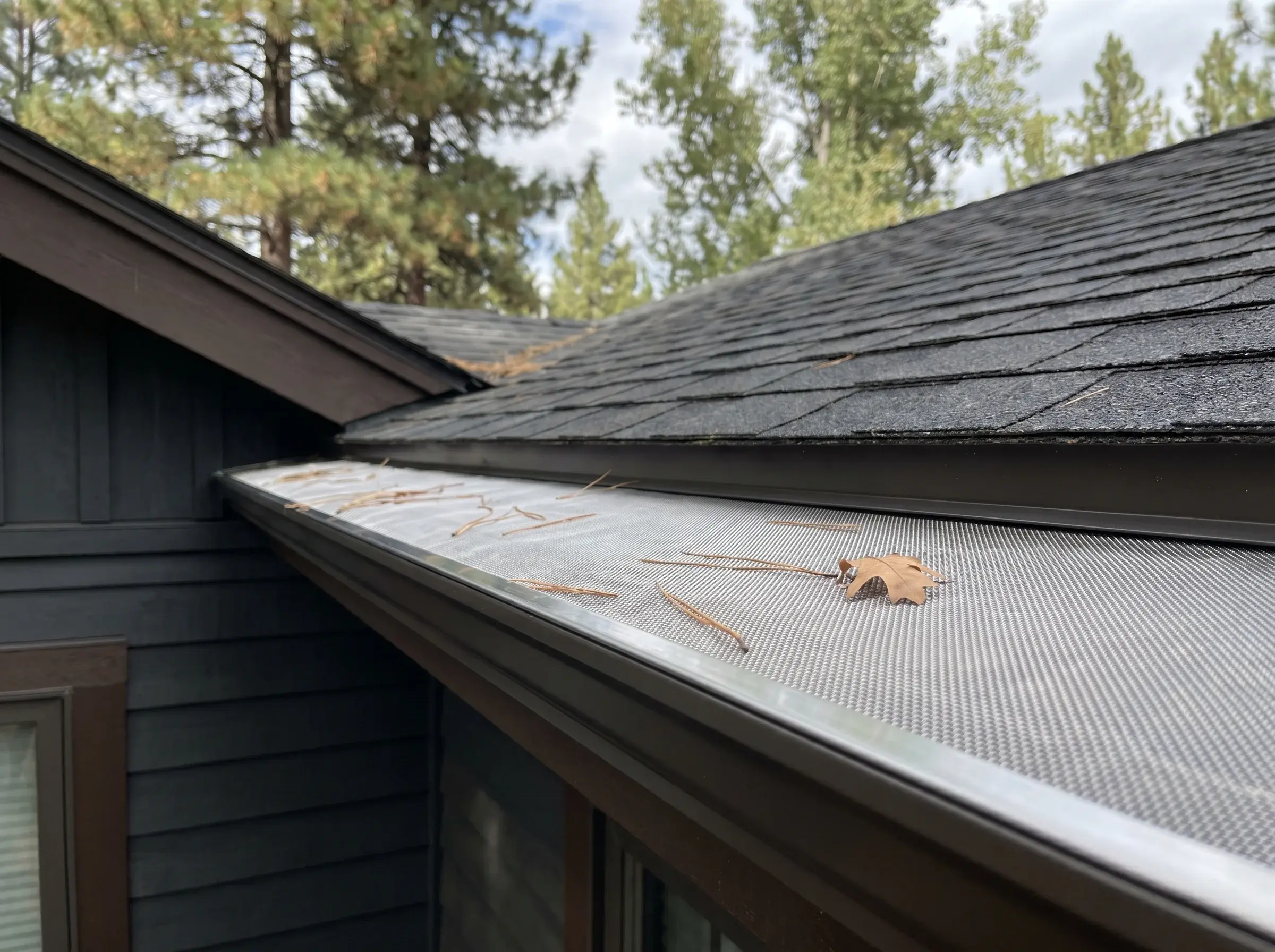
Guards are the covers that keep debris out while letting water in. The differences between them matter most in pine country — and almost everywhere in the Treasure Valley foothills counts as pine country.
| Term | What it means |
|---|---|
| Micro-mesh | A guard with a fine stainless-steel or metal mesh over a rigid frame that blocks even small debris while letting water through. It is the most effective option against pine needles, the most common Treasure Valley gutter clog. |
| Reverse-curve (surface-tension) guard | A solid-topped guard with a curved nose at the front edge; water clings to the curve and follows it into the gutter while debris falls off. Effective against leaves but can let fine needles and grit ride over in heavy rain if not well matched. |
| Perforated screen | A metal or plastic panel with punched or stamped holes that keeps out leaves and larger debris. Cheaper than micro-mesh but the larger openings can still admit pine needles and small seed pods. |
| Foam insert | A porous foam block dropped inside the gutter so water passes through while debris stays on top. Inexpensive and DIY-friendly, but it degrades in sun, can hold seeds that sprout, and is generally short-lived. |
| Brush guard | A cylindrical bristle insert (like a large pipe cleaner) set in the gutter to catch debris while water flows around the bristles. Easy to install but tends to trap pine needles in the bristles, limiting its usefulness in needle-heavy foothills yards. |
Section
Anatomy of the eave
These are the parts of the roof edge the gutter interacts with. They aren't gutter itself, but they decide whether a gutter can be hung securely — and they're the first things to rot when a gutter overflows.
| Term | What it means |
|---|---|
| Fascia | The vertical, outward-facing board running along the roof edge that the gutter mounts to. Because it bears the gutter's weight, water-damaged or rotted fascia must be repaired before reliable gutter hanging. |
| Soffit | The underside panel that closes the gap between the roof edge and the exterior wall, often vented for attic airflow. Overflowing or back-pitched gutters are a leading cause of soffit staining and rot. |
| Rake | The sloped edge of the roof that runs up the gable end (as opposed to the horizontal eave). Gutters typically hang on the eave, not the rake, though the rake edge still sheds water that the gutter system must manage. |
Section
Problems
When a gutter system fails, it usually fails in one of these specific ways. Knowing the term tells you what the fix is — and several of these are aggravated by the Treasure Valley's freeze-thaw winters.
| Term | What it means |
|---|---|
| Ice dam | A ridge of ice that forms at the roof edge when melting snow refreezes, backing water up under the shingles. Clogged or poorly draining gutters worsen ice dams, a recurring concern during Treasure Valley freeze-thaw winters. |
| Overshoot | When water sheets off the roof faster than the gutter can capture it and spills over the front edge, often during heavy downpours or off steep roofs. Undersized gutters, too few outlets, or debris buildup all contribute. |
| Back-pitch | When a gutter slopes the wrong way (away from the downspout), causing standing water that overflows the back edge toward the fascia. It promotes fascia rot, mosquito breeding, and ice buildup in winter. |
| Fascia rot | Decay of the fascia board caused by chronic moisture from overflowing, leaking, or back-pitched gutters. Rotted fascia loses its grip on hangers and must be replaced before the gutter can be securely re-hung. |
| Oxidation | The chalky, dull, or discolored surface that develops as a gutter's metal or paint finish reacts with air and moisture over years. On aluminum it is mostly cosmetic; on steel it progresses to rust. |
Section
Process
Finally, the words that describe how the gutter gets made and installed — the difference between a system that lasts and one that leaks at every joint.
| Term | What it means |
|---|---|
| Seamless / on-site roll-forming | Gutter formed in one continuous length from coil stock by a roll-forming machine brought to the job site, cut to fit each run. Eliminating mid-run seams sharply reduces leak points compared with sectional gutter. |
| Sectional | Gutter sold in pre-cut lengths (often 10 feet) that are joined together with connectors and sealant during installation. The seams are the main weakness, making sectional gutter more leak-prone than seamless over time. |
| Reseal | Cleaning out an existing joint, miter, or end cap and applying fresh gutter sealant to stop or prevent leaks. A standard step before installing guards on existing gutters so the system is watertight first. |
| Pitch / slope | The slight downhill angle a gutter is hung at so water flows toward the outlet and downspout rather than pooling. Correct pitch is essential for drainage and for preventing standing water that freezes in winter. |
Once the vocabulary is clear, the decisions get easier. If you're weighing the build method, our breakdown on whether seamless gutters are worth it covers why seamless beats sectional in our freeze-thaw climate. For guard choice in pine country, our guide to the best gutter guards for pine needles walks through what actually stops needles. And if you're not sure your gutters are big enough, our gutter-sizing primer explains when 5-inch isn't enough — all three are linked below. We're a licensed Idaho gutter contractor (RCE-6681702) serving the Treasure Valley — if a term on your estimate still isn't clear, ask the installer to point to it on the house.
FAQ
Common questions on this topic.
What's the difference between fascia and soffit?
What gauge aluminum is best for gutters?
What's the difference between seamless and sectional gutters?
What is back-pitch and why does it cause leaks?
Which gutter guard is best for pine needles?
About the author
Mark
Owner· Licensed Idaho Contractor RCE-6681702
Mark owns Boise Gutter Guards, a licensed Idaho contractor (RCE-6681702) serving Boise, Meridian, Eagle, Nampa, Caldwell, Kuna, Star, and Garden City. He started the company after seeing too many Treasure Valley homeowners get sold under-sized gutters, nailed-on hangers, and silicone-sealed seams that fail in the first hard freeze. Every estimate is done in person, every install is backed in writing, and every customer gets a job-site walkthrough before the crew leaves.