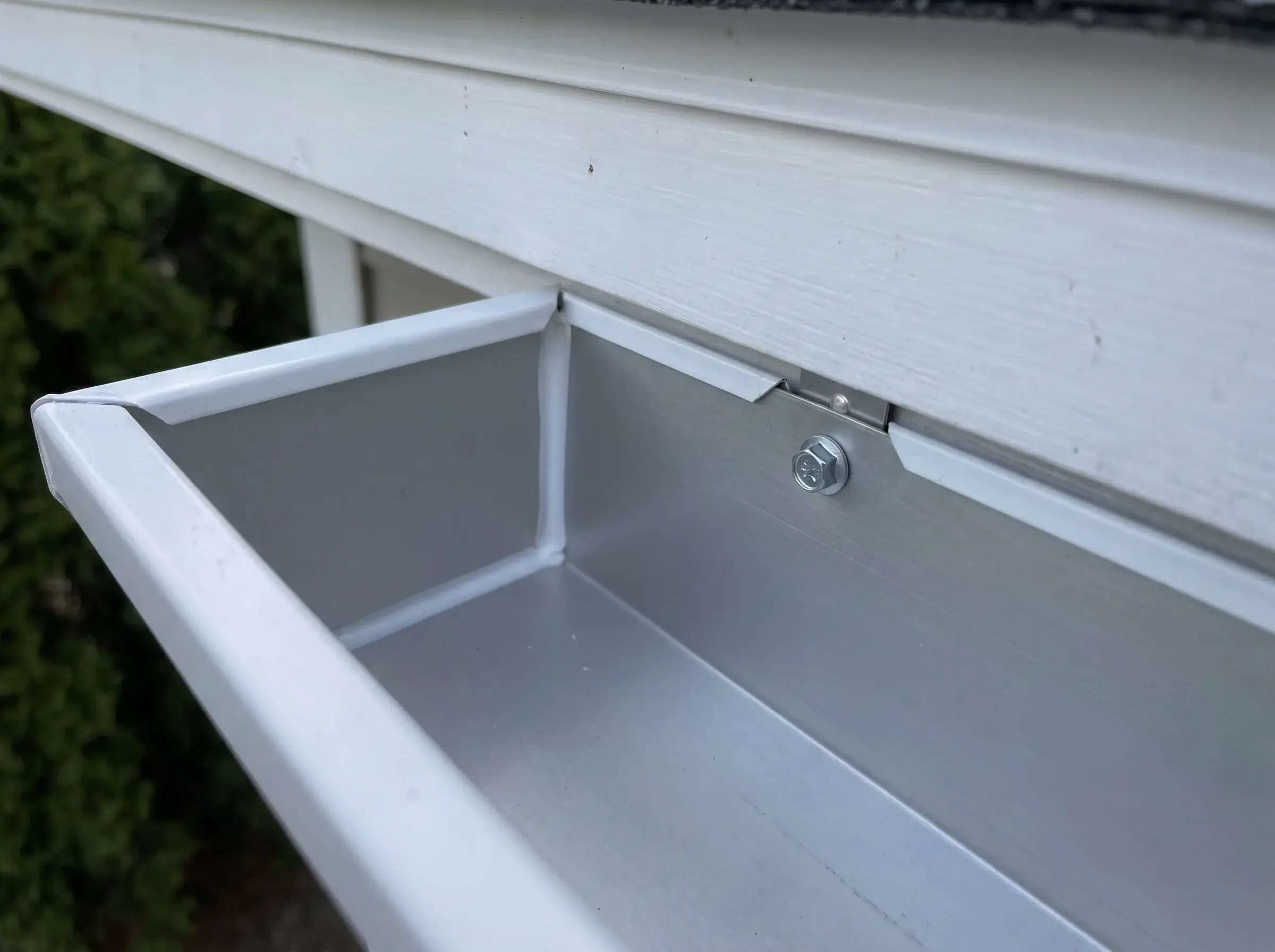
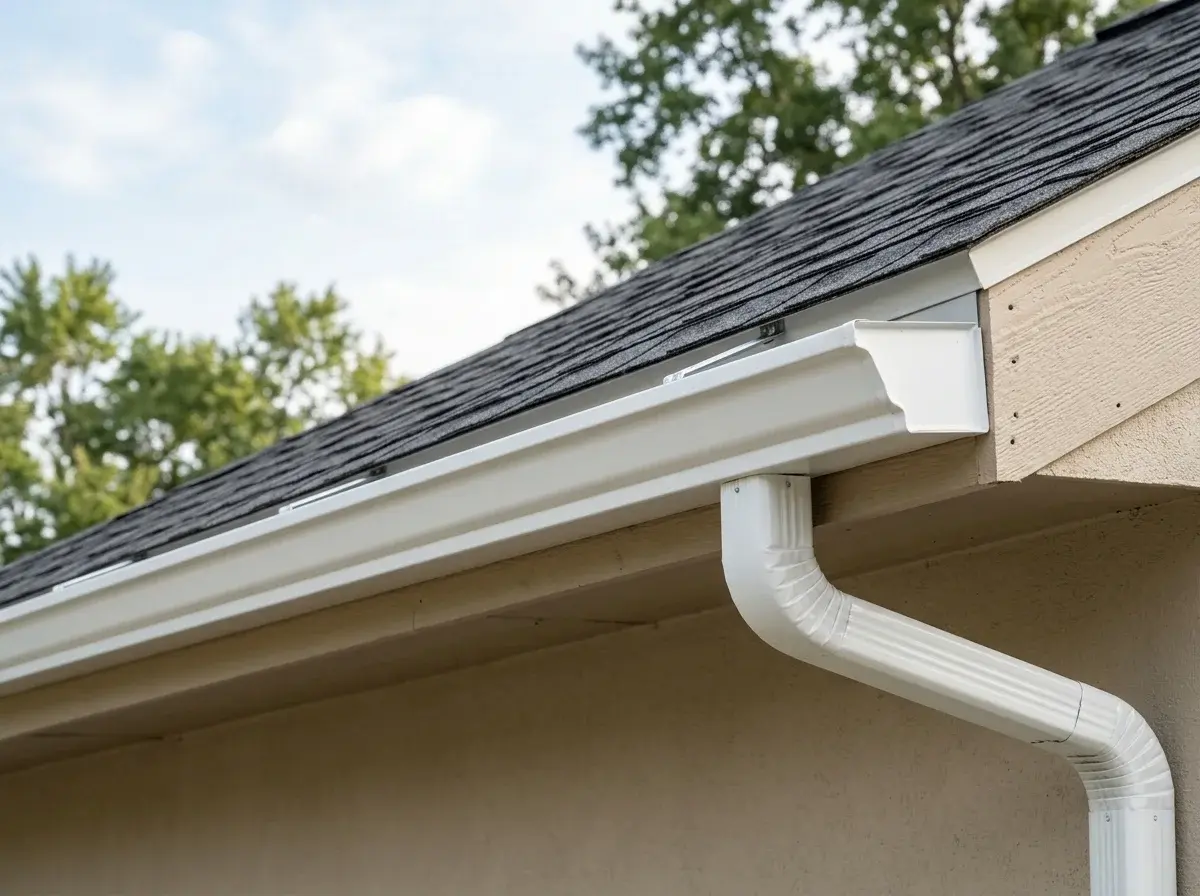
5-inch K-style is the default residential gutter across the Treasure Valley, and it's the correct spec for most homes — typically anything under about 1,500 square feet of roof per drainage segment with standard pitch and moderate debris load. 6-inch K-style is right for roughly 30% of Treasure Valley homes: steep-pitch architecturals, larger custom builds, anything in the Foothills with heavy pine load, and many Eagle and Star custom homes with multi-gable rooflines that funnel water into concentrated valleys.
Getting the size wrong is the single most common cause of recurring overflow at corners, fascia rot above downspouts, and ice-dam formation in winter. This guide walks through how capacity actually works, when each profile is appropriate, why downspout sizing matters as much as gutter size, and the specific mistakes that show up on call-outs across the valley.
Section
How gutter capacity actually works
Gutter capacity isn't really a single number — it's a flow rate, and it depends on the gutter cross-section, the pitch, the downspout outlets, and the downspout sizing. As a rough working model, a properly pitched 5-inch K-style gutter handles roughly 5,500–6,000 square feet of standard-pitch roof per downspout. A 6-inch K-style with the same pitch handles roughly 7,500–8,500 square feet per downspout — meaningfully more, and the corner outlets don't bottleneck as fast under thunderstorm peak flows. Steeper roofs deliver water to the gutter faster, which effectively reduces the roof area each downspout can handle before water overshoots the gutter or backs up at the outlet.
Section
When 5-inch K-style is correct
- Most production single-story homes in Meridian, Kuna, West Boise, and South Nampa with roofs under about 2,000 square feet per drainage segment.
- Standard-pitch rooflines (4/12 to 7/12) without unusual valleys or dormer concentrations.
- Homes with minimal tree cover — newer subdivisions, ag-adjacent lots without mature pines or cottonwoods overhead.
- Homes where the original 5-inch system has performed well for years without overflow — replacement with 5-inch makes sense if nothing's changed.
- Tighter aesthetic match on smaller cottage and bungalow architecture where 6-inch looks visually oversized.
Section
When 6-inch K-style is the right call
- Steep-pitch architectural homes (8/12 and up) — water moves faster down a steep roof and overshoots a 5-inch gutter at the eave.
- Larger custom homes with roof segments over about 2,000–2,500 square feet draining to a single gutter run.
- Homes in the Boise Foothills, Hidden Springs, and the Bench foothill edge with heavy ponderosa pine, lodgepole pine, and Douglas fir overhead — the larger cross-section keeps draining even with partial debris load.
- Eagle and Star custom builds with multi-gable rooflines that concentrate runoff into specific valleys.
- Any home where the existing 5-inch system overflows at corners during summer thunderstorms — that's the system telling you it's undersized.
- Detached shops, RV barns, and outbuildings over about 1,500 square feet of roof — these often need 6-inch even when the main house is on 5-inch.
Section
What about half-round?
Half-round gutters are an architectural choice as much as a sizing choice. The classic 6-inch half-round profile is correct on craftsman, colonial, and historic homes — anything where K-style would look visually wrong against the architecture. Capacity-wise, a 6-inch half-round runs slightly under a 6-inch K-style at the same pitch because the cross-sectional area is smaller, but the smooth interior surface drains debris more efficiently. For pre-1950 homes in the North End, downtown Caldwell, downtown Emmett, and craftsman builds in Eagle, half-round is often the right specification both visually and functionally. See our half-round gutter service page for material and color options, and our companion piece comparing seamless versus sectional construction for the underlying joint-quality question.
Want this handled by a local crew?
Free on-site estimate across the Treasure Valley — call or send a few details and we'll get back the same day.
Section
Downspout sizing matters as much as gutter size
An upsized 6-inch gutter with undersized 2x3 downspouts at the corners creates a bottleneck — the gutter fills and overflows at the outlet because the downspout can't carry water away fast enough. This is the single most common new-construction sizing mistake in the valley: builder upgrades to 6-inch on a custom home but keeps the 2x3 downspouts from the production-home spec sheet. The fix is matching the downspout to the gutter and the drainage area.
| Downspout size | Cross-section area | Roof area handled (approx.) |
|---|---|---|
| 2x3 rectangular | 6 sq in | Up to ~1,200 sq ft per downspout |
| 3x4 rectangular | 12 sq in | Up to ~2,400 sq ft per downspout |
| 3-inch round (half-round) | 7 sq in | Up to ~1,400 sq ft per downspout |
| 4-inch round (half-round) | 12.5 sq in | Up to ~2,500 sq ft per downspout |
These are working estimates at typical pitch — steeper roofs reduce the area each downspout can carry. The practical rule on a 6-inch gutter is to pair with 3x4 downspouts unless the roof area per outlet is genuinely small. Mixing a 6-inch gutter with a 2x3 downspout is technically possible and visually unobjectionable, but it's also the configuration we get called back to fix when the corners overflow during the first hard summer storm.
Section
Treasure Valley specifics
Local conditions push specific neighborhoods toward specific sizing. A short list of how that breaks down:
- Boise Foothills and Hidden Springs — 6-inch K-style with 3x4 downspouts is effectively required. The combination of pine debris (which reduces effective capacity), steep architectural pitches, and elevation-driven freeze-thaw means 5-inch overflows in summer and ice-dams in winter.
- Eagle custom homes — almost always 6-inch K-style or 6-inch half-round, with 3x4 downspouts at the corners. Multi-gable rooflines concentrate runoff at valleys that overwhelm 5-inch.
- Star acreage with detached shops — main house on 6-inch is common; outbuildings sized to their actual roof area, often also 6-inch with 3x4.
- Meridian production homes — most original builds are on 5-inch, and that's correct for the actual roof area on standard production-build footprints. The downspouts are often undersized, so replacement is often the moment to upsize from 2x3 to 3x4 at the corners that overflow.
- Caldwell, Nampa, Middleton — wind exposure matters more than capacity for most of these homes. 5-inch is typically right; what changes is hanger spacing (tighter than standard) and consistent use of screws.
- Garden City along the river — heavy leaf load + standard-pitch roofs means 5-inch usually works if paired with guards; 6-inch with guards is the long-term-low-maintenance spec.
Section
Common sizing mistakes
- Defaulting to 5-inch on a steep-pitch custom home because that's what the builder spec sheet says — the spec sheet was written for a standard production roof, not yours.
- Upgrading to 6-inch gutters while keeping 2x3 downspouts — the bottleneck moves from the gutter to the outlet but the overflow stays in the same place.
- Installing 5-inch on a Foothills home with heavy pine load — even with guards, the smaller cross-section reduces effective capacity once any debris is in the system.
- Sizing for the roof segment as a whole instead of for each drainage segment — what matters is how much roof drains to each individual gutter run, not the total roof area of the home.
- Treating downspout count as fixed — adding a third or fourth downspout to a long run often solves overflow more cheaply than upsizing the gutter itself.
Section
How to get the right size for your home
Section
Sources
- NWS Boise Climate (rankings, normals, precipitation/snow extremes for Boise + Treasure Valley) — https://www.weather.gov/boi/climate
- University of Arizona Cooperative Extension (Water Wise) — Harvest Rain: 1-inch rain = 600 gallons from a 1,000 sq ft roof — https://waterwise.arizona.edu/ways-save-water/harvest-rain
- This Old House — How to Size Gutters and Downspouts — https://www.thisoldhouse.com/gutters/21014888/how-to-size-gutters-and-downspouts
The on-site measurement is the only reliable path to the right size. A contractor who quotes a profile over the phone without seeing the actual roof pitch, drainage segments, and tree cover is guessing — usually to whatever's easiest to install. Our cost calculator at /cost-calculator/gutter-installation lets you model 5-inch vs. 6-inch and standard vs. oversized downspouts to see the cost difference; the on-site visit confirms what's actually appropriate for your home. Call (208) 247-2660 or request a free estimate at /contact and we'll walk the roof with you, measure the segments, and quote the size that's right for what the roof has to handle.
FAQ
Common questions on this topic.
What's the difference between 5-inch and 6-inch K-style gutters?
How much more do 6-inch gutters cost?
Can I just add more downspouts instead of upsizing the gutter?
Do I need 6-inch gutters in the Boise Foothills?
Is half-round a good choice for any home?
About the author
Mark
Owner· Licensed Idaho Contractor RCE-6681702
Mark owns Boise Gutter Guards, a licensed Idaho contractor (RCE-6681702) serving Boise, Meridian, Eagle, Nampa, Caldwell, Kuna, Star, and Garden City. He started the company after seeing too many Treasure Valley homeowners get sold under-sized gutters, nailed-on hangers, and silicone-sealed seams that fail in the first hard freeze. Every estimate is done in person, every install is backed in writing, and every customer gets a job-site walkthrough before the crew leaves.