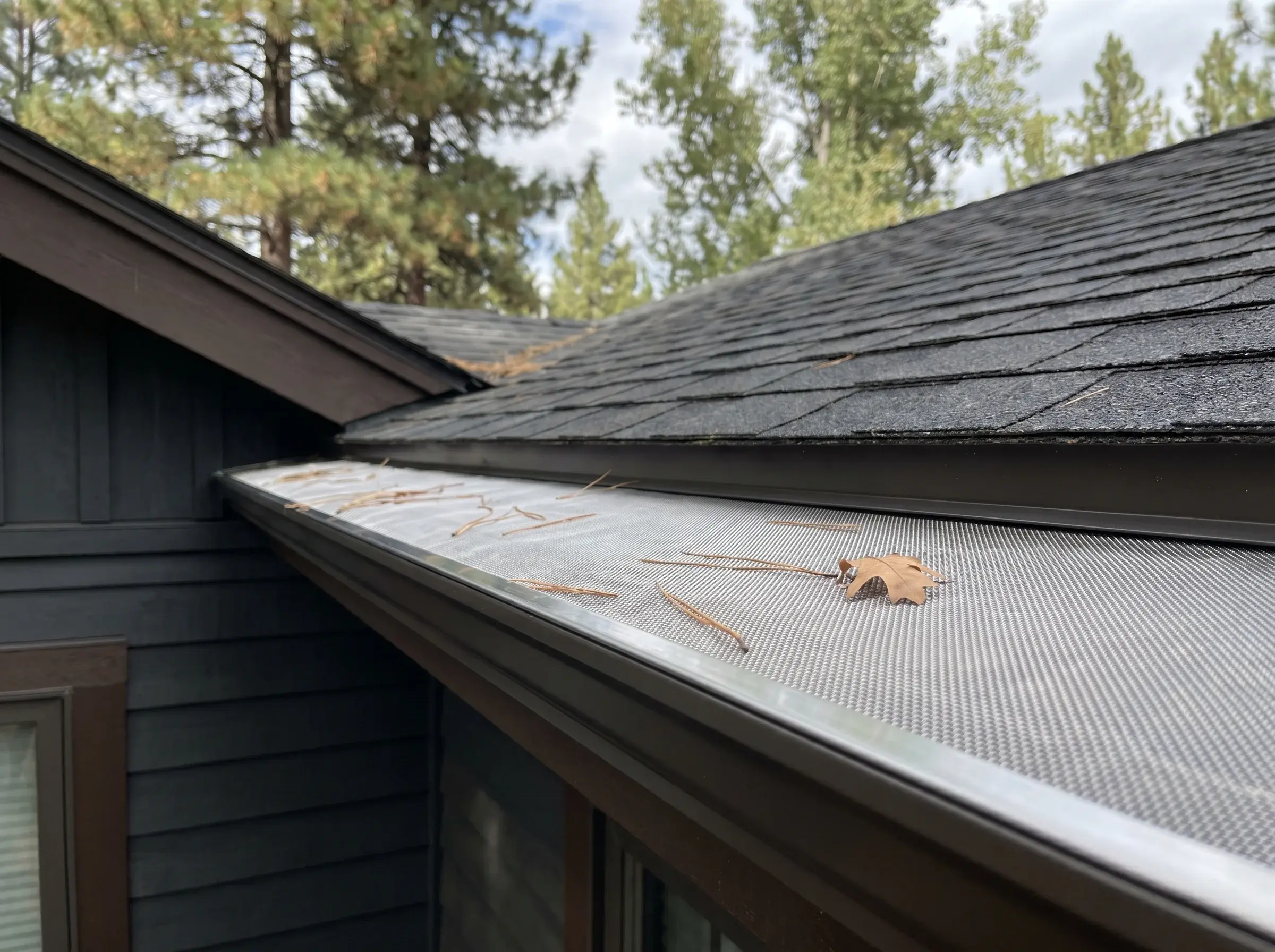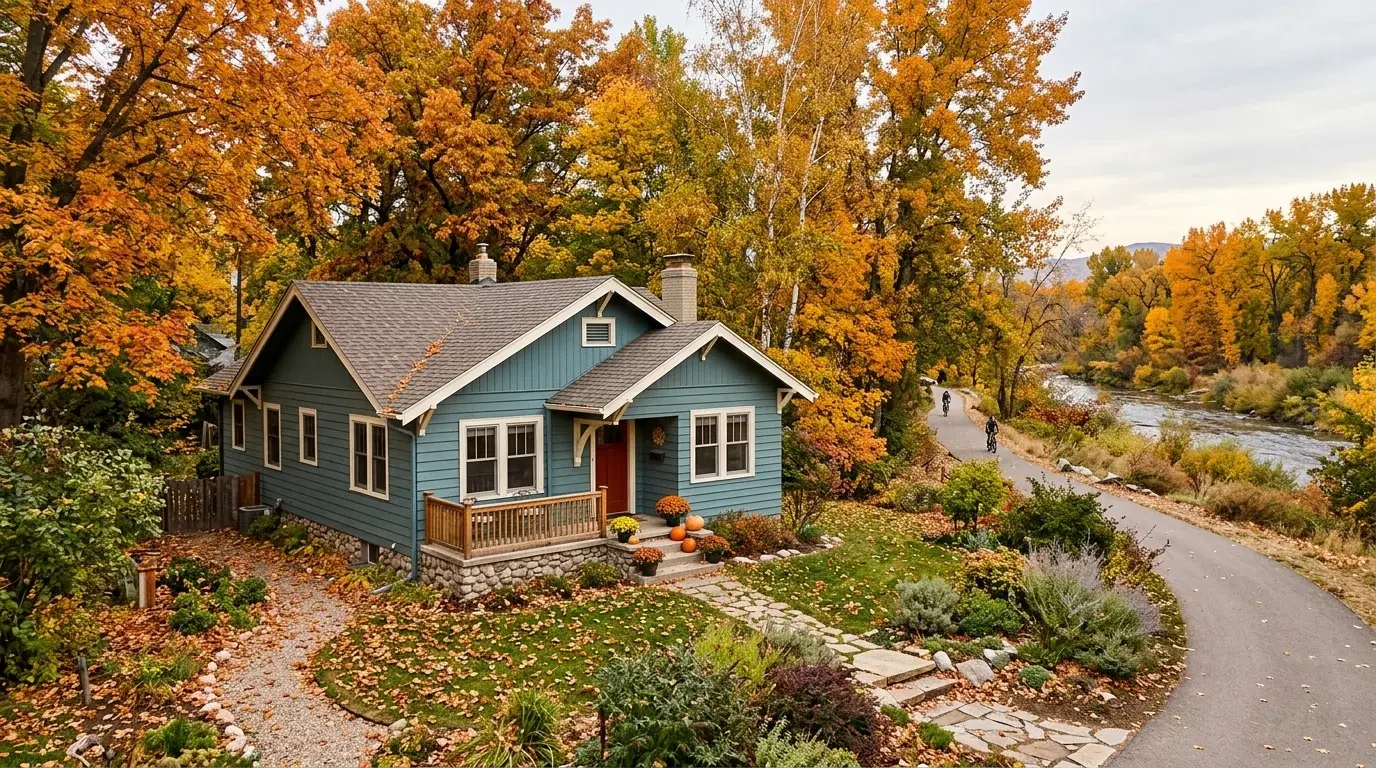
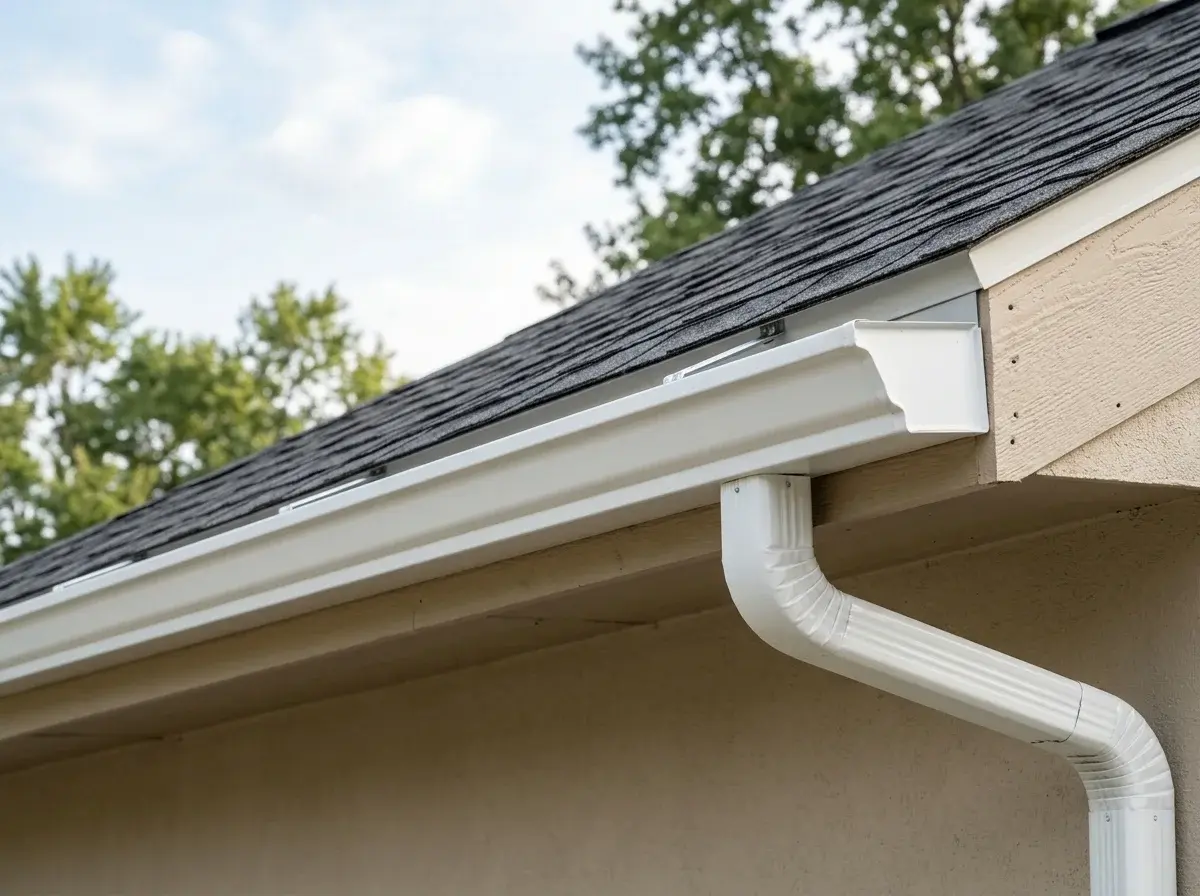
K-style is the gutter you see on almost every Treasure Valley home — flat back, ogee front, easy to form on a portable seamless machine. It became the residential default in the 1950s and hasn't moved since. But Boise's North End was platted and largely built before that — bungalows, craftsmans, and colonial revivals from the 1900s through the 1940s, designed around half-round gutters and round downspouts as period-correct hardware. Putting K-style on a 1920s craftsman is functional. It also reads instantly wrong to anyone who notices.
This isn't a purity argument. K-style is the right call on plenty of North End homes that have already been substantially modified, expanded, or re-clad. The question worth answering before any gutter replacement is: which profile fits this home, and what are you actually trading off?
Section
What makes North End homes architecturally different
The North End was platted in the late 1800s and built out through the 1940s. The dominant styles are craftsman bungalow (1900-1930), American foursquare (1900-1920), colonial revival (1900-1940), and Tudor revival (1920-1940), with a scattering of earlier Victorians along Harrison Boulevard and Warm Springs Avenue. What ties them together visually is the eave detail: exposed rafter tails, knee braces, deep overhangs, and rooflines designed with the gutter visible as an architectural element — not hidden behind facia trim. Half-round was the standard hardware of that entire era. Round downspouts with crimped elbows were the matching detail. The whole eave was designed as a system.
Section
Why half-round was the original spec
Half-round wasn't chosen because it looked nicer — though it does. It was chosen because the manufacturing technology of the era was rolled sheet metal in long sections, and a half-circle profile is the simplest, strongest shape you can roll from a flat sheet without a brake press. K-style requires the press to form the flat back and ogee front; that tooling didn't exist on jobsites until the post-war seamless machine arrived. So if your home was built before about 1950, the original gutters were almost certainly half-round, copper or galvanized steel, soldered at the joints. When you replace those with K-style, the eave loses the visual rhythm it was designed with. K-style reads as a 1960s-and-later detail, period.
Section
Half-round vs K-style: what changes functionally
| Spec | K-style 5-inch | Half-round 6-inch |
|---|---|---|
| Water capacity per foot | Higher per-foot at the same nominal size | Lower per-foot; size up one increment to match |
| Debris shedding | Debris catches on the inside corner of the ogee | Smoother interior; debris flushes more easily |
| Downspout pairing | Rectangular 2×3 or 3×4 standard | Round corrugated, larger diameter, period-correct |
| Hanger type | Hidden hanger, screwed | Brackets or spike-and-ferrule for restoration |
| Cost | Lower (commodity profile) | Higher (less common, often custom) |
| Longevity | Same as K-style aluminum (25-40 years) | Same when aluminum; copper 50+ |
| Period correctness on pre-1950 homes | Reads wrong | Reads correct |
Section
When K-style is still the right answer in the North End
Half-round isn't always the right call, even on a vintage home. A few situations where K-style is genuinely the better choice:
- Heavily modified homes — if the original eave detail has already been re-clad, the rafter tails enclosed, and the trim package changed, the half-round visual argument doesn't apply anymore.
- Additions in a different style — a 1990s second-story addition on a 1920s bungalow already breaks the period-correct case. K-style on the whole home is more visually consistent than half-round on the original + K-style on the addition.
- Tight budget constraints — half-round runs meaningfully more per foot than K-style. If the choice is between half-round on half the home or K-style on the whole home, the whole home wins.
- Multi-gable production-builder homes built on infill lots in the North End — these aren't period homes, they're new builds. K-style is fine.
- Homes where the gutter is essentially hidden behind a fascia trim board — if you can't see the profile from the street anyway, the visual argument is moot.
Want this handled by a local crew?
Free on-site estimate across the Treasure Valley — call or send a few details and we'll get back the same day.
Section
Aluminum vs copper half-round for the North End
Aluminum half-round is the practical, paint-matched answer for most North End homes — it gets the profile right at a reasonable cost and color-matches to fascia and trim. Copper half-round is the long-game, premium answer for homes where the architecture and the owner's investment horizon both line up. Copper develops a patina over five to ten years in Idaho's climate, gets better-looking with age, and lasts 50-plus years with soldered joints that don't fail. Worth reading our deeper writeup at /services/copper-gutters before going either direction on a high-end restoration.
Section
Historic district considerations
Boise doesn't have a formal historic district overlay across the whole North End, but several streets fall within neighborhood-association design guidelines — Harrison Boulevard most notably. Color guidelines and profile recommendations vary by street and by the era of the home. We pull current guidelines for your specific block before quoting, and present approved color samples on-site so there's no guesswork between estimate and install. For homes outside any overlay, you have full color and profile freedom — but the period-correct argument still applies if you care about the visual reading.
Section
Cost difference
Aluminum half-round runs meaningfully more per foot than K-style — typically 30-50% more on materials alone, plus higher labor because the brackets and downspout fittings take longer to install. The break-even argument isn't financial; it's whether the period correctness is worth the upgrade on your specific home. For a deeper breakdown of profile vs profile cost, see /resources/seamless-vs-sectional-gutters.
Section
Installing on original 1920s fascia
This is the conversation we have on almost every North End estimate. Original 1920s fascia is typically old-growth Douglas fir or western larch — denser and more weather-resistant than modern dimensional lumber. The good news: when it's sound, it holds a hidden hanger or bracket better than new fascia. The bad news: a century of paint cycles, freeze-thaw, and intermittent moisture means a lot of original fascia has soft spots, hidden rot under the gutter line, or pulled-fastener damage from previous installs. We probe every fascia run before hanging new gutters. If we find soft spots, we flag it before quoting — sometimes the right call is to budget for partial fascia repair in the same project, sometimes it's spot-treating and reinforcing locally. Either way, hanging new gutters on bad fascia is the fastest way to a callback within two seasons.
Section
Other Treasure Valley neighborhoods where half-round fits
- Downtown Caldwell — historic bungalows and craftsman homes along the streets near Indian Creek and the Caldwell town center.
- Garden City cottage and bungalow neighborhoods — pre-1960 cottage homes along older Garden City streets near the Boise River.
- Downtown Emmett — historic farmhouses and craftsman homes from the early 1900s.
- Older Nampa craftsman homes — pre-1950 stock in central Nampa and Karcher-area streets.
- Older homes scattered through the Bench in Boise — particularly Vista, Latah, and other pre-war streets.
FAQ
Common questions on this topic.
Can I get half-round gutters in colors other than copper?
Do half-round gutters handle Boise snow load?
Will replacing K-style with half-round require new fascia work?
Are half-round gutters harder to maintain than K-style?
Do you install half-round on new construction in the Treasure Valley?
About the author
Mark
Owner· Licensed Idaho Contractor RCE-6681702
Mark owns Boise Gutter Guards, a licensed Idaho contractor (RCE-6681702) serving Boise, Meridian, Eagle, Nampa, Caldwell, Kuna, Star, and Garden City. He started the company after seeing too many Treasure Valley homeowners get sold under-sized gutters, nailed-on hangers, and silicone-sealed seams that fail in the first hard freeze. Every estimate is done in person, every install is backed in writing, and every customer gets a job-site walkthrough before the crew leaves.