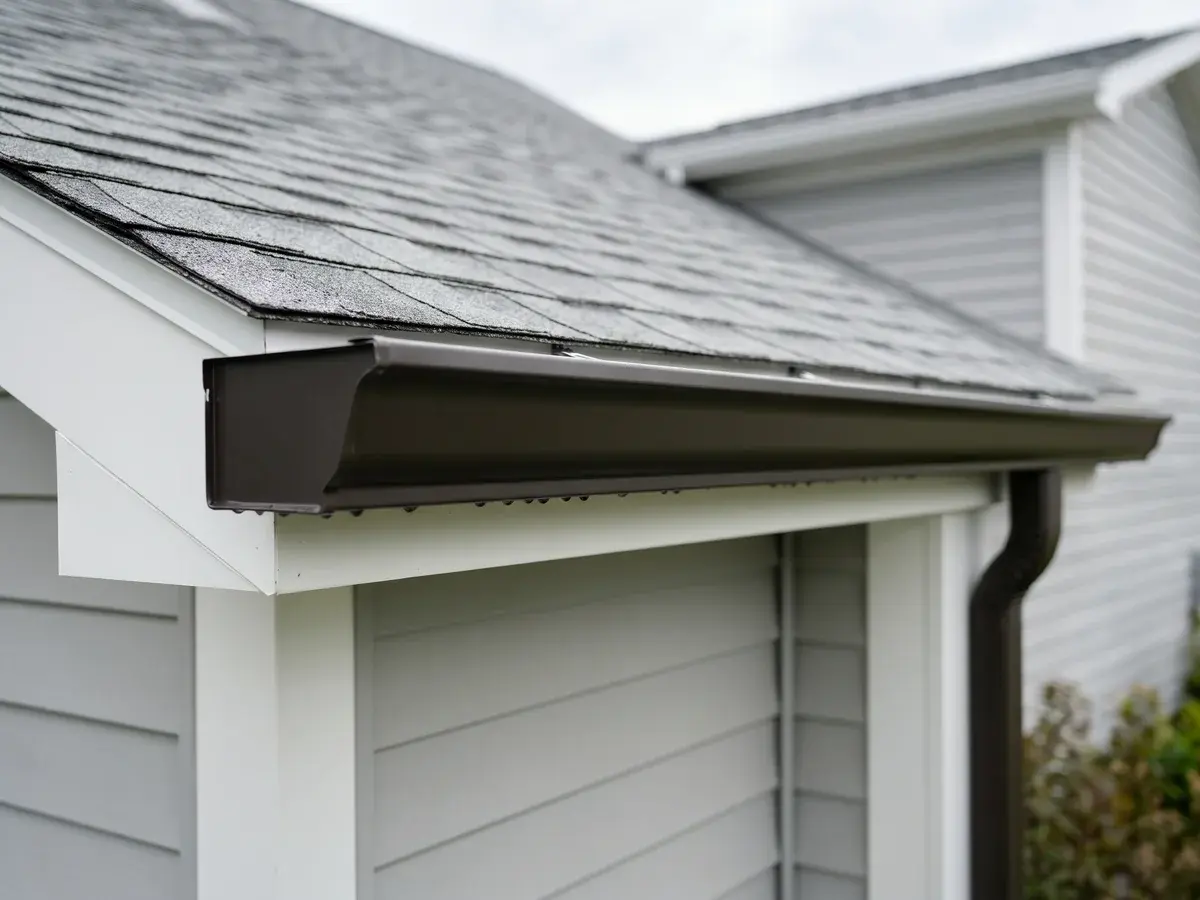
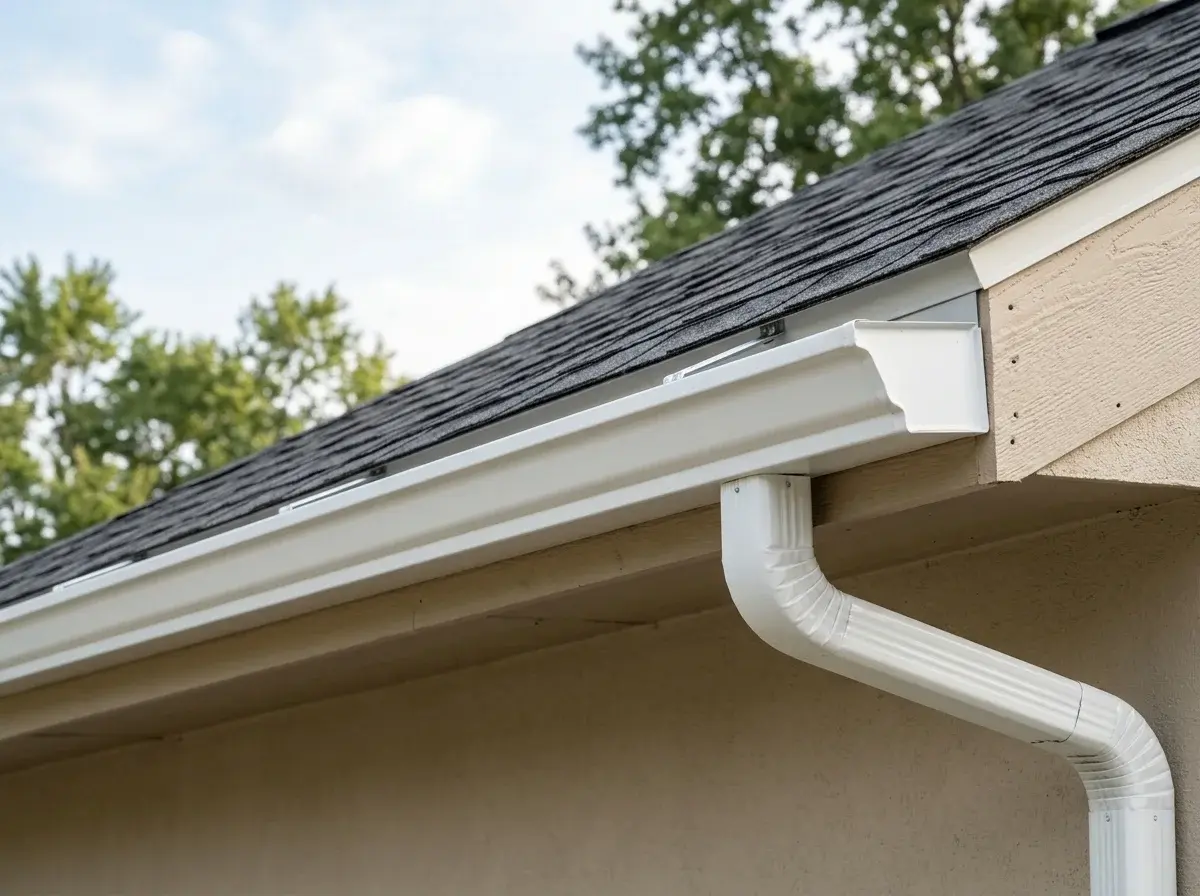
This is our 2026 field report on what gutters actually cost across the Treasure Valley and what fills them up. The pricing below is our own installed ranges — the numbers we quote across Ada, Canyon, Gem, and Elmore counties — not a survey or a national average. The debris breakdown is organized from what we pull out of gutters city by city after fifteen years of cleaning and replacing systems here. The climate context is sourced to NOAA, the National Weather Service, the USDA, and other primary references, cited inline. Where we don't have hard data, we say so rather than invent a number.
The short version: installed gutter work in the valley runs roughly $10 to $22 per linear foot for new gutters and $8 to $20 per foot for guards, with per-visit repair and cleaning priced separately. What drives the spread isn't just the house — it's the debris load, and the debris load is local. A Foothills home buried in ponderosa needles, a Garden City lot under cottonwoods, and a Mountain Home place collecting high-desert dust each need a different system on a different schedule. Below is how that breaks down.
Section
Treasure Valley gutter cost ranges for 2026
Here are our published pricing ranges across the Treasure Valley — the same ranges our cost calculator uses, not a third-party survey. Per-foot services are priced by the linear foot; repair and cleaning are priced per visit. Ranges are intentionally wide because profile, home size, story count, and access all move the number — and the on-site visit always supersedes a published range.
| Service | Low | Typical | High | Unit |
|---|---|---|---|---|
| Gutter Installation / Replacement | $10 | $14 | $22 | per linear foot |
| Gutter Guard Installation | $8 | $12 | $20 | per linear foot |
| Gutter Repair | $200 | $450 | $900 | per visit |
| Gutter Cleaning | $175 | $250 | $425 | per visit |
| Downspout add-on (per-foot services only) | $40 | $65 | $90 | each |
Profile changes the per-foot number too: a standard 5-inch K-style run is the baseline, a 6-inch K-style runs higher, and half-round costs the most to fabricate and hang. We don't publish a separate profile line item here because it's a multiplier on the per-foot ranges above, not a standalone price. Run your own home through our /cost-calculator for a ranged estimate, then we confirm it on-site.
Section
What fills gutters in each Treasure Valley city?
Debris load is the single most local variable in this whole report, and it's the one most pricing guides ignore. What's clogging your gutters in the North End is not what's clogging them in Kuna or Mountain Home. This table is our documented field experience by area — organized from what we actually pull out, not a measured study. We don't have pound counts or percentages, and we won't pretend to; these are qualitative profiles and the cleaning frequencies are what we recommend based on what we see.
| Area | What fills the gutters |
|---|---|
| Boise (Ada County) | Mature deciduous debris in the North End and Bench; ponderosa/lodgepole pine and Douglas fir along the Foothills (year-round, heaviest in fall); cottonwood seed pods every spring along the Boise River corridor and the East End; locust seed pods in the Foothills. Pre-1970 North End/Bench homes have undersized 4-inch sectional gutters. |
| Meridian (Ada County) | New-build landscaping (mulch + bark) plus surrounding ag-land dust accumulates faster than expected — dust- and builder-grade-failure-driven more than tree-driven. Established trees only in older neighborhoods. |
| Eagle (Ada County) | Cottonwood and willow debris off the Boise River corridor (Eagle Island, Banbury) clogs gutters spring through fall. Significant river-corridor tree cover means a higher leaf load than central Meridian or Boise. |
| Nampa (Canyon County) | Less tree-driven; the primary issues are wind off the Snake River plain and spring hail denting aluminum. Underground downspout drains silt up over time. |
| Caldwell (Canyon County) | Indian Creek-adjacent homes pick up cottonwood and willow leaf load in fall. Otherwise wind- and UV-weathering-driven rather than heavy tree debris. |
| Kuna (Ada County) | Ag-land dust from surrounding farmland builds up faster than tree debris alone, plus seed-pod buildup. Minimal mature tree cover on newer homes; the dust/ag-debris load warrants cleaning twice a year. |
| Star (Ada County) | Cottonwood, willow, and Russian olive debris off the Boise River corridor accumulates fast in fall, with heavy pollen and cottonwood seed load. Large custom-home roof footprints. |
| Garden City (Ada County) | Mature cottonwoods and locusts along the Boise River and Greenbelt drop heavy seed and leaf loads. Three cleanings a year is typical on open gutters — late spring after seed pods, mid-fall, and late fall after leaf drop. |
| Hidden Springs (Ada County, Boise Foothills) | Year-round ponderosa pine and Douglas fir needle/fir debris from surrounding foothill trees, with a heavy fall load. Micro-mesh is the only long-term fix. |
| Southeast Boise (Ada County) | Cottonwood and locust debris off the Boise River corridor on Harris Ranch and East End-adjacent homes, every spring and fall and heavier near the Greenbelt. Original 4-inch sectional gutters on older 1960s–70s homes. |
| West Boise (Ada County) | Mature landscaping planted at original build now drops significant leaf load on systems never sized for it. Mostly builder-grade end-of-life and fastener failure rather than one tree species. |
| Middleton (Canyon County) | Ag-land dust from surrounding farmland fills gutters faster than tree debris alone — twice-a-year cleaning is the baseline — plus wind-driven fastener failure. Little heavy tree cover. |
| Emmett (Gem County) | Heavy spring orchard pollen and blossom load (Emmett Valley is historic apple country), plus cottonwood and willow leaf load along the Payette River corridor in fall. |
| Mountain Home (Elmore County) | Sparse tree cover means less leaf load; high-desert dust accumulates and holds moisture in the gutters, with occasional tumbleweed debris. Dust-focused rather than leaf-focused cleaning. |
The pattern: river-corridor towns (Eagle, Garden City, Star, Southeast Boise) fight cottonwood and willow; the Foothills (Boise's edge, Hidden Springs) fight pine needles year-round; the ag-land cities (Kuna, Middleton, Meridian's fringe) fight dust more than leaves; and Mountain Home fights high-desert dust. That's why the cleaning schedule — and whether guards are worth it — is a local question, not a one-size answer.
Section
How does Treasure Valley climate drive gutter wear?
Boise sits in a semi-arid high-desert moisture regime — roughly 11.7 inches of total annual precipitation under the 1991–2020 NOAA climate normals, per NWS Boise, with about 17.6 inches of annual snowfall over the same period. Low rainfall fools people into thinking gutters don't matter here. The opposite is true: the water arrives in concentrated bursts and the climate is hard on the hardware.
- Freeze-thaw cycling from November through March drives sealant failure on older gutters across Boise and the central valley. The National Weather Service defines a freeze as surface air at or below 32°F over a widespread area, and water expands roughly 9% when it freezes — a known engineering mechanism that works seams and fasteners loose over a winter. (We don't cite a specific annual freeze-thaw count because no primary NWS figure for the valley exists.)
- Ice dams form on homes with poor gutter drainage during sustained sub-32 nights — especially older Bench rooflines and north-facing production-home gutters.
- Spring and early-summer afternoon thunderstorms plus spring snowmelt stress undersized downspouts with high-volume, short-duration loads.
- Wind off the Snake River plain is strongest in Caldwell (the windiest part of the valley), Nampa, Middleton, and Mountain Home, loosening nailed gutter sections and pulling fasteners out of dry, weathered fascia.
- Spring hail in Nampa dents soft aluminum gutters and breaks sealant.
- Microclimate cold: Hidden Springs runs colder than the valley floor (earlier first freeze, more sustained freezing nights, higher ice-dam risk), and Emmett's river valley holds cold air longer through sustained cold snaps.
- Mountain Home's high-desert climate is hotter, drier, and windier than the valley — intense UV accelerates sealant failure, and concentrated summer thunderstorms overwhelm undersized downspouts despite the lower overall rainfall.
- River-corridor humidity (Eagle, Garden City, Star, Southeast Boise) raises both the leaf/debris load and the foundation-water risk near the Boise River and Greenbelt.
Want this handled by a local crew?
Free on-site estimate across the Treasure Valley — call or send a few details and we'll get back the same day.
Section
Why does where the water goes matter more than how much falls?
Because a roof moves a lot of water fast, and our soil won't take it. A roof sheds roughly 620 gallons for every inch of rain on 1,000 square feet of roof, per University of Arizona Cooperative Extension figures (0.623 gallons per square foot per inch). Dump that volume at the base of the wall on expansive Ada-series clay and it sits there. Expansive smectitic clays are known to be susceptible to seasonal shrink-swell and frost heave — water expands about 9% when it freezes below 32°F, then contracts on thaw — repeatedly stressing footings. That mechanism is well established in soil-mechanics terms even though no single government statistic ties it to a specific Ada County foundation-failure rate.
The stakes are why the cheap fix wins. The U.S. national average to repair a foundation is about $5,173, with most homeowners spending between $2,225 and $8,133 and bad cases running past $16,000, per HomeAdvisor's 2025 data. Getting downspouts and grade right is a rounding error against that — and on our clay soils it's not optional.
Section
Does wildfire exposure change anything for gutters here?
It raises the case for guards on Foothills and wildland-edge homes, though we won't overstate it. A 2025 USDA Forest Service study found the U.S. wildland-urban interface grew 46% between 1990 and 2020, and — citing FEMA data — the Idaho State Bar puts 30 to 40 percent of Idaho homes inside the WUI. Those are housing and exposure counts, not gutter-debris statistics, and we won't extrapolate them into a gutter-specific risk percentage. What they do mean for a Hidden Springs or Foothills home: dry needle and leaf debris sitting in an open gutter near the wildland edge is fuel you don't want, and that's a real, if unquantified, reason micro-mesh earns its keep up there.
Section
How to use these Treasure Valley gutter cost ranges
- Start with the per-foot range for the work you need, then adjust up for a 6-inch or half-round profile, two-story access, or a complex roofline.
- Match your cleaning schedule to your debris load — twice a year on ag-land dust (Kuna, Middleton), three times on heavy cottonwood (Garden City), and consider micro-mesh guards on year-round pine (Hidden Springs, the Foothills).
- Don't skip drainage. Where downspouts discharge and how the ground grades matters more than the rainfall total on our clay soils.
- Get an on-site visit before you commit. These are our pricing ranges, not a quote — the final number comes from seeing the roof.
Section
Sources
- NWS Boise Climate (rankings, normals, precipitation/snow extremes for Boise + Treasure Valley) — https://www.weather.gov/boi/climate
- University of Arizona Cooperative Extension (Water Wise) — Harvest Rain: 1-inch rain = 600 gallons from a 1,000 sq ft roof — https://waterwise.arizona.edu/ways-save-water/harvest-rain
- NIFC Wildfire Statistics (Total Wildland Fires and Acres 1983-2025) — https://www.nifc.gov/fire-information/statistics/wildfires
- This Old House — Seamless Gutters Cost — https://www.thisoldhouse.com/gutters/seamless-gutters-cost
- HomeAdvisor — Install Gutters and Downspouts Cost — https://www.homeadvisor.com/cost/gutters/install-gutters-and-downspouts/
We're a licensed Idaho gutter contractor (RCE-6681702) serving the Treasure Valley and Southwest Idaho. Run your project through our /cost-calculator for a ranged estimate, or call for a free on-site visit and we'll give you a real number.
FAQ
Common questions on this topic.
How much do new gutters cost in the Treasure Valley in 2026?
Why does gutter pricing vary so much within the valley?
Which Treasure Valley areas have the worst gutter debris?
Does it really rain little enough in Boise to skip gutters?
How does Treasure Valley weather wear out gutters?
Are these prices a quote?
About the author
Mark
Owner· Licensed Idaho Contractor RCE-6681702
Mark owns Boise Gutter Guards, a licensed Idaho contractor (RCE-6681702) serving Boise, Meridian, Eagle, Nampa, Caldwell, Kuna, Star, and Garden City. He started the company after seeing too many Treasure Valley homeowners get sold under-sized gutters, nailed-on hangers, and silicone-sealed seams that fail in the first hard freeze. Every estimate is done in person, every install is backed in writing, and every customer gets a job-site walkthrough before the crew leaves.