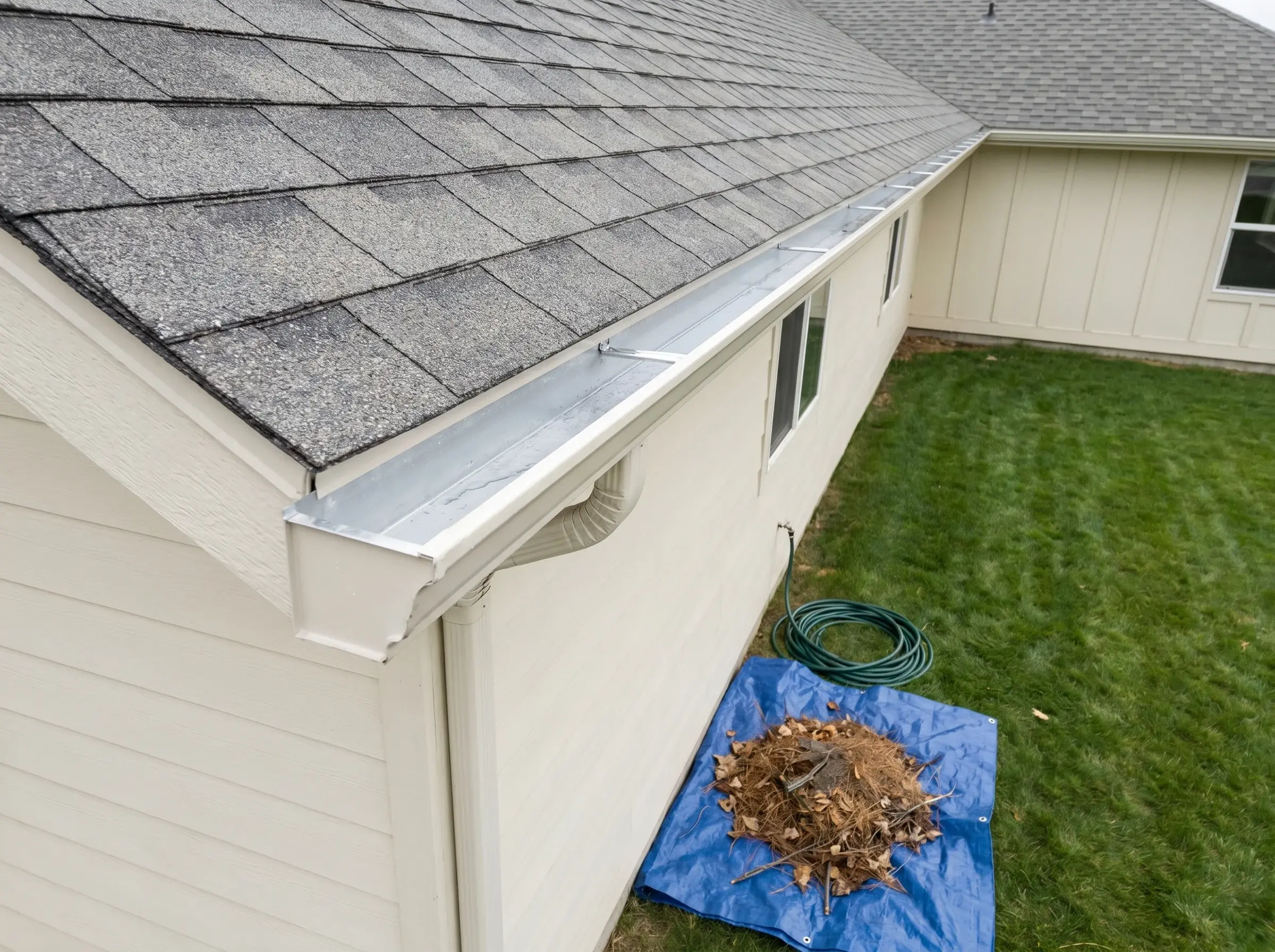
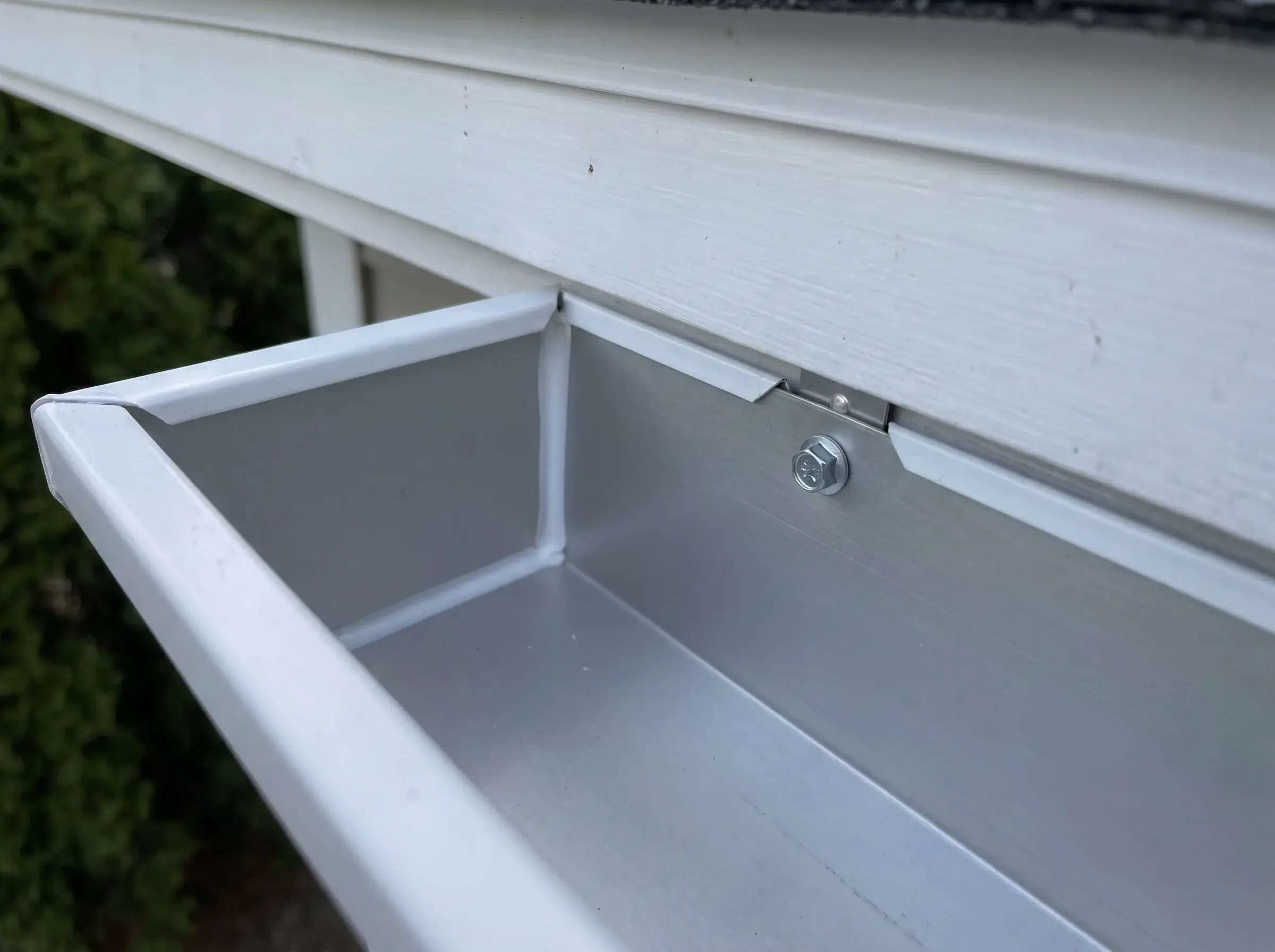
Nampa, Caldwell, and the Snake River plain side of the valley get more spring hail than central Treasure Valley does. The combination of open exposure, the warm-cold air collision over the plain, and the timing of late-spring storms produces hail events most years, and aluminum gutters are one of the first things to take damage. Front lips dent, end caps pop loose, sealant cracks, and downspouts pick up impact dents you'll notice the next time it rains and water runs down the outside of the leg instead of the inside.
Section
What hail does to aluminum gutters
Aluminum is soft. That's why gutters are made from it: formable, cuttable, and corrosion-resistant. The tradeoff is that hail dents it more easily than steel, and the dents have functional consequences beyond cosmetic damage.
- Front-lip dents that flatten or roll the leading edge. Water sheets over the front instead of staying in the channel during heavy rain.
- Broken end caps where sealant impact and aluminum deformation pop the seal open. Leaks at every storm afterward.
- Dented downspouts that look minor but kink the internal flow path. Partial backups during the next storm reveal them.
- Cracked outlet boxes where the gutter outlet meets the downspout (the most common post-hail leak point).
- Compromised hangers where impact transmitted through the gutter loosens the screw seat in the fascia.
Section
The 24-48 hour homeowner checklist
The first two days after a hail event set up everything that follows. Insurance claims have filing deadlines. Damage that goes undocumented in the immediate aftermath is harder to prove later. Work through this list in order:
- Walk the entire perimeter of the house and photograph every dent, broken end cap, and damaged downspout with your phone. Include wide shots and close-ups. Date stamps help.
- Check every downspout for new dents, kinks, or detached elbows. Look at the ground for splash patterns that weren't there before.
- Inspect the fascia and siding directly under each gutter run for splash damage (discolored paint, soaked wood, or water tracking that suggests the gutter is no longer catching runoff).
- Walk the interior and look at ceiling corners near exterior walls, the top of window casings, and the underside of soffits. Stains here mean water has already entered the structure.
- File the insurance claim within your carrier's window. Most are 30 days but some are shorter. Don't wait to see how bad it really is. Open the claim first.
- Get a written contractor assessment with itemized photos and a claim-format quote. This is what your adjuster will use to scope coverage. Without it, you're negotiating from your phone photos alone.
Section
What insurance typically covers
Homeowner policies in Idaho generally cover sudden hail damage as a named peril. That means functional damage from a documented hail event (broken end caps, dented downspouts that affect flow, cracked outlet boxes, sealant failures) usually qualifies for coverage net of deductible. We document for insurance claims as a standard part of our hail-damage assessments; see our /insurance-claims page for what we provide and how the process works on our end.
Section
What insurance often doesn't cover
Some categories of damage routinely get denied or partially covered. Knowing this in advance saves arguing with the adjuster later.
- Pre-existing wear that the hail merely exposed. Corroded sectional gutters, fasteners that were already pulling loose, or sealant that had already failed before the storm.
- Cosmetic-only dents that don't affect water flow. A dent on the back of the gutter where you'll never see it and where it doesn't affect drainage often gets categorized as cosmetic.
- Age-related material failure. Gutters past their typical service life that would have needed replacement soon regardless of the storm.
- Damage from improper installation. Original installs that didn't meet manufacturer specifications sometimes get excluded.
- Repairs you authorized before the adjuster's inspection. Most carriers require the adjuster to see the damage in its post-storm state before any repair is performed.
Want this handled by a local crew?
Free on-site estimate across the Treasure Valley — call or send a few details and we'll get back the same day.
Section
Nampa-specific patterns
Hail events in Nampa and Canyon County follow a few predictable patterns. We see the same neighborhoods repeatedly because of how exposure and storm tracks combine.
- Snake River plain wind plus hail in combination. Hail driven sideways at 30+ mph hits the front face of the gutter, not just the top.
- Ag-area pollen layer plus hail. A dust-pollen coating on the gutter surface holds moisture that re-freezes and amplifies impact damage at sealant joints.
- Karcher and Sunny Ridge subdivisions hit harder than average because of exposure on the west and south sides of Nampa with limited tree windbreak.
- Older South Nampa homes with already-failing sectional gutters, where hail often becomes the trigger event that pushes the system from "manageable repairs" to "full replacement justifiable to insurance."
Section
Repair vs replace after hail
After a hail event, the repair-vs-replace decision shifts. Insurance coverage changes the math, and adjusters often approve replacement of the full impacted run rather than spot repairs to multiple sections. We cover the general framework in our /resources/repair-vs-replace-gutters write-up; for hail specifically, replacement of entire impacted runs is more common than the equivalent non-storm damage scenario.
Section
How we document for claims
Adjusters work from documentation. The more complete the package, the cleaner the claim. Our standard hail-damage write-up for an insurance claim includes:
- Written assessment of every damaged section, linked to a specific run on the home (front-elevation east, rear-elevation north, etc).
- Dated photos of each damage point: wide context shots and close-ups of dents, broken seals, and impacted hardware.
- Itemized claim-format quote with line items the adjuster can match to their scope sheet.
- Willingness to meet the adjuster on-site for a walkthrough so we're agreeing on the same damage in real time.
- Materials and method specifications for the replacement so the adjuster can verify equivalent or better than what was installed.
More detail on the claims process is on our /insurance-claims page, including what to expect at the adjuster visit and how supplements work when additional damage gets uncovered during the repair.
Section
Other Treasure Valley hail-prone areas
Nampa isn't alone. The Snake River plain pattern extends across several Canyon County and outer-Ada County areas. If you live in any of these, the same playbook applies after a hail event.
- Caldwell, especially open-exposure subdivisions on the west side of town.
- Middleton, semi-rural homes with little windbreak from surrounding fields.
- Western Meridian, where newer subdivisions on the south and west edges lack mature tree cover.
- Kuna, where open ag-edge lots take direct hail without canopy diffusion.
- Star and parts of Eagle: less frequent but not immune, especially during the May and June storm window.
FAQ
Common questions on this topic.
How quickly do I need to file an insurance claim after hail?
Should I get the repair done before the adjuster visits?
Will my insurance rates go up after a hail claim?
Can you handle the insurance paperwork directly?
What if my hail damage is cosmetic but I still want it fixed?
About the author
Mark
Owner· Licensed Idaho Contractor RCE-6681702
Mark owns Boise Gutter Guards, a licensed Idaho contractor (RCE-6681702) serving Boise, Meridian, Eagle, Nampa, Caldwell, Kuna, Star, and Garden City. He started the company after seeing too many Treasure Valley homeowners get sold under-sized gutters, nailed-on hangers, and silicone-sealed seams that fail in the first hard freeze. Every estimate is done in person, every install is backed in writing, and every customer gets a job-site walkthrough before the crew leaves.